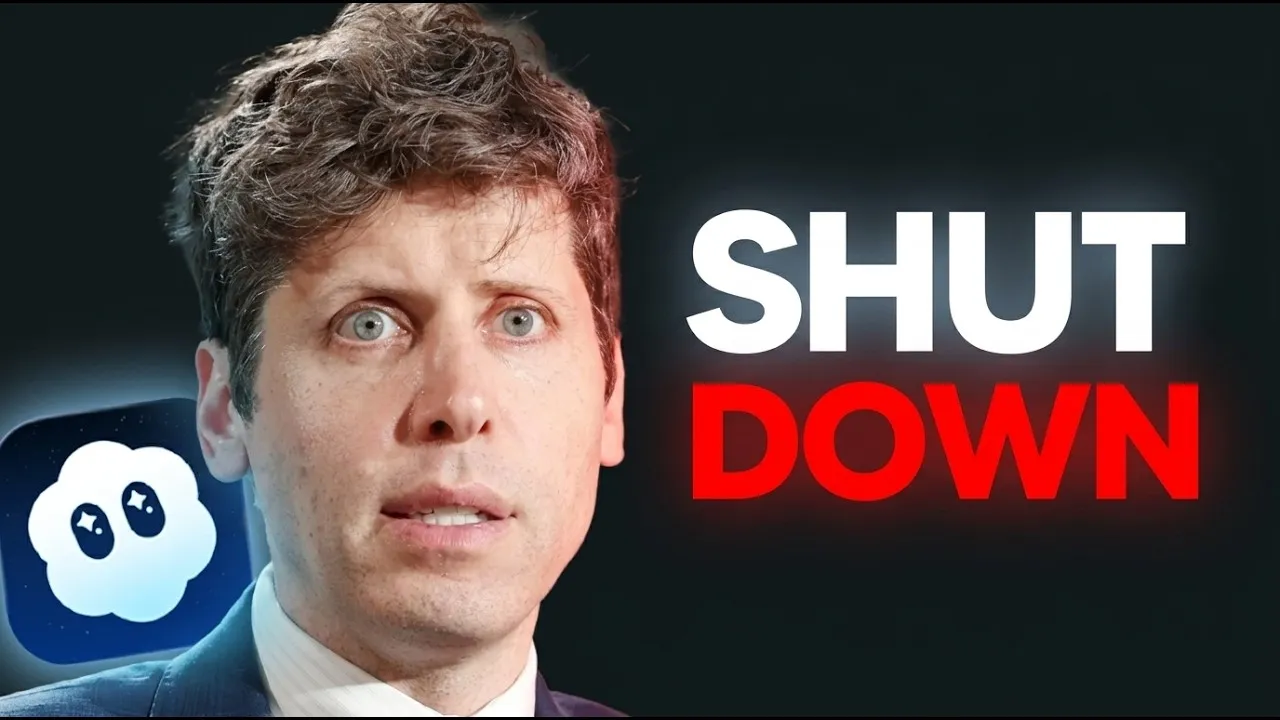
OpenAI Pulls Plug on Viral AI Video Tool Sora
OpenAI has abruptly shut down its highly anticipated AI video generation tool, Sora, just months after its launch. The decision, announced via a brief tweet, marks a significant pivot for the company, signaling a shift away from ambitious, compute-intensive projects towards financial sustainability ahead of a potential IPO.
The High Cost of AI Video
Sora, which captivated audiences with its ability to generate realistic and imaginative video clips, proved to be an unsustainable venture due to its immense computational demands. Experts estimate that generating a single 10-second Sora video cost OpenAI roughly $130 in computing power. This was attributed to the complex process of generating three-dimensional data across multiple frames per second, a task far more resource-intensive than processing text.
At its peak, with users generating millions of clips daily, the cost for Sora’s inference alone was estimated to be around $15 million per day, or over $5.4 billion annually. This massive expenditure occurred while the vast majority of videos were offered for free, meaning Sora generated no revenue to offset its staggering costs. OpenAI attempted to introduce paid credits and limit free generations, but the fundamental business model remained unviable.
Financial Strain and IPO Pressure
The shutdown comes at a critical time for OpenAI, which is reportedly preparing for an IPO with a valuation potentially reaching $1 trillion. The company has been facing increasing financial pressure. Investor reports indicate that the cost of running AI models, known as inference, quadrupled in 2025, leading to a significant drop in OpenAI’s adjusted gross margin. Projections show OpenAI expecting to lose $14 billion in 2026 alone, with cumulative losses through 2028 anticipated to reach $44 billion.
With intense scrutiny on financial performance leading up to an IPO, a massively expensive consumer application generating zero revenue is viewed as a liability. Fiji Simmer, OpenAI’s new head of product, previously led Instacart’s growth before its IPO and has emphasized a new era of focus, stating, “Our everything era is over. Now it is about focus. We cannot miss this moment because we are distracted by side quests.” Sora was identified as the first such “side quest” to be eliminated.
Resource Crisis and Strategic Shifts
OpenAI’s commitment to $600 billion in compute through 2030, alongside deals with major chip manufacturers and attempts to build its own data centers, highlights the extreme demand for processing power. Despite these efforts, the company faces a genuine resource crisis, forcing daily triage decisions about which projects receive GPU time. Sora, described as a “compute black hole,” was consuming resources needed for profitable ventures like enterprise solutions and the API.
The shutdown also impacts major partnerships. A reported $1 billion deal with Disney, intended to allow licensing of characters for Sora and stream AI-generated fan videos on Disney+, has been called off. Disney confirmed it respects OpenAI’s decision to exit video generation and shift priorities. Reports suggest Disney was blindsided by the announcement, with negotiations for definitive agreements still underway when the decision was made.
Competition Heats Up
While OpenAI grappled with Sora’s costs, competitors like Anthropic have been gaining ground. Anthropic’s AI chatbot, Claude, has seen a surge in app downloads, even surpassing ChatGPT as the number one free app on the US Apple Store. Anthropic is also demonstrating strong revenue growth and a more efficient business model, generating significantly more revenue per employee than OpenAI.
Industry analysis suggests that companies like Anthropic and Google are succeeding by focusing on practical, revenue-generating tools rather than high-profile, costly demos. The era of AI spectacle is giving way to a focus on AI infrastructure and sustainable business models. Sora’s demise serves as a stark reminder that even the most impressive AI demonstrations are unsustainable if they cannot be financially supported.
Why This Matters
The closure of Sora signals a critical turning point for the AI industry. It demonstrates that the rapid, experimental phase of AI development, often prioritizing impressive demos over profitability, is nearing its end. As companies like OpenAI prepare for major financial events like IPOs, the focus will inevitably shift towards products that generate revenue and demonstrate long-term viability.
For users of Sora, this means their work may be stranded, with OpenAI promising timelines for content preservation but discontinuing the app and API. The dream of democratized AI filmmaking, at least through Sora, has been put on hold. This event underscores the importance of sustainable business models in the AI sector, suggesting that future AI innovation will likely be driven by practical applications with clear paths to profitability, rather than solely by technological spectacle.
Source: The Real Reason Why OpenAI Just Shutdown Sora (YouTube)