Understand Rotational Kinetic Energy to Predict Motion
Have you ever wondered why some objects roll down a hill faster than others, even if they start at the same height? It’s not just about how heavy they are or how fast they’re moving forward. When an object spins as it moves, it has both translational kinetic energy (from moving forward) and rotational kinetic energy (from spinning). Understanding rotational kinetic energy helps us figure out which object will reach the bottom of a hill first.
What You’ll Learn
- How to calculate rotational kinetic energy.
- Why the distribution of mass matters in rotation.
- How to combine translational and rotational motion.
- How to predict which object rolls down a hill fastest.
Prerequisites
- Basic understanding of kinetic and potential energy.
- Familiarity with concepts like force and motion.
1. Understand Different Types of Motion
When an object moves, it can do so in two main ways: moving in a straight line (translation) or spinning around an axis (rotation).
Translational Motion
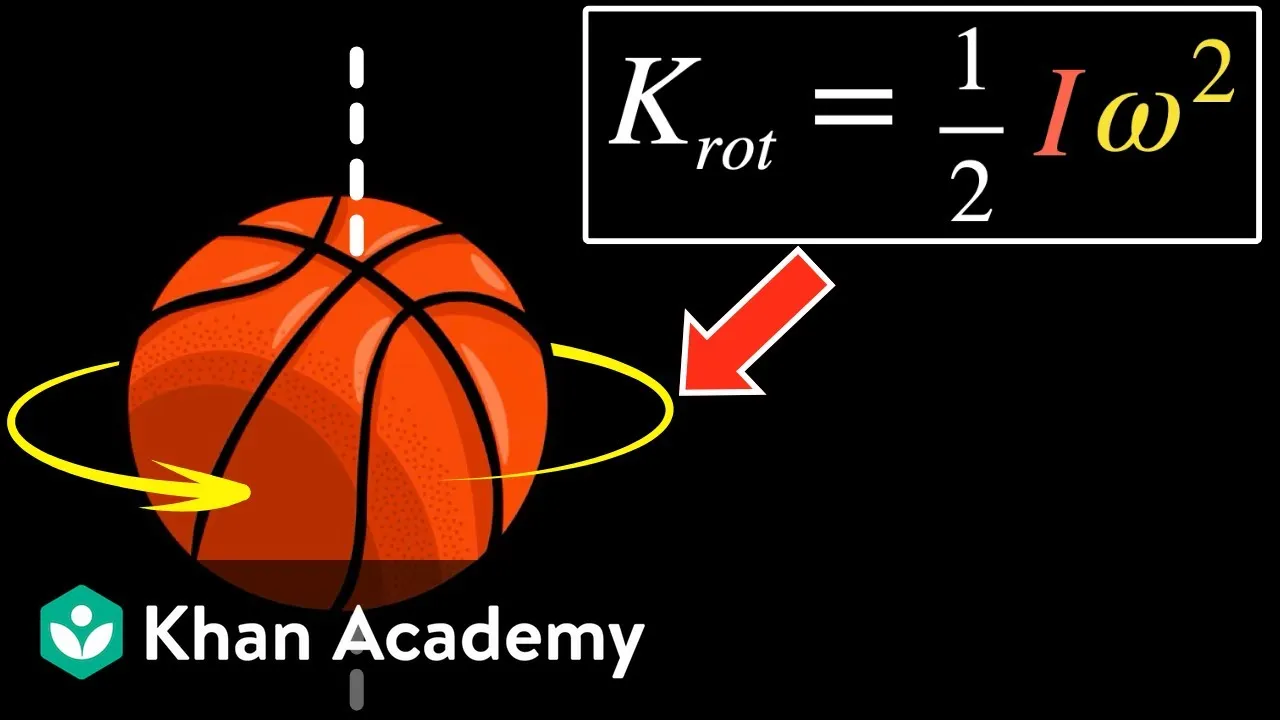
Imagine a basketball moving straight across the floor. Every point on the ball has the same speed in the same direction. This is called translational motion. The energy it has because it’s moving is called translational kinetic energy. You calculate it with the formula: KEtranslational = 1/2 * m * v2. Here, ‘m’ is the mass of the object and ‘v’ is its speed.
Rotational Motion
Now, imagine that same basketball spinning in place. Different parts of the ball move at different speeds. Points farther from the center travel faster than points closer to the center. This spinning is called rotational motion. All parts of the spinning object have the same angular speed, which is how fast it spins in terms of angles.
2. Introduce Rotational Inertia
Just like mass tells us how hard it is to change an object’s straight-line motion, a similar property tells us how hard it is to change an object’s spinning motion. This property is called rotational inertia, often shown as ‘I’. It’s also sometimes called moment of inertia.
Rotational inertia depends not only on the object’s mass but also on how that mass is spread out. If more of the mass is farther away from the center of rotation, the rotational inertia is higher. Think of a figure skater pulling their arms in to spin faster; they are decreasing their rotational inertia.
3. Calculate Rotational Kinetic Energy
Similar to how translational kinetic energy is calculated, rotational kinetic energy uses rotational inertia and angular speed. The formula is: KErotational = 1/2 * I * ω2. Here, ‘I’ is the rotational inertia, and ‘ω’ (omega) is the angular speed.
This formula shows that for the same angular speed, an object with a higher rotational inertia will have more rotational kinetic energy. This is a key difference from translational motion, where only mass matters.
4. Combine Translational and Rotational Motion
Many real-world motions involve both moving forward and spinning at the same time. For example, a rolling ball or a car tire. To find the total kinetic energy of such an object, you add its translational kinetic energy and its rotational kinetic energy.
Total KE = KEtranslational + KErotational
Total KE = (1/2 * m * v2) + (1/2 * I * ω2)
5. Understand the Work-Energy Theorem
The work-energy theorem is a powerful tool that connects work done on an object to its change in kinetic energy. For translational motion, the work done by the net force equals the change in translational kinetic energy.
Work = Change in KEtranslational
Similarly, for rotational motion, the work done by the net torque equals the change in rotational kinetic energy. Torque is the rotational equivalent of force.
Work done by torque = Change in KErotational
This theorem is useful because it allows us to find speeds or energies without needing to calculate the exact time it takes for the motion to occur.
6. Analyze Objects Rolling Down an Incline
Let’s go back to the example of objects rolling down an incline: a solid sphere, a hollow sphere, and a ring. They all have the same mass and radius and start from the same height.
When they are released, their gravitational potential energy starts converting into kinetic energy. If they were just sliding without spinning, all potential energy would become translational kinetic energy, and they’d all reach the bottom at the same time with the same speed.
However, because they roll, some potential energy becomes rotational kinetic energy. The amount of rotational kinetic energy depends on the object’s rotational inertia.
- Ring/Hoop: All its mass is at the maximum distance from the center. It has the highest rotational inertia.
- Hollow Sphere: Mass is distributed, but less than a ring. It has a medium rotational inertia.
- Solid Sphere: Mass is concentrated closer to the center. It has the lowest rotational inertia.
7. Predict Which Object Reaches the Bottom First
Since the total energy (potential converted to kinetic) is the same for all objects, the one that ends up with the most rotational kinetic energy must have the least translational kinetic energy left over.
The ring, with the highest rotational inertia, will convert the most potential energy into rotational kinetic energy. This leaves it with the least translational kinetic energy and therefore the lowest speed.
The solid sphere, with the lowest rotational inertia, will convert the least potential energy into rotational kinetic energy. This leaves it with the most translational kinetic energy and the highest speed.
Therefore, the solid sphere will reach the bottom of the incline first, followed by the hollow sphere, and lastly the ring.
Source: Rotational kinetic energy of rigid systems | AP Physics | Khan Academy (YouTube)