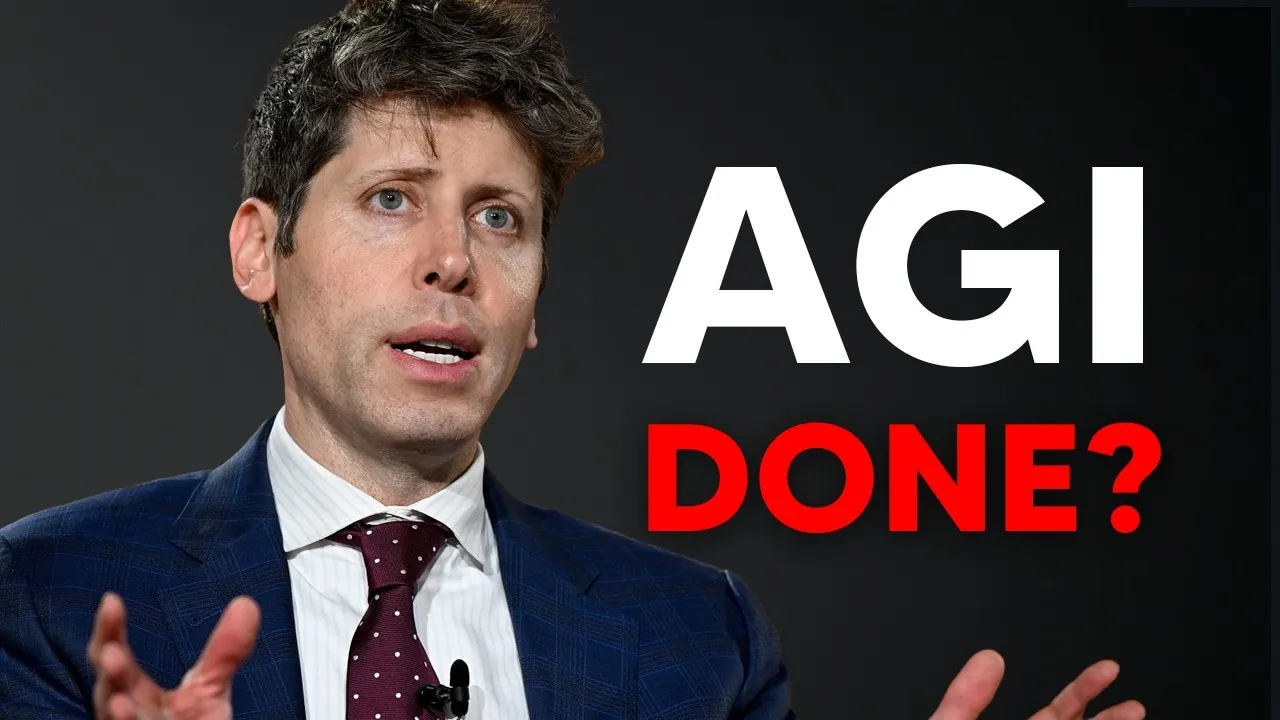
OpenAI Renames Product Team to ‘AGI Deployment’
In a surprising move, OpenAI has internally renamed its product team to ‘AGI Deployment.’ This shift, revealed internally on March 24, 2026, suggests a significant change in the company’s focus and its stance on the current state of artificial intelligence.
Key Internal Announcements at OpenAI
During an all-hands meeting, CEO Sam Altman shared three key points with employees. Firstly, he is stepping down from overseeing AI safety to concentrate on building massive data centers. Secondly, OpenAI has completed the initial development of its next AI model, codenamed ‘Spud.’ Thirdly, and most notably, the product team has been rebranded from ‘Product’ to ‘AGI Deployment.’ This renaming signifies a transition from research and development to actively deploying advanced AI systems.
Industry Leaders Weigh In on AGI
The notion that Artificial General Intelligence (AGI) might be here or is imminent has gained traction recently. Nvidia CEO Jensen Huang, whose company provides the chips powering most AI development, stated on Lex Fridman’s podcast, “I think it’s now. I think we’ve actually achieved AGI.” This statement caused a stir in the tech community.
Adding to this sentiment, Mark Gubrud, the individual who coined the term AGI in 1997, also posted on X (formerly Twitter) that he believes AGI has been achieved. Gubrud defined AGI as an AI capable of starting, growing, and running a technology company worth over a billion dollars. Huang echoed this sentiment, suggesting that AI agents could create successful web services, even if they are short-lived.
Defining Artificial General Intelligence (AGI)
It’s important to understand what AGI means. Gubrud originally defined AGI in 1997 as an AI that could match the human brain in complexity, speed, and general knowledge, operating in any scenario where human intelligence is needed. This is a broad definition, encompassing reasoning, adaptability, and broad understanding.
However, Huang’s recent comments focus on economic value generation. He clarified that he is not claiming AI can think like a human or reason across unfamiliar situations. Instead, he refers to AI’s ability to generate significant economic value, even if it’s a temporary success. This is a more financial definition of AGI, distinct from a cognitive one.
Historical Context and Predictions
Shane Legg, a co-founder of Google DeepMind and a prominent figure in AI research, has long predicted the arrival of human-level AGI. In a 2009 blog post, he estimated human-level AGI would arrive around 2025. He later adjusted this prediction, giving a 50% chance by 2028, and noted a clear technological path forward.
Legg’s current stance aligns with Gubrud’s. He believes current models, while still having scaling deficiencies, perform at a high human level in language and general knowledge, and operate thousands of times faster. He acknowledges that some major limitations remain but are rapidly improving.
OpenAI’s Strategic Shift
The internal changes at OpenAI, including the renaming of the product team and the completion of the ‘Spud’ model, point to a strategic pivot. The company has also reportedly canceled its standalone AI video platform, Sora, and its planned integration into ChatGPT. This move, along with the termination of a significant partnership with Disney, suggests OpenAI is consolidating its efforts.
The focus appears to be shifting towards a unified desktop application that integrates various tools like the Codex coding agent and the Atlas browser. This strategy aims to enhance enterprise coding and reasoning capabilities.
Why This Matters
The implications of OpenAI’s actions and the statements from industry leaders are far-reaching. If AGI is indeed here or close, it could dramatically accelerate economic growth and transform various industries. The creation of highly autonomous systems capable of outperforming humans in most economically valuable tasks would represent a significant milestone in technological history.
For OpenAI, this development has contractual significance. Their charter defines AGI as a system outperforming humans in most economically valuable work. A formal declaration of AGI could trigger clauses in their partnership with Microsoft, potentially altering their revenue-sharing agreements and cloud service obligations. OpenAI, valued at an estimated $730-$800 billion after recent funding rounds, is reportedly eyeing an IPO, making any AGI declaration a powerful market signal.
The Path Forward
While OpenAI has not formally declared AGI, the renaming of the product team to ‘AGI Deployment’ sends a strong message. Combined with statements from key figures like Jensen Huang and Mark Gubrud, it suggests a collective belief within the AI elite that a new era of intelligence is upon us. Whether this is a full realization of AGI or a strategic positioning for market advantage, the industry is clearly preparing for its impact.
Source: Did OpenAI Just Quietly Build AGI? (YouTube)