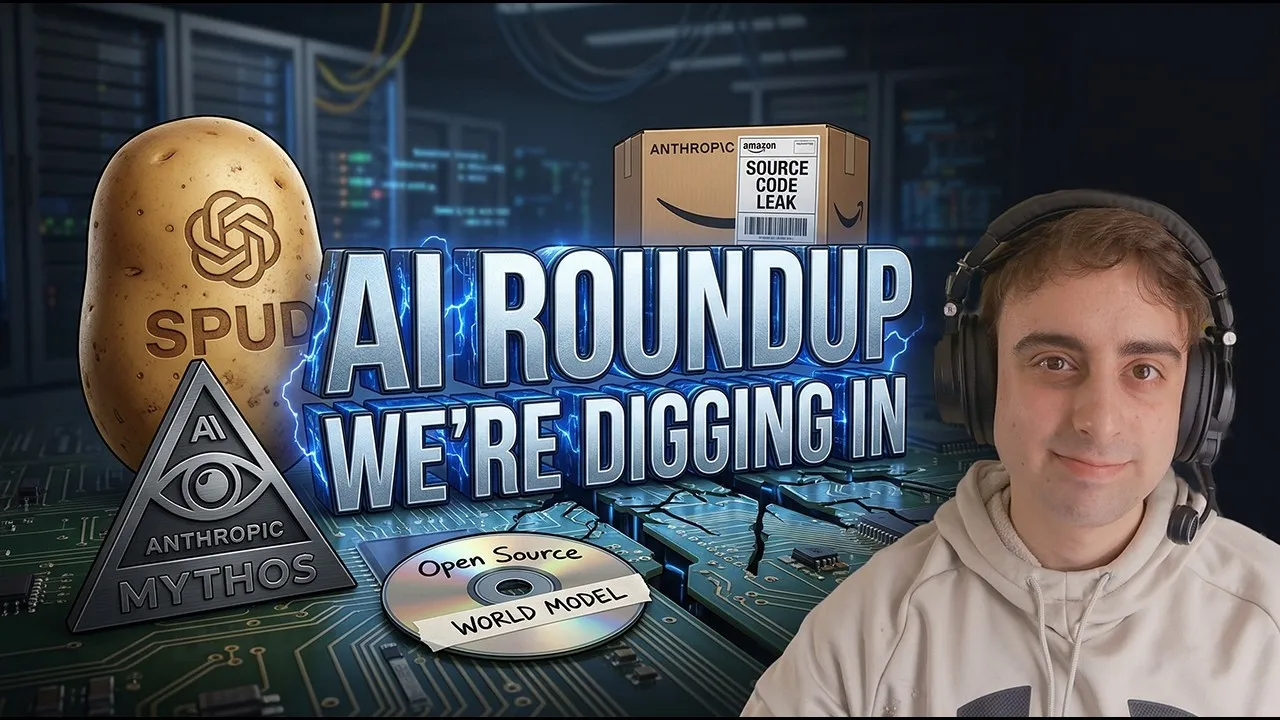
OpenAI’s Spud Model Hints at Economic Boost
OpenAI has completed a significant new AI model, codenamed ‘Spud,’ which company representatives suggest could have a major impact on the economy. This isn’t just a small improvement; the model is expected to perform tasks differently, acting more like an agent that can handle complex jobs over longer periods. While the official name and release details are still under wraps, it’s anticipated to be a substantial step forward, potentially even the highly awaited GPT-5. This new model represents two years of research and builds upon OpenAI’s previous work.
The team at OpenAI is looking for a qualitative shift in AI capabilities, often referred to as ‘big model smell.’ This means the AI’s output will feel noticeably smarter and more capable. Users should be able to tell that the AI truly understands their prompts and intentions, aligning more closely with what they want. The real test for Spud will be its ability to perform tasks that current models struggle with, demonstrating a tangible economic impact. While current AI can complete research, the hope is that Spud will be able to autonomously apply that research and build solutions, rather than just presenting information.
Anthropic’s Claude Faces Leaks and Security Breakthroughs
Anthropic, another major AI player, has also been in the news. Recently, their AI assistant Claude demonstrated a remarkable ability to find zero-day security vulnerabilities. In a live demo, Claude identified a critical flaw in the widely used GitHub project Ghost in just 90 minutes. It then repeated this feat with the Linux kernel. This capability highlights the advanced nature of newer AI models, which are becoming increasingly adept at complex problem-solving, including security analysis.
These findings raise questions about public access to such powerful AI. Even with premium plans, the risk of sophisticated security flaws being exploited is significant. The potential for open-source AI models to reach this level of capability, running on everyday hardware, is a concern for many. However, this powerful technology also offers the promise of building more secure and robust systems, a classic double-edged sword in AI development.
Adding to the buzz, significant leaks have emerged regarding Anthropic’s upcoming models. Rumors suggest their next model, potentially codenamed ‘Mythos,’ could feature a context window of one million tokens. While Anthropic models are known for handling large amounts of text, the output capability on a single request is also a key area of interest. More substantively, the entire source code for Anthropic’s Claude Command Line Interface (CLI) was accidentally leaked. This leak exposed nearly 900 files and half a million lines of code, revealing the tool’s architecture, command system, and user interface. While one GitHub repository hosting the leaked code was quickly taken down, the information is now widely available, allowing developers to examine and build upon Anthropic’s internal tools.
AI’s Emotional Intelligence and Future Applications
Anthropic has also published research exploring how AI models, like Claude, process and simulate emotion concepts. The research suggests that internal representations of emotions, driven by the model’s training data and fine-tuning, can influence Claude’s output. When a model encounters text describing an emotion, it can adjust internal ‘vectors’ associated with that emotion, steering its response. It’s crucial to understand that these are not genuine emotions or consciousness, but rather sophisticated patterns learned from human language and behavior. These emotive systems reflect humanity’s own emotional expressions present in the training data, showing that a degree of ’emotion’ is necessary for AI to effectively complete tasks, whether it’s coding, writing, or research.
Open Source AI Continues to Grow
Google is actively contributing to the open-source AI community with releases like Gemma 4. Unlike some competitors who are more guarded with their advanced models, Google continues to offer free, open-source options. This approach fosters wider adoption and innovation. For instance, Gemma has been combined with object detection models to provide instant, accurate scene descriptions. Furthermore, Google’s recent TurboQuant technology is enabling significant model compression. Experiments show it can reduce memory usage by 50%, allowing complex models like Quen 3.5 27B to run on a single RTX 5060 graphics card with no noticeable performance loss. This suggests that running advanced AI on consumer hardware with minimal compromise is becoming increasingly feasible within the next year.
Advancements in Image and Video Generation
The field of AI-generated imagery and video is also seeing rapid progress. Skywork has released Matrix Game 3.0, an open-source, real-time interactive world model. This model can generate video at 720p resolution and 40 frames per second with a minute-long memory consistency, a notable achievement in temporal coherence. Trained on data from Unreal Engine and AAA games, it can generate scenes that mimic popular titles like Red Dead Redemption and Grand Theft Auto. While some areas exhibit AI ‘mushiness,’ the overall consistency and controllability are impressive, with lower VRAM requirements making it accessible on consumer hardware.
Seedance 2.0 is rolling out, offering advanced video generation capabilities, including the ability to render human faces realistically. Though not yet widely available in the US, it represents a significant step in video synthesis. For image upscaling, Perceptual has launched Page Upscale, capable of producing 8-megapixel outputs for a fraction of a cent, making high-resolution image generation more affordable. Additionally, When 2.7 has been released, offering audio-driven generation that matches visuals to sound with high fidelity, though its open-source status is still pending. Gro Imagine, an AI video generation tool, has also received updates, including a ‘quality mode’ that enhances detail and realism, making its output comparable to leading platforms like Seedance and Sora in many aspects.
Sora’s Discontinuation and OpenAI’s Super App Vision
In a strategic shift, OpenAI is discontinuing its popular video generation model, Sora, with the web app shutting down on April 26th and the API following later. This move is aimed at refocusing compute resources and financial investment. OpenAI is now prioritizing the development of a unified ‘super app.’ This app aims to integrate various AI tools, including ChatGPT, coding assistants, and browsing capabilities, into a single, seamless experience. The company envisions this super app becoming core infrastructure for the AI era, transitioning from consumer tools to enterprise dominance.
The pace of AI development continues to accelerate, with new tools and models emerging weekly. From advanced security analysis by Anthropic’s Claude to OpenAI’s ambitious Spud model and the growing open-source contributions from Google, the landscape is dynamic. The progress in generative AI, particularly in video and image creation, is making previously futuristic concepts feel within reach, fueling excitement for what the coming years will bring.
Source: Open AI Spud, Claude Mythos, Leaks & Open Source drops | AI NEWS (YouTube)