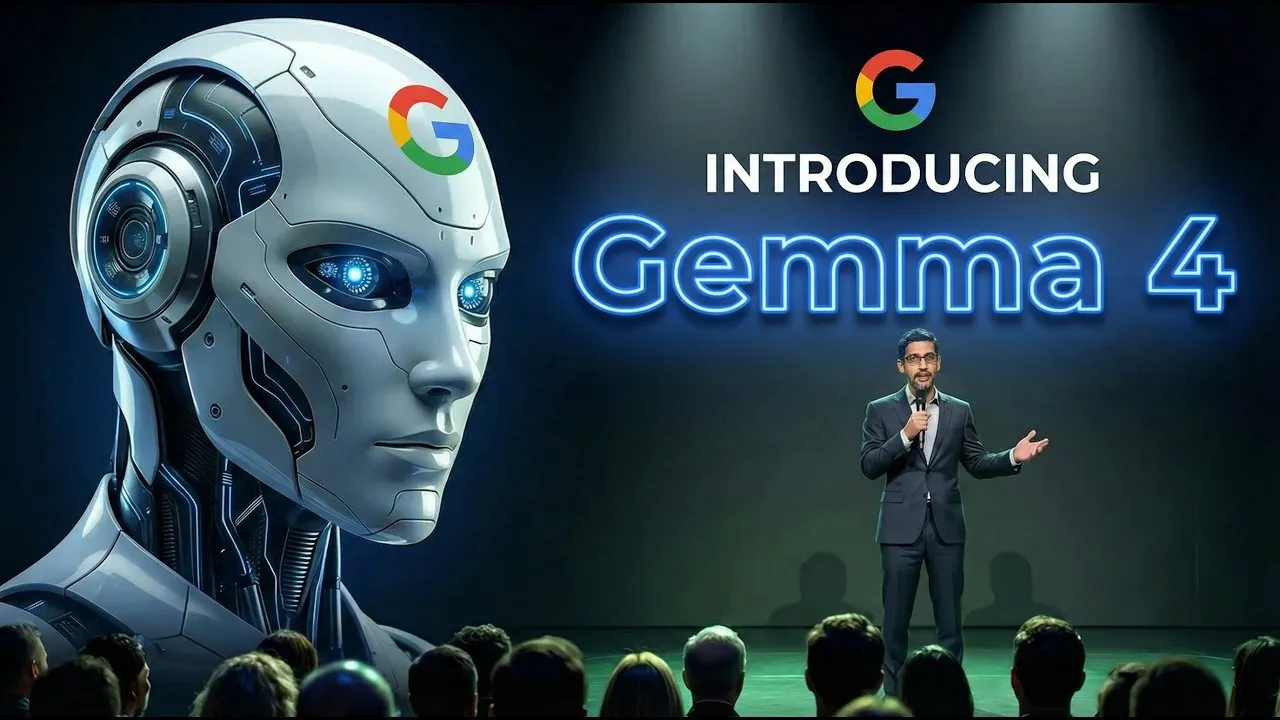
Google Launches Gemma 4, Bringing Powerful AI to Personal Devices
Google has surprised the AI community by releasing Gemma 4, a new family of open AI models. These models are designed to run directly on your own devices, like phones, laptops, and desktops. This move makes advanced AI technology more accessible and keeps your data private.
Gemma 4: Built for the Future, Open to All
Gemma 4 is built using the same advanced research behind Google’s powerful Gemini models. For the first time, Google is releasing Gemma under an open-source license called Apache 2.0. This means developers and users can freely use and build upon these AI models.
These new models are made for what Google calls the “agentic era.” This means they can handle complex tasks, plan steps, and work like smart assistants that can take action for you. They are very good at using their “tokens” – the small pieces of information AI uses – efficiently to be smart and helpful.
Models Designed for Every Need
The Gemma 4 family includes several models:
- 26B and 31B Models: These larger models offer top-tier AI performance that can run on your personal computer. They allow for advanced reasoning and coding tasks without sending your data elsewhere. The 26 billion parameter model is very fast, while the 31 billion parameter model focuses on producing the best quality results.
- 2B and 4B Models: These smaller models are built to be very efficient with memory. They bring a new level of intelligence to devices like smartphones and IoT gadgets. These models can process both audio and vision, meaning they can “see” and “hear” the world around them. They also support over 140 languages natively.
Google highlighted how these models can handle multilingual tasks, with one example showing a model responding in English to a request in another language.
Security and Trust for Enterprises
Developed by Google DeepMind, Gemma 4 models go through strict security checks, similar to Google’s private AI models. This gives businesses and developers a secure and trustworthy foundation to build new AI applications.
Performance That Matters: Efficiency Over Size
While benchmarks might initially seem lower than some other AI models, their real strength lies in their efficiency. The 31 billion parameter model, for instance, offers performance comparable to models like Kimi 2.5, but with significantly fewer parameters. This means you can run it on your own hardware if you have enough RAM.
Running models locally offers key advantages: no subscription fees, complete data privacy, and the ability to work completely offline. This is a major step forward for open-source AI, where previously running advanced models often required expensive cloud services or sharing data.
The comparison of model performance versus size is a key highlight. Google has created models that are remarkably effective for their size, offering a great balance of power and efficiency. This makes advanced AI accessible even on less powerful hardware.
Why This Matters
Gemma 4’s release is significant because it democratizes access to powerful AI. Being able to run these models locally means:
- Cost Savings: No more paying for cloud computing to run AI tasks.
- Enhanced Privacy: Your sensitive data stays on your device.
- Offline Access: AI capabilities are available even without an internet connection.
- Innovation Boost: Developers can experiment and build new applications more freely.
The smaller 2B and 4B models, in particular, open up possibilities for AI on mobile devices and the Internet of Things (IoT). Imagine your phone or smart home devices having advanced AI capabilities without needing to connect to the internet.
Accessibility and Availability
Google has made the Gemma 4 model weights available for download. Users can start experimenting with them today. Google plans to release guides on how to use Gemma 4 locally, including on mobile phones.
For hardware requirements, it’s suggested that devices have at least 6-8 GB of RAM for running some of the smaller models. Even older devices might be able to run the very smallest versions.
The ability to run these models privately and locally, with impressive capabilities for reasoning, coding, and multilingual tasks, marks a new chapter for open-source AI. Google’s focus on efficiency means users get powerful tools without the usual high costs or privacy concerns.
Source: Googles Gemma 4 Just Shocked The AI Industry (YouTube)