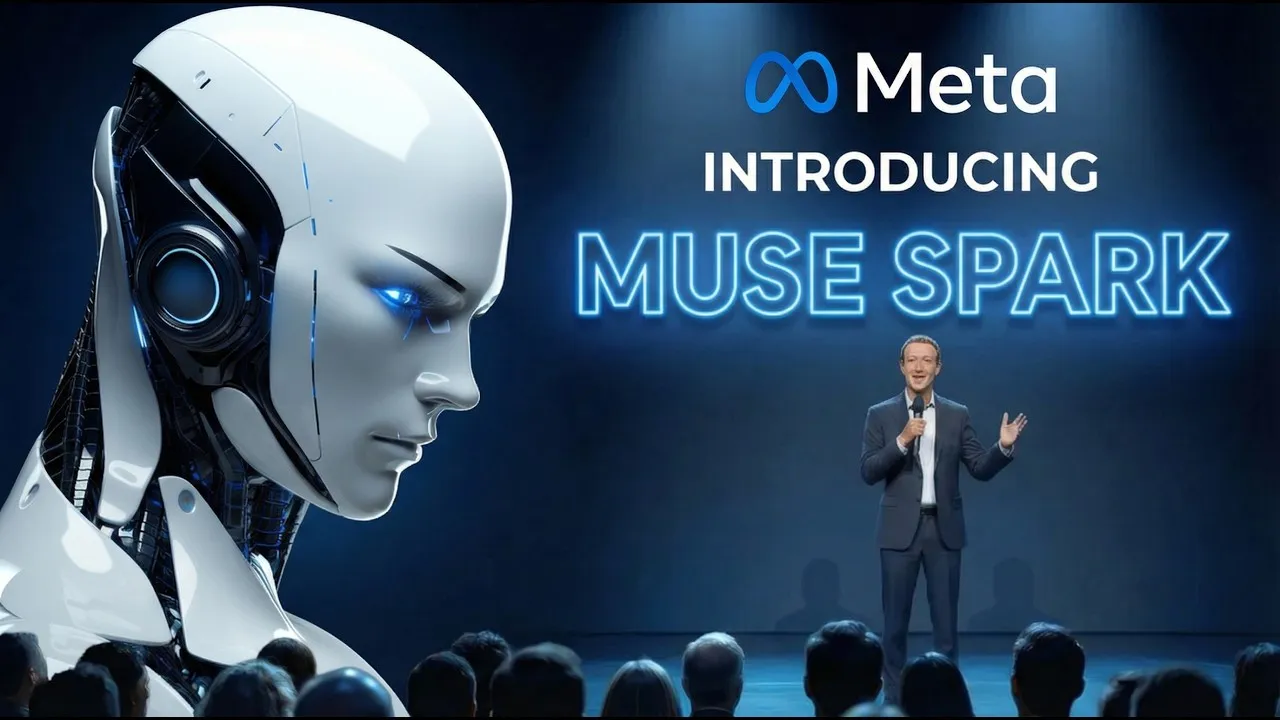
Meta’s Muse Spark AI Makes a Strong Debut
Meta has officially launched Muse Spark, its latest artificial intelligence model. This new AI is part of the Muse family from Meta’s Intelligence Labs. What makes Muse Spark stand out is that it was built from the ground up to understand and work with different types of information at once. This includes text, images, audio, and video, making it a natively multimodal AI.
Understanding Multimodality
Think of a multimodal AI like a person who can read a book, watch a video, and listen to a podcast all at the same time. They can connect ideas across all these different formats. Muse Spark was designed specifically to do this. Meta reports that on tests measuring how well AI understands these combined types of information, Muse Spark performs very well, often better than many other AI models.
While Muse Spark doesn’t top every single AI benchmark, it shows strong performance in its multimodal abilities. Some other models, like GPT-4 or Gemini 3, might perform slightly better in certain specific areas. However, Muse Spark’s strength lies in its ability to handle and reason across various data types simultaneously.
Performance on Key Benchmarks
To get a general idea of Muse Spark’s overall performance, Meta uses something called the Artificial Analysis Index. This index combines results from many different tests, not just one. It gives a broader picture of how the AI performs across a range of tasks, like reasoning and understanding complex questions. On this combined index, Muse Spark is currently performing close to top-tier models like Claude Opus.
Meta’s progress is clear, showing a significant leap forward since their earlier Llama 4 Maverick model. Muse Spark is considered a frontier-class model, meaning it’s among the most advanced AI models available today.
Excelling in Visual Understanding
One area where Muse Spark truly shines is in visual tasks. In a test conducted by an independent website, Muse Spark was asked to read a handwritten chalkboard menu from a restaurant called Yezis. This is a challenging task because the writing is difficult to read, there are reflections on the glass, and prices are listed in different sections. When asked what was on the menu, Muse Spark was able to correctly identify the items and prices most of the time.
While some might call this a “cherry-picked” example, Meta argues that most AI models are not built to handle this kind of visual information natively. Models trained from the start to be multimodal, like Muse Spark, often show superior results in these complex tasks. This ability to process and understand visual data alongside text is a key advantage.
Real-Time Data Capabilities
Another surprising strength of Muse Spark is its ability to access and process real-time data. Many users currently rely on AI models like Grok for up-to-date information. However, in a test where models were asked to find current stock prices for major tech companies like Nvidia, AMD, and Intel, Muse Spark performed the best. It provided the most accurate and current information, outperforming other models in this specific task.
This capability is linked to its performance on benchmarks like the Deep Search QA, where Muse Spark also scored well. Being able to access and understand current information is crucial for many real-world applications.
Introducing ‘Contemplating Mode’
Meta has also introduced an innovative feature called “contemplating mode” within Muse Spark. This is a new approach to complex problem-solving. Contemplating mode works by using multiple AI agents that work together at the same time. These agents collaborate to reason through difficult scientific questions. Meta’s testing shows this approach is competitive with other advanced reasoning models.
Imagine having a team of experts work on a problem together. Contemplating mode is like that for AI. It allows the AI to combine the insights of several specialized agents to arrive at a better, more accurate final answer. This method can also be more efficient, using fewer computational resources, or “tokens,” to reach a solution.
In tests like “humanity’s last exam,” Muse Spark using contemplating mode achieved state-of-the-art results, performing nearly as well as top models like GPT-4 Pro. The more agents used in this mode, the higher the accuracy. This suggests that using multiple collaborating AI agents could be a significant trend for future AI development.
Practical Applications: Fridge Scan Example
Muse Spark’s multimodal capabilities are demonstrated in practical, everyday scenarios. In one example, a user took a screenshot of their refrigerator and asked the AI for advice, noting they have high cholesterol. The user marked recommended and not-recommended foods with colored dots.
Muse Spark was able to analyze the image, understand the user’s dietary needs, and provide justifications for its recommendations. It also included nutritional information like calories, carbs, protein, and fat for the food items. This demo was tested and worked as described, showing the AI’s ability to connect visual information with specific user needs and health data.
Video Analysis Capabilities
A significant advancement with Muse Spark is its native ability to analyze video content. While some AI models can process text and images, native video analysis is still rare. Currently, Gemini is a leading model in this area, and now Muse Spark joins it. This means Muse Spark can understand and interpret moving images, opening up new possibilities for content analysis and understanding.
Thought Compression: A Key Innovation
One of Meta’s most interesting breakthroughs with Muse Spark is a technique called “thought compression.” Traditional AI models can sometimes use a lot of computational power, or “tokens,” to work through a problem. Meta found that by penalizing the AI for taking too long to “think,” it learns to be more efficient. It compresses its reasoning process, solving the same problem using fewer tokens.
Think of it like being asked to summarize a long essay into a few sentences. You become more concise and clear. This innovation means Muse Spark can become smarter while using less energy and fewer resources. This leads to faster responses and lower operating costs, which is crucial for AI companies serving billions of users.
Training Efficiency: A Competitive Edge
Meta has also focused on making its AI training process more efficient. They developed a “scaling ladder” that maps how performance improves with more training data and computing power. Muse Spark was trained using a new recipe that optimizes architecture, data, and training methods.
The result is that Muse Spark achieves the same level of performance as other leading models but requires significantly less computing power. For example, previous Meta models like Llama 4 Maverick needed ten times more compute to reach the same quality. This efficiency translates to massive cost savings and allows Meta to develop and improve AI models much faster than competitors.
Focus on Healthcare Applications
Muse Spark is also being developed with a focus on the healthcare sector. Meta collaborated with over a thousand doctors to gather training data. This data helps Muse Spark provide more factual and comprehensive health information. It can generate interactive displays explaining nutritional content of foods or identifying muscles used during exercise.
Navigating Benchmark Presentations
When Meta released Muse Spark, they presented its performance on benchmarks in a way that highlighted its strengths. However, some observers noted that the presentation could be subtly biased, making the model appear state-of-the-art across the board. A closer look at more objective benchmarks shows that while Muse Spark excels in areas like multimodal reasoning, agentic search, and open-ended health queries, other models like Gemini 3.1 Pro might lead in different categories.
Currently, many top AI models are very close in performance, often differing by only a few percentage points. The key is often how well a model performs in its specialized domain. While Anthropic leads in coding and Gemini excels in multimodality, Meta is also making strong strides in multimodality with Muse Spark.
Image Generation Note
It’s important to note that while Muse Spark is multimodal, its current image generation capabilities in the app rely on Midjourney. Midjourney is known for creating aesthetically pleasing images, but they may not always be the most accurate visual representations. Users looking for precise image generation might need to consider this limitation.
Source: Metas MUSE SPARK Just Surprised The AI Industry – Meta Muse Spark Explained (YouTube)