How to Cover 10 Points with Non-Overlapping Unit Discs
This article explains how to determine if 10 points on a flat surface can always be covered by non-overlapping discs, each with a radius of one. You’ll learn the conditions under which this is possible and understand the limitations of this geometric puzzle.
Understanding the Problem
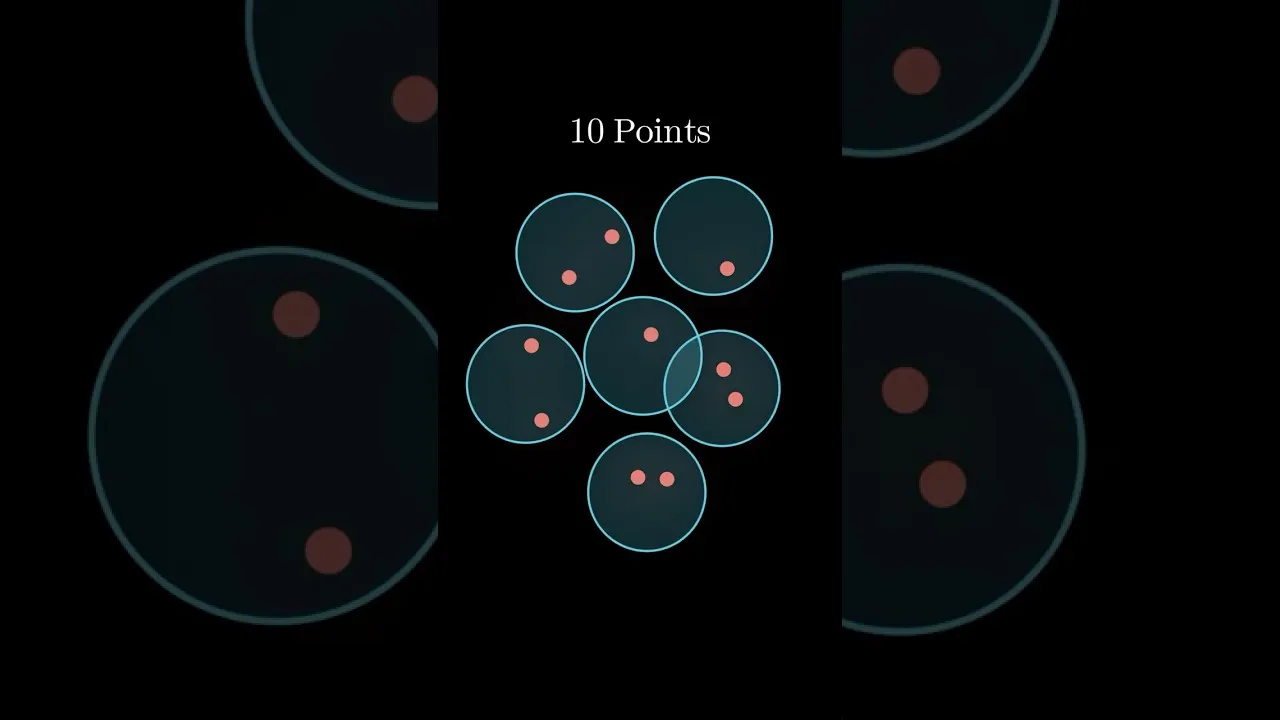
Imagine you have 10 dots scattered on a piece of paper. Your task is to place circular discs, each exactly the size of a standard frisbee (radius of one unit), over these dots.
There’s one important rule: none of the discs can overlap each other. The puzzle asks if you can always succeed in covering all 10 dots with these non-overlapping discs, no matter how the dots are arranged.
For instance, if all 10 dots are very close together, you might be able to cover them all with just one disc. On the other hand, if the dots are spread very far apart, you might need one disc for each dot. The real question is whether there’s a guaranteed way to do this for any arrangement of 10 points.
The Core Challenge
The challenge lies in the potential arrangements of the points. If the points are clustered, one disc might suffice.
If they are spread out, more discs are needed. The puzzle hinges on whether there’s a maximum number of points that can be covered by a single unit disc without overlap, or if the points can be so spread out that even with many discs, they cannot be covered.
Exploring Different Scenarios
Consider a scenario where the points are very close. If all 10 points can fit within a single circle of radius one, then you only need one disc. This is the simplest case and shows it’s possible under certain conditions.
Now, think about points that are very far apart. If each point is more than two units away from every other point, then each point would require its own separate disc. In this case, you would need 10 discs, and since they are far apart, they wouldn’t overlap.
The Crucial Question: Can it Always Be Done?
The puzzle asks if this is *always* possible, regardless of the point distribution. This means we need to consider if there are any tricky arrangements that make it impossible. The possibility of covering the points depends on the distances between them and how many points can fit within the area covered by a single unit disc.
The Answer and Its Implications
The surprising answer is no, you cannot always cover 10 points with non-overlapping unit discs, no matter where they are placed. There are specific arrangements of points where this becomes impossible. This happens when the points are positioned in such a way that they cannot be grouped efficiently under non-overlapping unit discs.
For example, imagine points that are just slightly too far apart to fit within a single disc, but too close to be covered by separate discs without forcing those discs to overlap. This delicate spacing is key to the puzzle’s difficulty.
Why It Fails: A Deeper Look
The failure occurs when the points are spread in a pattern that requires more discs than can be placed without overlap. A unit disc can cover a certain area, and the arrangement of points determines how many such areas are needed. If the required areas must overlap to cover all points, then the condition of non-overlapping discs is violated.
This problem relates to concepts in geometry about packing and covering. It shows that even simple geometric shapes can lead to complex problems when constraints like non-overlap are introduced. The specific number 10 is important here; it’s a threshold where such impossible arrangements become possible.
Conclusion
So, while it’s possible to cover 10 points with non-overlapping unit discs in many cases, it is not always guaranteed. The spatial relationship between the points is the deciding factor. This puzzle highlights that geometric coverage isn’t always straightforward.
The next time you encounter a similar geometric puzzle, remember to consider the worst-case scenarios for point distribution.
Source: Covering 10 points, a surprisingly tricky puzzle. (YouTube)