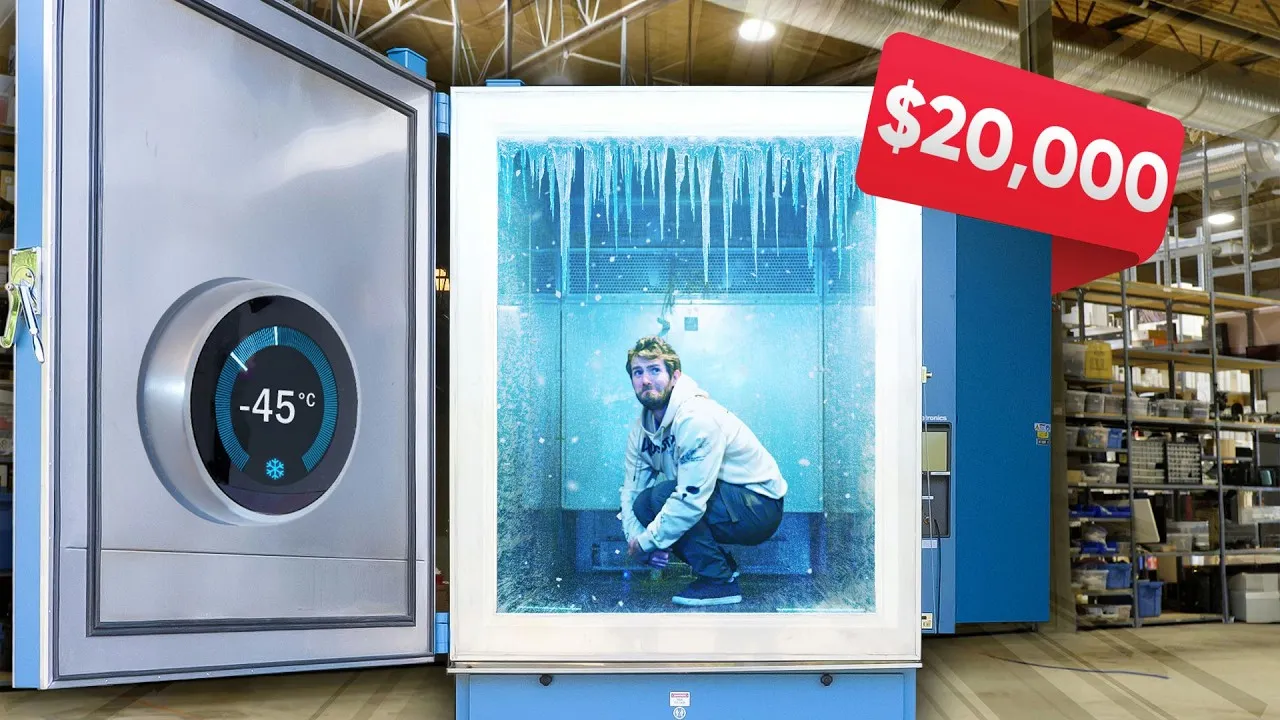
Massive $20K Chamber Refurbished for Under $2K
Imagine getting a high-tech industrial piece of equipment, worth tens of thousands of dollars, for less than $1,300. That’s exactly what happened when a team acquired a massive Environics thermal testing chamber.
This unit, originally costing a fortune, was decommissioned over a decade ago. Amazingly, it arrived with almost no rust, full documentation, and service history, making it a promising, albeit old, find.
The initial plan was to integrate this giant chamber into their testing lab, but the estimated cost for permanent installation was a staggering $4 million. That’s a far cry from the $1,300 purchase price. Fortunately, the same team that took the chamber apart agreed to get it working again.
Their price? Less than a tenth of the installation cost, making this salvaged marvel a potential bargain.
Getting the Cold Shoulder: Cooling Challenges
One of the biggest hurdles was cooling this water-cooled unit. Unlike air-cooled systems, it requires a substantial cooling setup.
The team initially tried using salvaged cooling towers, but these simply didn’t have enough power to handle the heat generated. This led to a temporary, albeit unusual, solution: running cold tap water directly through the unit and then letting the warmed water drain away.
This makeshift cooling system uses the city’s water supply, a fact the team humorously notes is temporary. They stressed that this is not a permanent setup and is only for the duration of the video shoot.
The hope is that the city won’t mind the temporary water usage for this massive experiment. It’s a creative, if unconventional, approach to a complex engineering problem.
Refrigeration Realities and a Leaky Compressor
Getting the refrigeration system running was another major task. The chamber arrived completely empty of refrigerant gases, requiring a specialized and expensive gas, R508B.
Handling these gases requires a professional license, adding another layer of complexity and cost. One of the two compressors also presented a significant problem.
This specific compressor had a leak, allowing its protective nitrogen charge to escape and its oil to become contaminated. Repairing it involved removing the old oil and, crucially, removing any moisture that had gotten inside. Moisture is a major enemy in refrigeration systems, as it can freeze and interfere with the refrigerant’s performance, even acting like a refrigerant itself.
A Smarter Brain: Upgrading the Controls
The original control system, featuring a touchscreen and an old Windows XP-era computer, was a potential headache. The team replaced this complex setup with a simple Watlo F4 controller. This is a common upgrade for such chambers, effectively simplifying the interface and functionality.
Essentially, they swapped out a powerful but outdated computer for a much simpler, modern controller, similar to replacing an old PC with a Raspberry Pi. This new system allows them to set target temperatures, durations, and shut-off times remotely, meeting their needs without the complexity of the original system. The space freed up by removing the old computer is also a welcome bonus.
Powering Up: The First Test
With the cooling and controls sorted, it was time for the moment of truth: firing up the chamber. After turning on the water supply for the cooling system, the unit was energized. The internal fans, responsible for circulating air within the chamber for consistent temperature, spun to life.
The team set a target temperature of minus one degree Celsius. The original unit could cool at a rate of 1.75 degrees Celsius per minute, even with a heavy load. While the refurbished unit is slightly slower, running at about 80% of its original efficiency, it still performs impressively, especially when empty.
Testing the Limits: Sub-Zero Adventures
The team then decided to push the chamber’s capabilities, setting it to minus 40 degrees Celsius. The experience inside was intense, with temperatures dropping rapidly and the air circulation creating a significant wind chill effect. Even with hearing protection, the noise level inside was over 100 decibels.
Inside the chamber, the cold was palpable, causing noses to run and mustaches to freeze. They managed to reach a temperature of minus 22 degrees Celsius, and then pushed it further to minus 48 degrees Celsius. This extreme cold demonstrates the chamber’s powerful cooling capacity, far exceeding what the team typically needs for their own testing.
Why It Can’t Stay: The Cost of Permanence
Despite its impressive performance, the chamber cannot remain in its current location. The primary reason is its extreme loudness, making it unsuitable for an open workspace. Permanent installation would require building a dedicated, soundproof room that meets strict building codes, including plumbing, fire suppression, and electrical systems.
Another major factor is the immense heat generated. Dissipating up to 200,000 BTU per hour requires a massive external cooling system, potentially larger than the salvaged cooling tower they had. Reinforcing the roof for such a system would be another significant and costly undertaking, adding to the overall expense.
A Second Chance: For Sale and Ready to Go
The good news is that the chamber’s story isn’t over. Thanks to the generous work of the refurbishment team, who provided significant cost savings, the unit is now in nearly fully functional condition. They are offering it for sale at the original purchase price, plus transport costs.
The buyer will need to handle capturing and recharging the refrigerant gases, a fraction of the cost of buying a new unit of this size and class. This offers a unique opportunity for businesses or researchers needing a powerful environmental testing chamber without the massive price tag of a new one. Interested parties are encouraged to reach out directly.
Specs & Key Features
- Model: Environics Thermal Testing Chamber
- Original Estimated Cost: Tens to hundreds of thousands of dollars
- Purchase Price: Less than $1,300 (including delivery)
- Refurbishment Cost: Less than 1/10th of the original $4 million installation estimate
- Cooling Type: Water-cooled
- Temperature Range: Capable of reaching -73°C (tested down to -48°C)
- Original Cooling Rate: 1.75°C per minute (with 600lb aluminum load)
- Current Performance: Approximately 80% of original efficiency
- Control System: Replaced with Watlo F4 controller (previously Windows XP era)
- Noise Level: Over 100 dB
- Key Challenges Addressed: Cooling system setup, refrigerant gas charging, compressor repair, control system upgrade
- For Sale: Yes, at purchase price plus transport. Buyer responsible for refrigerant gas handling.
Source: I Spent $20,000 on This and I Can’t Keep It… (YouTube)