How to Understand Oil Price Spikes During Conflicts
When a major oil shipping route is threatened, oil prices can jump much higher than the actual amount of oil that’s blocked. This article explains why this happens using a recent conflict as an example.
You’ll learn how global oil markets work, why some countries are more affected than others, and how traders and insurance companies can cause prices to swing wildly. It’s a look at how fear and speculation can impact the price of oil, sometimes more than the real supply problems.
Understanding the Strait of Hormuz Situation
Iran threatened to close the Strait of Hormuz, a vital waterway for oil transport. They attacked ships trying to pass through, creating a clear message to others. At the time, about 20% of the world’s oil moved through this narrow passage.
However, even with the threat, global oil production only dropped by about 8% in March 2026. Despite this relatively small drop in supply, oil prices shot up by a huge 60%.
Why Prices Jumped More Than Supply Dropped
This large price increase, which was seven and a half times more than the drop in supply, might seem strange. It highlights the complex nature of global oil markets. The Persian Gulf region is incredibly important for oil production because it has the largest oil reserves and the lowest production costs.
Key Oil-Producing Countries and Their Vulnerabilities
Even small countries like Bahrain, which is no bigger than New York City, are significant oil producers. Bahrain, Qatar, and Kuwait all rely completely on oil tankers passing through the Strait of Hormuz to export their oil.
A closure would be devastating for their economies, but they represent only a small fraction of the total oil production from the Gulf region. Their impact on global prices is limited.
Other Gulf countries are in a better position. The United Arab Emirates (UAE) produces much more oil than Bahrain, Qatar, and Kuwait combined.
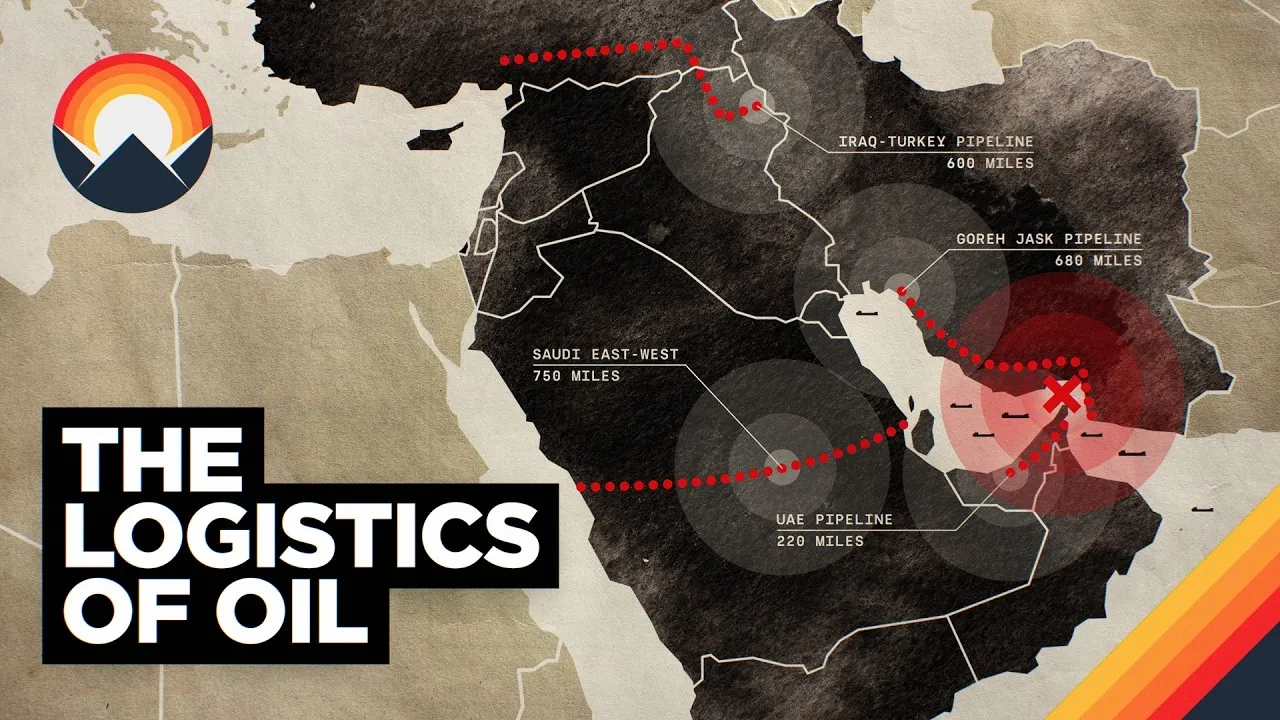
Crucially, the UAE built a pipeline in 2008 that allows them to export oil from a port on the other side of the Strait of Hormuz. This pipeline provides resilience against threats to the waterway.
Iran, another major oil producer, also developed a similar strategy. Most of its oil exports normally go through a single terminal. However, Iran also built its own pipeline to a port outside the Strait of Hormuz, providing an alternative export route.
Iraq, with its limited coastline, relies on a pipeline to Turkey that bypasses the Strait of Hormuz and the Suez Canal. However, this pipeline’s operation can be unreliable due to political issues within Iraq.
Saudi Arabia, the largest oil producer in the Gulf, has a significant advantage. It has a coastline on the Red Sea and built a large pipeline, the East-West pipeline, to handle oil exports. This pipeline has a massive capacity, ensuring Saudi Arabia can maintain its production and export levels even if the Strait of Hormuz is closed.
The Role of Pipelines in Mitigating Supply Shocks
These pipelines built by the UAE, Iran, Iraq, and Saudi Arabia provide significant alternative export capacity. This helps to lessen the impact of any closure of the Strait of Hormuz.
Added to this, some oil tankers were still managing to get through the strait during the conflict. These factors combined mean the actual reduction in global oil supply might have been less severe than headlines suggested.
Understanding Elasticity of Demand
So why did an 8% drop in supply cause a 60% jump in prices? This is explained by a concept called elasticity of demand.
Elasticity measures how much demand for a product changes when its price changes. For example, breakfast cereal is considered elastic; if the price goes up, people can easily switch to another brand or choose something else for breakfast.
Oil, however, is very inelastic. There are few immediate substitutes for oil, especially for transportation. Most driving is for essential trips like commuting or getting groceries.
Even for non-essential trips, people are unlikely to stop driving just because gas prices rise. Personal vehicles only account for a quarter of global oil use; the rest is used by commercial transportation and industries that cannot easily reduce their oil consumption in the short term.
While people might eventually switch to electric vehicles or find other ways to reduce oil use over the long term, these changes don’t happen quickly. Short-term research suggests oil has a very low elasticity of demand. The 8% supply contraction and 60% price increase during the conflict aligns closely with this low elasticity, suggesting that prices rose significantly to reduce demand by a corresponding amount.
The Influence of Commodity Traders
The oil market isn’t perfect and is influenced by subjective decisions made by commodity traders. These traders make money by betting on future oil prices.
They can heavily influence current prices by buying or selling large amounts of oil or using financial tools like futures contracts. If traders believe prices will rise, they might buy oil now, which actually reduces current supply and pushes prices up, creating a self-fulfilling prophecy.
This means that day-to-day oil price movements are often driven by a mix of actual events and the prevailing narrative or belief among traders. If a majority of traders believe prices will go up, they generally will. This helps explain why the initial reaction to the Strait of Hormuz threat was somewhat muted.
The Market’s Initial Reaction and the Role of Insurance
Even though the Strait of Hormuz closure was a major event, oil prices only rose modestly in the first few days of trading. Traders initially believed the conflict would be short-term, partly based on statements from political leaders suggesting a limited military operation. Despite ongoing reports of attacks on ships, the market remained relatively calm.
However, reality quickly set in when major marine insurance companies began canceling war risk insurance policies for ships operating in the affected areas. These policies are essential because large oil tankers and their cargo are worth hundreds of millions of dollars. Without insurance, ship owners faced unacceptable risks.
The cancellation of these insurance policies made it practically impossible for oil to be shipped out of the Gulf. Even when some insurers started offering new policies, the cost had increased dramatically, sometimes more than tenfold. This massive increase in insurance costs added significant expense to shipping oil, making it clear that the disruption was serious and likely to continue.
The Long-Term Impact of Uncertainty
As the weeks went on, the difficulty of moving oil became clearer. Even as alternative routes began to ramp up and the actual supply contraction lessened, oil prices remained high.
Traders’ focus shifted from the immediate supply figures to the growing concern about how long the disruption would last. The perception of stability in the Gulf had been shattered.
The conflict demonstrated that the region’s oil supply is not as guaranteed as markets previously assumed. This uncertainty about the continued operation of vital shipping routes is likely to be factored into oil prices for the long term. As long as the Strait of Hormuz remains a critical part of global oil logistics, any threat to its stability will likely mean higher prices at the pump for consumers worldwide.
Source: How the Iran War Spiked Oil Prices (YouTube)