Anthropic’s Claude 4.7 Faces Mixed Reviews Amid New AI Releases
The artificial intelligence world continues its rapid pace with new updates from major players like Anthropic, Google, and OpenAI. Anthropic recently launched Claude Opus 4.7, touting it as their most capable model yet. However, early user experiences suggest a more complex picture, with both impressive advancements and concerning regressions.
Claude Opus 4.7: Design and Coding Powerhouse?
Anthropic introduced Claude Opus 4.7 with several new features, including Claude Design. This tool allows users to create prototypes, slides, and one-page websites simply by chatting with Claude. The system is designed to be more user-friendly than traditional coding tools, offering a simple “tweaks” button for easy adjustments to elements like typography and theme.
The company also rebuilt Claude Code on desktop from the ground up. While not a personal favorite for some users, Anthropic claims this redesign significantly improves its performance.
The core Opus 4.7 model itself is highlighted for better handling of long tasks, more precise instruction following, and self-verification of outputs. This aims to reduce the need for constant human oversight on complex projects.
Vision Improvements and API Enhancements
A key claim for Opus 4.7 is its enhanced vision capabilities. The model can now process images at over three times the previous resolution, leading to higher quality outputs for designs and documents.
For developers using the API, a new “extra high” effort level has been introduced. This sits between “high” and “max,” offering finer control over reasoning and managing latency for difficult problems.
Anthropic also debuted a beta feature called “task budget.” This helps users prioritize specific types of work and manage costs on longer AI tasks. This cost-control feature is seen as a smart move, potentially influencing competitors like OpenAI to consider similar tools for users who rely on AI for income.
Community Feedback: Impressive Demos, Lingering Doubts
Early user reactions to Claude Opus 4.7 have been mixed. Some users have shared impressive results, such as building a functional clock with working hands on a website, a task that challenges even some image generation tools. This showcases the model’s potential in web development and design.
However, criticisms have surfaced regarding the model’s vision accuracy. In one instance, Opus 4.7 failed a colorblindness test, misidentifying the expected number. In another test involving music, multiple advanced models, including Opus 4.7, struggled to identify a specific guitar chord from an image, with Opus 4.7 stating there wasn’t enough information.
Long Context Regression Concerns
Perhaps the most significant concern raised by the community is a regression in long context performance. While Opus 4.7 shows improvements in many benchmarks, a deep dive into system cards revealed a substantial drop in its ability to handle very long texts compared to its predecessor, Opus 4.6. This is particularly surprising given that strong long-context ability was a major selling point of previous Claude models.
For example, in an 8-million token context test, Opus 4.7 scored 59.2%, a significant decrease from Opus 4.6’s 91.9%. At a 1-million token context window, Opus 4.7 dropped to 32.2% compared to Opus 4.6’s 78.3%. This decline in handling extended information is a major drawback for users who rely on AI for tasks involving extensive documents.
Google’s Expressive Text-to-Speech Model
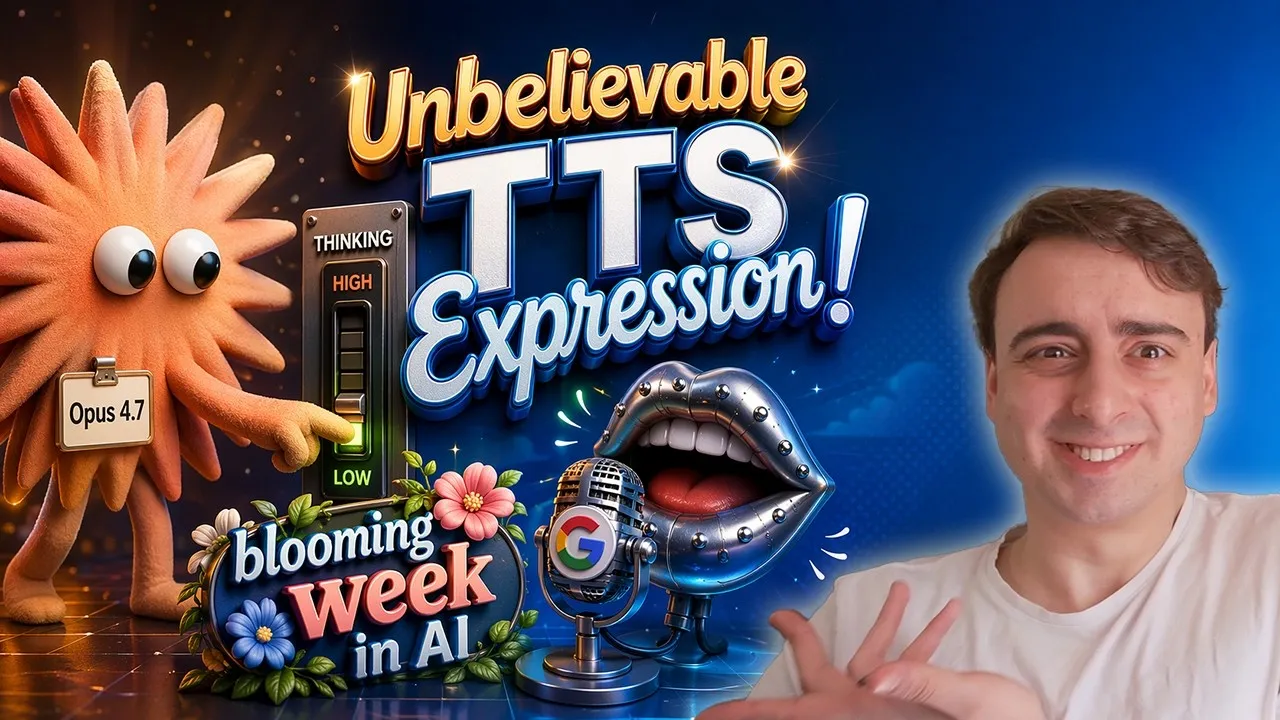
Shifting focus, Google has released a new text-to-speech (TTS) model that is generating excitement for its expressiveness and control. This model allows users to dictate speech with various emotions and styles using simple tags. Demonstrations show the TTS model mimicking characters like Mickey Mouse, a New York goblin, and even a frustrated robot.
The TTS model’s controllability is a standout feature, enabling users to specify tone, emotion, and even attempt sound effects. While it does not offer voice cloning, the variety of built-in voices and the ability to fine-tune the delivery with natural language prompts are impressive. The potential to pair this TTS with a large language model for interactive conversations is also a promising avenue.
OpenAI’s Scientific Focus and Image Generation
OpenAI has also been busy, with its upcoming image generation model, codenamed “Duct Tape” or “Masking Tape,” currently in A/B testing. Early examples show improvements in generating reflections and complex objects, though some issues with accuracy, like incorrect Rubik’s cube arrangements, persist.
More significantly, OpenAI launched GPT Rosalind, a frontier reasoning model specifically designed for research in biology, drug discovery, and medicine. This model aims to accelerate the process from target discovery to drug approval. It shows significant improvements over GPT-4.5 in areas like chemistry, biochemistry, and experimental design, suggesting a trend towards highly specialized AI models for scientific endeavors.
Why This Matters
The rapid advancements highlight a competitive AI race. Anthropic’s Opus 4.7 shows promise in design and coding but faces scrutiny over regressions in key areas like long context.
Google’s TTS model demonstrates a leap in natural-sounding and controllable synthetic speech, which could impact content creation and accessibility. OpenAI’s specialized GPT Rosalind signals a future where AI tackles complex scientific challenges, potentially speeding up life-saving discoveries.
These developments show AI is becoming more capable in specific domains, from creative design to scientific research and even realistic voice generation. However, the mixed results, particularly the regressions in Claude Opus 4.7’s long context, highlight the ongoing challenges in developing consistently reliable and broadly capable AI systems. Users must carefully evaluate these tools based on their specific needs and be aware of their current limitations.
The AI landscape is constantly evolving. While Opus 4.7 offers new creative tools, its long context issues and vision inaccuracies serve as a reminder that even the most advanced models have room for improvement.
Google’s TTS offers a fun and functional new way to generate speech, and OpenAI’s specialized models hint at future breakthroughs in science. The next major release to watch will likely be OpenAI’s “Spud” model, which could incorporate lessons learned from these recent advancements.
Source: Opus 4.7 arrived & Googles new TTS Absurdly fun and Unusually Controllable! (YouTube)