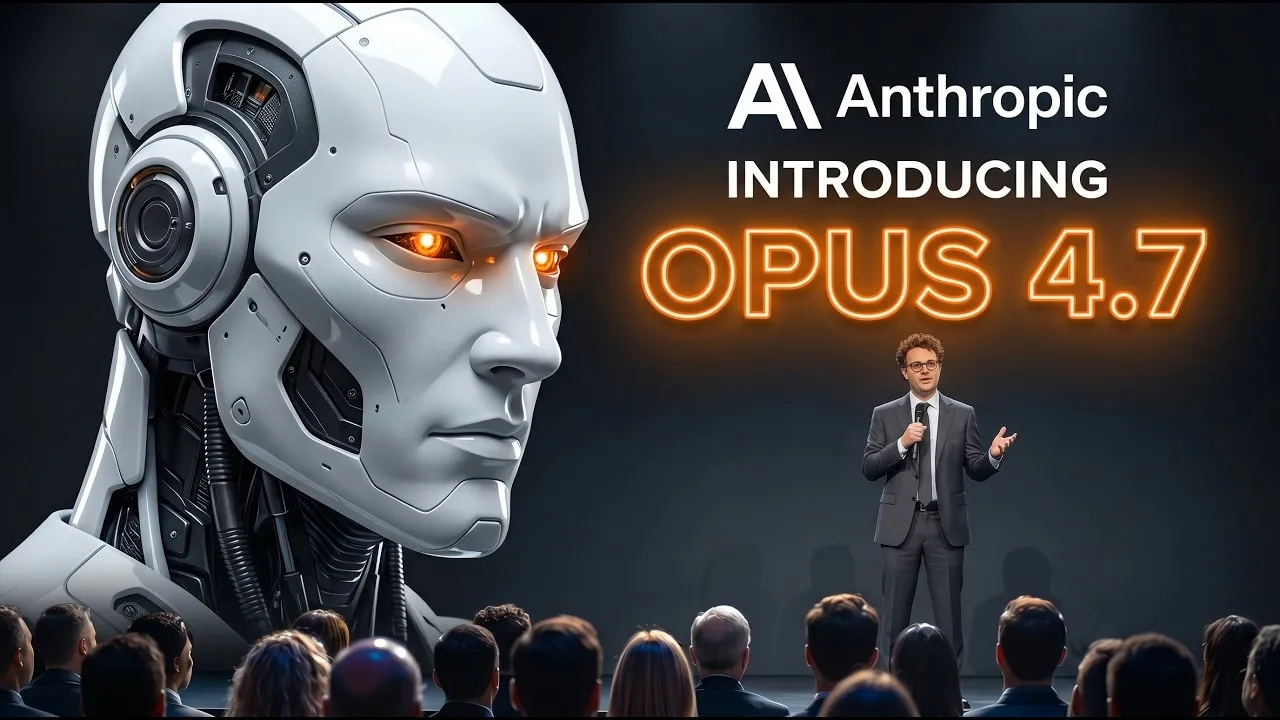
Anthropic’s Opus 4.7 Targets Enterprise, Not Everyday Users
Anthropic recently released Opus 4.7, an update to its advanced AI model. However, many users are missing the key changes and the true focus of this new version.
While benchmarks show improvements in specific areas, Opus 4.7 is not designed to be a better all-around AI for the average person. Instead, it marks a strategic shift towards serving large businesses and enterprise clients.
New Benchmarks Highlight Specialized Gains
The latest benchmarks for Opus 4.7 reveal significant progress in a few critical domains. These include coding tasks, agentic tool use, and visual reasoning.
The model shows stronger performance in visual navigation, which is like teaching an AI to drive a computer by just looking at the screen. This is important for future uses like AI agents browsing the web and interacting with websites like humans do.
Document reasoning has also seen a major leap. Opus 4.7 can now read and understand multiple complex documents, like financial reports and contracts, much better than previous versions.
It stands out significantly from other leading models like those from OpenAI and Google in this area. This makes it a top choice for tasks involving analyzing large amounts of text information.
Focus on Long-Term Tasks and Agentic AI
Another key area of improvement is long-term coherence. This refers to how well an AI can stick to a complex plan over an extended period without losing track of its goals.
In tests simulating tasks like running a vending machine, Opus 4.7 performed much better, ending up with a higher virtual balance. This shows a 36% increase in its final earnings in such simulations.
Anthropic’s main goal is to create AI that can perform jobs currently done by humans. This requires models that can handle tasks over long horizons.
Therefore, improvements in long-term coherence are crucial for this vision. Many older benchmarks are becoming less relevant as AI companies focus on these more complex, real-world tasks.
GDP Value Benchmark Shows Enterprise Strength
Perhaps the most telling sign of Opus 4.7’s direction is its performance on the GDP Value benchmark. This benchmark measures how well AI agents can perform tasks that humans do and that contribute to the economy.
Opus 4.7 scored 1753 on this benchmark, surpassing GPT-4’s highest setting. This score is tied to actual economic value, using tasks from industries like finance, insurance, and healthcare.
The GDP Value benchmark is considered highly important for current AI companies. It reflects the real economic output AI can generate. Opus 4.7’s strong performance here indicates it is optimized for business applications that directly impact financial results, rather than general user tasks.
The “Jagged Frontier” and Trade-offs
AI development doesn’t always improve smoothly; it often follows a “jagged frontier.” This means an AI can become exceptionally good at certain difficult tasks while still struggling with simpler ones. Opus 4.7 exemplifies this. While it excels in areas like enterprise software services, IT, and coding, it may perform less well in other domains like entertainment or sports analysis.
This uneven improvement is why some users report Opus 4.7 feels worse in certain aspects. When Anthropic prioritizes specific capabilities, like those needed for enterprise GDP tasks, other areas might see a decline. This is a trade-off that affects how the model performs for different types of users.
Compute Limitations and “Nerfing” Concerns
Despite the benchmark gains, many users have reported that Opus 4.7 feels like a downgrade, leading to discussions about the model being “nerfed.” This perception stems from real-world issues, including frequent outages and Anthropic metering computing supply. The company is facing challenges with having enough computing power to meet demand, especially during peak hours.
To manage this, Anthropic is prioritizing compute for large enterprises. They are rolling out their most powerful models, like Mythos, to select partners.
Meanwhile, everyday users might experience limitations on the reasoning capabilities of Opus 4.7, as the system may be conserving resources. This means the model might not be performing at its full potential for general users.
Subtle Price Increase and Tokenizer Changes
Another factor many users missed is a practical increase in cost. While the list price for Opus 4.7 appears the same as Opus 4.6 ($5 per million input tokens and $25 per million output tokens), there’s a hidden increase.
Opus 4.7 uses a new tokenizer that maps the same text to more tokens than before. This can result in a 35% higher real cost for the same workload.
This change means that users will consume their token limits faster, even if the per-token price seems unchanged. This sneaky pricing adjustment, buried in the fine print, makes the model more expensive for daily workflows. It further suggests Anthropic’s focus is on users who can afford these higher costs, like large companies.
Real-World Performance Struggles
The impact of these limitations is visible in certain benchmarks. For instance, on the Simple Benchmark, which tests common-sense reasoning and avoiding common traps, Opus 4.7 scored 62%, lower than Opus 4.6’s 67%. Similarly, on Reper Bench, designed to test if AI models can reject nonsensical questions, Opus 4.7 also scored worse than its predecessor.
These regressions highlight the challenges Anthropic faces in balancing advanced capabilities with available resources and enterprise demands. Opus 4.7 represents a significant step forward for agentic AI and enterprise applications, but for the average user, it may not feel like an upgrade and could even be more costly.
What’s Next for Anthropic’s AI
Anthropic is focused on serving businesses that need AI for economic output. The company is making its most advanced models available to large enterprises first.
For individual users, the current offerings may be constrained due to compute limitations and strategic pricing changes. The next steps for Anthropic will likely involve continued development for enterprise clients while managing resource constraints for broader access.
Source: Opus 4.7 Just Dropped — Here's What Everyone Missed (YouTube)