AI Agent Masters Complex Robot Hand Programming
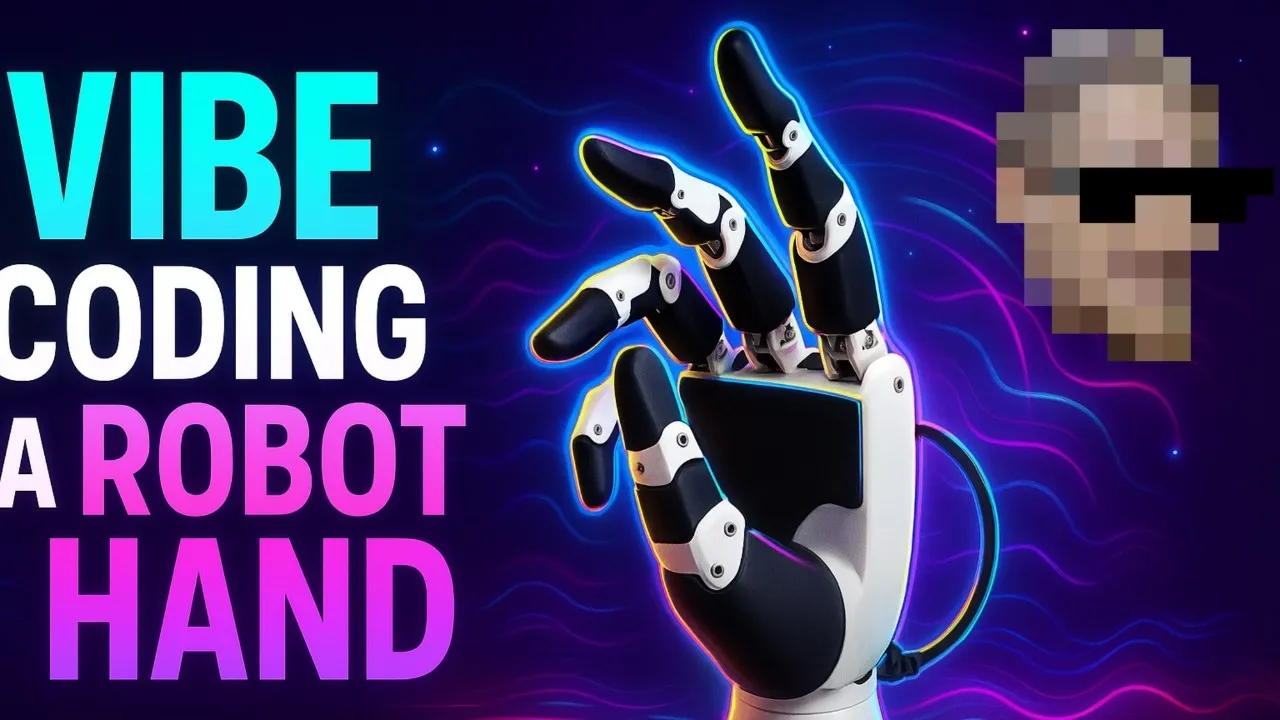
In the rapidly evolving field of robotics, bridging the gap between advanced hardware and practical programming has often been a significant hurdle. Many cutting-edge robots, particularly humanoid or dexterous manipulators, are showcased through impressive, yet often inaccessible, demonstrations. The complexity and cost of these machines mean that detailed programming information and user-friendly interfaces are scarce, leaving enthusiasts and developers struggling to move beyond the hype. However, a recent demonstration using an AI agent, specifically Claude 3.7 Sonnet via the Cursor IDE, has shown remarkable potential in demystifying and accelerating the programming of sophisticated robotic hardware.
The Challenge of Dexterous Robotics
The video highlights the common frustration faced by those venturing into advanced robotics. The author, eager to program Inspire RH56DFQ-2L/R robot hands, found himself confronting a steep learning curve. Despite the hands coming with a manual, the documentation provided technical specifications but lacked the direct translation into executable code. This is a prevalent issue across the industry; while companies like Unitree with their G1 robots (rumored to be around $16,000, though pricing remains elusive) or Boston Dynamics with their Spot robots produce astonishing feats, the practical application and programming often remain in the realm of specialized engineers.
The author recounts past attempts to engage with robotics companies like Boston Dynamics and Unitree, only to be met with a lack of response or missed opportunities. This personal journey underscores the difficulty of accessing and utilizing such advanced technology. The Inspire robot hands, developed by Lucky Robots, a startup focused on robot simulation and training, represent a more accessible entry point, but still pose a significant programming challenge.
AI as a Programming Co-Pilot
The core of the demonstration revolves around using Cursor, an IDE enhanced with AI capabilities, and Claude 3.7 Sonnet, to interpret the robot hand’s manual and generate functional Python code. The process began by feeding the entire PDF manual into the AI agent. The author, admitting his own lack of expertise in programming these specific hands, expressed confidence that an AI agent could drastically reduce the time and effort required compared to a manual approach, which he estimated could take weeks.
This mirrors a previous success the author had using Claude 3.5 Sonnet to repurpose a Raspberry Pi for locating a break in an underground dog fence by converting it into a radio antenna. This analogy emphasizes how AI can be used to solve practical problems by reinterpreting existing technology and information in novel ways.
Initial Setup and Communication Hurdles
The AI agent, after receiving the manual, began generating Python code. A key aspect of the setup involved establishing communication with the robot hand, which typically uses serial ports. The author noted a preference for disabling Cursor’s ‘auto-select’ feature for running commands, as it seemed to keep the output within the chat window, facilitating a more interactive debugging process.
The initial generated code aimed to create a Python module for communication. However, the process wasn’t entirely smooth. The system initially attempted to use a general ‘Python 3’ command, which the author corrected to ‘Python 3.10’ due to his specific system configuration and installed libraries. This highlights the importance of precise environment management even when using AI assistance.
The first attempts to run the code encountered issues. The script struggled to find the correct serial port and reported communication errors. The AI then generated scripts to check the serial port and attempt communication using different baud rates, a common parameter for serial communication. When direct RS485 communication failed, the AI pivoted to exploring the Modbus protocol, a widely adopted industrial communication standard that can run over RS485.
Overcoming Protocol Challenges with Modbus
The manual specified a default baud rate of 115200 for the hand. After initial RS485 attempts proved unsuccessful, the AI generated a Modbus test script. The author inquired about the difference between RS485 and Modbus, prompting the AI to explain:
- RS485: The physical layer, defining electrical characteristics, wires, voltage levels, and signal transmission – essentially the hardware connection.
- Modbus: The communication protocol, a set of rules for data exchange that runs on top of physical layers like RS485 – akin to the language spoken over the wires.
The AI explained that the initial RS485 attempt involved trying to communicate using a proprietary binary protocol directly, while Modbus offers a standardized framework. This distinction was crucial for progressing. The Modbus test script, surprisingly, reported reading an error, which the AI interpreted as successful communication, as it received a response indicating an error state rather than no response at all.
Achieving Basic Hand Movement
The breakthrough came when the AI generated a script that successfully initiated movement in the robot hand. The author described hearing the hand activate and seeing it move, confirming that communication had been established. This initial success, achieved within approximately 25 minutes of focused AI interaction, was a significant milestone.
Following this, the AI was tasked with creating an interactive script for controlling the hand via a command-line interface (CLI). This involved commands like ‘open’, ‘close’, ‘pinch’, and ‘three-finger grip’. The AI generated code that allowed for these basic manipulations, demonstrating the ability to exert force and move fingers to precise locations.
Interactive Control and Fine-Tuning
The interactive script allowed the author to issue commands like ‘O’ for open, ‘C’ for close, and ‘P’ for pinch. While the initial attempts at specific grips like ‘pinch’ or ‘three-finger grip’ weren’t perfect, requiring further refinement, the fundamental ability to control the hand’s basic movements was established. The AI also generated code for individual finger control, allowing for specific angles and positions to be set.
During this phase, the author encountered issues where commands would sometimes fail or execute unexpectedly. For instance, the ‘point’ command, intended to use the index finger, incorrectly activated the middle finger. The AI helped identify and correct such errors, including issues with writing to incorrect registers and understanding finger indexing. The process revealed that the AI could help debug and refine the code by analyzing the generated scripts and comparing them to the desired outcomes.
The AI’s ability to explain concepts like Modbus and RS485 in simple terms, and to iterate on code based on observed failures, proved invaluable. The author noted that the AI not only generated code but also helped in understanding the underlying protocols and potential pitfalls.
Why This Matters
This demonstration is significant for several reasons:
- Democratizing Robotics: It shows how AI agents can lower the barrier to entry for complex robotics, making advanced hardware more accessible to a broader range of developers and hobbyists.
- Accelerated Development: The speed at which the AI helped establish communication and basic control (around 25 minutes for initial movement) drastically reduces development time compared to manual coding and debugging.
- Bridging the Documentation Gap: AI can effectively interpret and translate dense technical documentation into functional code, a task that is often time-consuming and requires specialized knowledge.
- Enhanced Problem-Solving: The iterative process of generating code, encountering errors, and refining solutions with AI assistance demonstrates a powerful new paradigm for tackling complex technical challenges.
While the Inspire robot hands are not as high-profile as Boston Dynamics’ robots, the principles demonstrated are broadly applicable. The ability to program dexterous manipulators, even at a basic level, opens doors for applications in research, education, and specialized industrial tasks where custom robotic solutions are needed.
Future Possibilities and Conclusion
The author plans to package the generated Python library and make it available on GitHub, further supporting the community’s efforts in working with these robot hands. While full manipulation and complex tasks still require further development, the foundation laid by the AI agent is substantial. The ability to control individual fingers, exert force, and set precise positions offers a strong starting point for more advanced applications, such as grasping objects or performing delicate manipulation tasks.
The experiment concluded with the author expressing significant satisfaction with both the Inspire hands and the capabilities of Cursor and Claude 3.7 Sonnet. The AI not only saved a considerable amount of time and potential frustration but also facilitated a learning experience that would have been significantly more arduous otherwise. This success story highlights the growing synergy between advanced AI and sophisticated hardware, paving the way for a future where complex robotics are more within reach for everyone.
Source: Vibe Coding Robot Hands w/ Cursor (Inspire RH56DFQ-2L/R) (YouTube)