AI Agents Gain Persistent Memory, Revolutionizing Coding Workflows
One of the most significant hurdles for AI coding assistants has been their limited memory, often causing them to forget previous tasks or repeat mistakes. A new project, dubbed ‘One Context,’ aims to solve this by introducing a persistent, shareable memory framework inspired by Git, promising to boost agent performance and enable smaller models to compete with larger ones.
For years, developers have grappled with the ‘context window’ limitation of large language models (LLMs). While models boast massive token capacities (up to 1 million), their effective usable context is often much smaller, typically between 120,000 and 200,000 tokens. This constraint forces coding agents to employ complex mechanisms to compress and manage conversations, leading to a gradual degradation in performance as tasks become longer and more intricate. Agents might seem to ‘get dumber’ over time, a frustrating experience for users relying on them for complex projects.
While some tools, like GitHub Copilot’s recent memory feature, allow agents to log information into project-specific memory files, these solutions are often siloed. Each project might get its own memory file, which can balloon in size for complex codebases. More importantly, this knowledge isn’t shared across different agent sessions or even different AI agents, preventing the accumulation of team-wide knowledge and continuous improvement of the AI’s capabilities.
Introducing One Context: Git-Inspired Memory for AI Agents
One Context introduces a novel approach using a ‘Get Context Controller’ that defines a simple yet powerful memory framework. The core idea is to manage an agent’s memory akin to how Git manages code versions. This allows for persistent memory that can be shared across any session and any coding agent, potentially even integrated with tools like Slack or Telegram.
The framework utilizes a structured file system to store an agent’s actions and learnings at different levels. Key components include:
- main.md: Stores the global context and roadmap of the project.
- Branching: Agents can create branches to explore alternative strategies or approaches. Each branch acts as a separate directory for tracking specific lines of inquiry.
- commit.md (within each branch): Logs high-level milestones or completed subtasks, similar to Git commits.
- log.md (within each branch): Stores the full raw conversation history, including observations, thoughts, and actions (often referred to as OODA or just raw messages and metadata).
- metadata: Contains project-specific metadata to help agents find relevant information quickly.
This structure supports four key actions for the agent:
- Branch: Triggered when an agent decides to explore a new strategy.
- Commit: Executed when an agent reaches a milestone or completes a subtask, summarizing progress in
commit.md. - Merge: Used to integrate the history of a specific branch back into the main project context after completion.
- (Implicit) Retrieval: The system allows agents to progressively retrieve information, starting from the global
main.md, diving into specific branches, and even accessing raw conversation logs.
Real-World Performance Gains
The impact of this structured memory system is significant. Early results show that with One Context, GitHub Copilot has demonstrated a 13% improvement in software engineering tasks. More remarkably, it enables smaller, more cost-effective models like GPT-4.5 Turbo to perform at a level comparable to frontier models. This suggests that by providing robust, accessible memory, the efficiency of AI agents can be dramatically enhanced, reducing reliance on sheer model size.
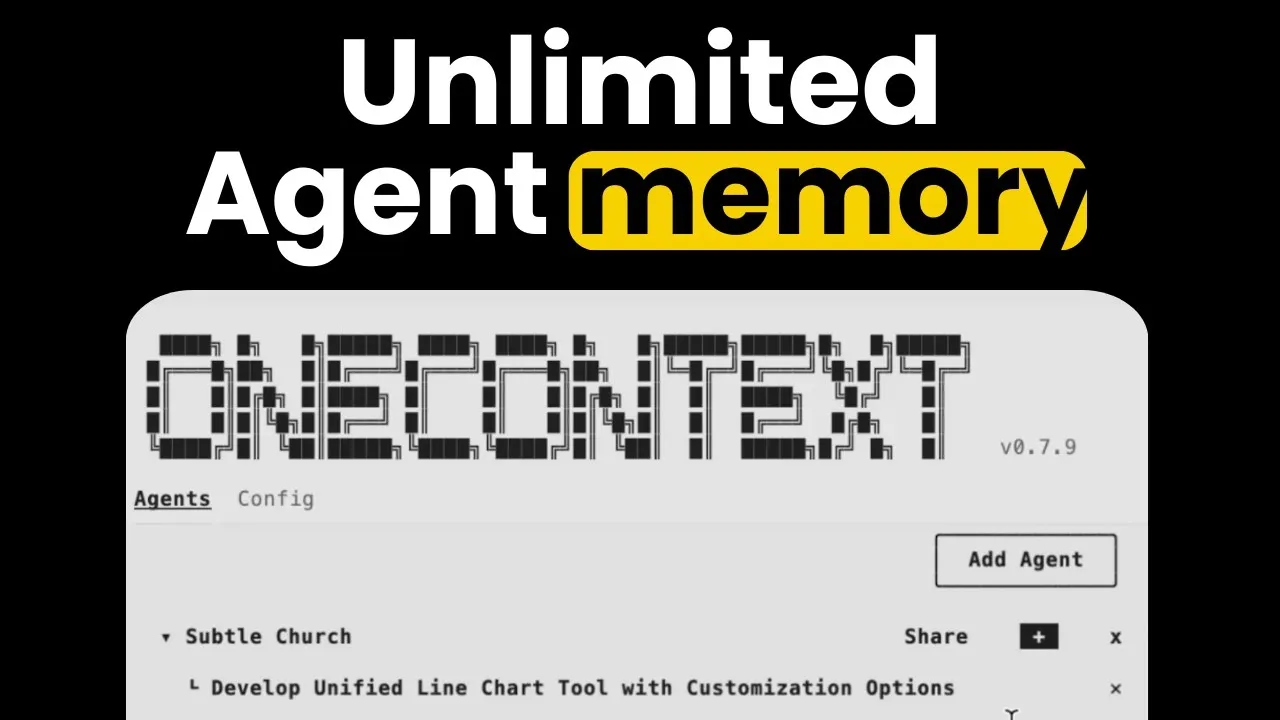
The One Context CLI tool encapsulates this methodology, making it relatively easy to set up. Users can install it via npm and run the onecontext command to initiate a split-view interface. Here, users can add ‘contexts’ (essentially groups of shared memory) and initiate ‘sessions’ with various coding agents (like Copilot or CodeX).
When an agent performs an action, One Context captures this information. For instance, if you tell an agent your name is Jason, even across different sessions or projects, One Context can recall this information by searching its persistent memory, demonstrating true cross-session recall.
Why This Matters
The implications of persistent, shareable AI agent memory are profound:
- Enhanced Productivity: Developers can rely on AI assistants that don’t forget previous instructions or context, leading to faster development cycles and fewer errors.
- Democratization of AI: Smaller, cheaper models can achieve higher performance, making advanced AI capabilities more accessible and affordable.
- Team Collaboration: Knowledge accumulated by one agent or team member can be shared across the entire team, creating a collective intelligence.
- Continuous Learning: AI agents become more valuable over time as they build a comprehensive history of interactions and project progress.
The One Context system is built on a local database (.line.db) that stores conversation history and summaries. It leverages watcher services and LLM calls (defaulting to GPT-4 mini for summaries) to maintain this knowledge base. The flexibility allows agents to explore different paths—like switching from a Playwright script to an API-based approach for a web scraper—while maintaining a clear history of each exploration.
Sharing and Collaboration
A key feature highlighted is the ability to share these contexts. Once a set of conversations and learnings are stored, users can generate a shareable link, effectively creating a chatbot interface powered by the collective memory of the agent’s sessions. This allows anyone with the link to query the AI about the project’s history and learnings, fostering transparency and shared understanding.
While the interface for shared contexts might still be basic, the underlying mechanism of using a file system to store, summarize, and abstract past actions is powerful. This setup allows for locally saved memory for coding agents, with the potential for significant improvements in retrieval accuracy and overall system robustness.
The project is open-source, and the developers behind One Context also offer workshops through AI Builder Club, providing practical tips and step-by-step tutorials for setting up coding agent memory and building production-ready agents.
Source: Agent memory resolved? (YouTube)