AI Breakthrough Simulates Realistic Glints in Real-Time
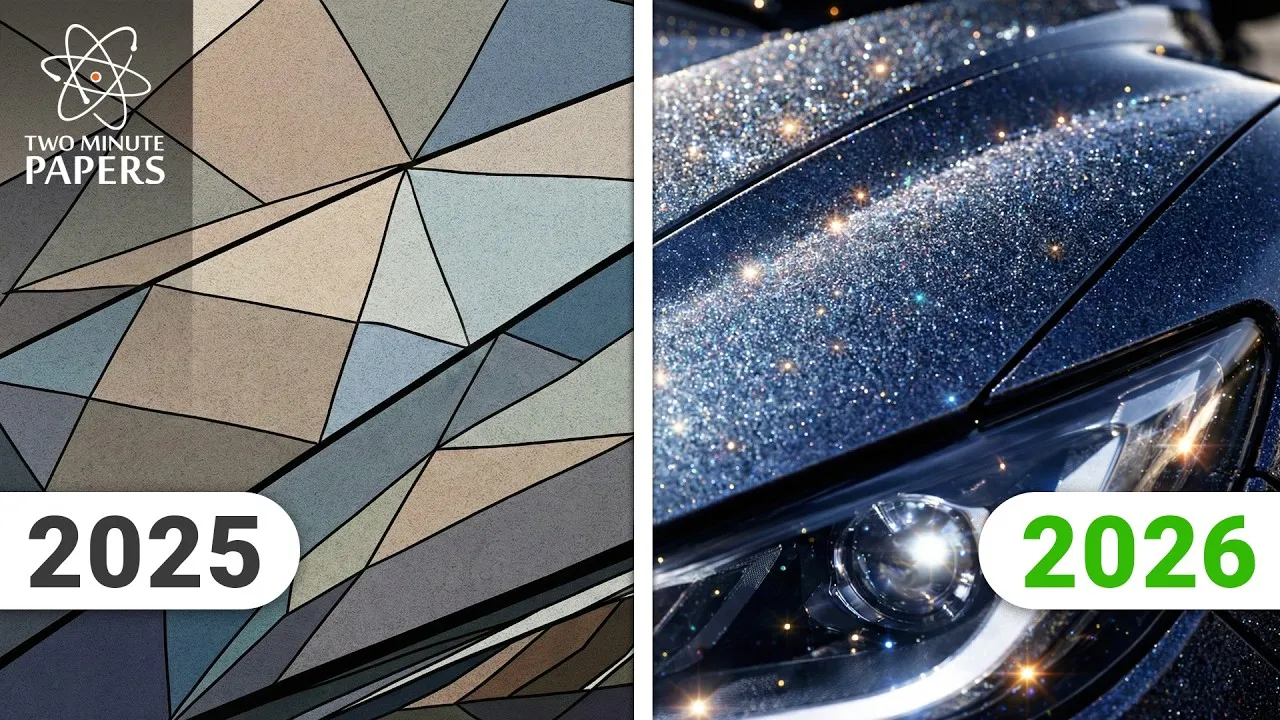
A groundbreaking new technique developed by researchers at Adobe Research, NVIDIA, and Aalto University is set to revolutionize computer graphics by enabling the real-time simulation of complex surface effects, such as the glinting particles seen on fresh snow or metallic car paint. This innovative approach, which is freely available, bypasses traditional computational hurdles, offering unprecedented visual fidelity without demanding immense processing power.
The Challenge of Simulating Microscopic Detail
Creating realistic visual effects like the sparkle of metallic flakes or the shimmer of wet surfaces has long been a major challenge in computer graphics. These effects involve millions of microscopic reflective elements. Simulating each one individually would overwhelm even the most powerful computers, leading to drastically reduced frame rates or requiring excessive memory. Consequently, existing methods often result in a less detailed, ‘bland’ appearance in video games and films.
A Novel Approach: The ‘Bouncer’ Analogy
The new research introduces a paradigm shift in how these effects are rendered. Instead of meticulously tracking every single reflective particle (likened to managing a massive guest list for a party), the technique employs a more efficient, on-the-fly generation method. The researchers use an analogy of a ‘bouncer’ who, without a guest list, uses mathematical rules to instantly determine where each ‘guest’ (particle) should appear at any given moment. This ‘bouncer’ figure represents an algorithm that calculates the necessary detail only when and where it’s needed, drastically cutting down on computational overhead.
Unprecedented Speed and Stability
This new method achieves remarkable performance, reportedly capable of rendering over 280 frames per second on consumer NVIDIA graphics cards, and even runs in real-time on less powerful laptops. A key advantage highlighted is its temporal stability. Unlike older techniques where effects might flicker or jump as the camera moves, this new method recalculates results for each frame so rapidly and accurately that the visual output remains consistent and smooth. This means millions of reflective particles can be rendered without the distracting ‘strobe light’ effect, creating a beautiful, shimmering appearance.
Outperforming Industry Standards
Comparisons with existing industry-standard techniques, such as the GGX sampling method, demonstrate the superiority of the new approach. In tests where both methods were given equal rendering time, the new technique produced significantly clearer and less noisy images much faster. This is because GGX often resorts to blind searching for highlights, leading to prolonged noise, while the new method intelligently predicts and generates the necessary details, clearing up the image almost instantly.
Dynamic Detail and UV-Free Rendering
The ‘bouncer’ algorithm dynamically manages the density of detail. Similar to how a party organizer might group guests from afar but reveal individual dancers up close, the system adjusts the level of detail based on the viewer’s perspective. This ensures that the simulation uses only the minimum necessary computation, providing intricate detail without being overwhelmed. A particularly revolutionary aspect is its potential for UV-free rendering. Traditional 3D texturing requires ‘unwrapping’ complex 3D models into 2D maps (UV mapping), a process prone to issues like tearing and seams, especially on intricate shapes. This new technique, operating directly in 3D space, can apply these surface effects without the need for UV mapping, simplifying the workflow for artists and eliminating visual artifacts.
Real-World Impact and Applications
Why This Matters: The ability to render such complex visual phenomena in real-time has profound implications across several industries. For video game developers, it means more immersive and visually stunning environments without compromising performance. Filmmakers can achieve hyper-realistic visual effects more efficiently. Even in fields like product design and architectural visualization, the enhanced realism can lead to better client presentations and design iterations. The UV-free capability is also a significant boon for artists working with complex or organic 3D models, streamlining the texturing pipeline.
Limitations and Availability
While the technique is highly advanced, it’s not without its limitations. It is not strictly energy-conserving, which might lead to minor artificial gains or losses of light energy near boundaries, though this is generally negligible for entertainment applications. Certain parameter combinations can also produce unexpected visual results. Furthermore, the UV-free rendering, while powerful, can be slightly slower than traditional methods.
Despite these minor drawbacks, the research is remarkable because it is offered freely. The full source code is available, implemented in a surprisingly concise amount of code (around 337 lines), allowing developers to integrate and experiment with the technology. A live demo is also available online, enabling users to explore the glinting effects by adjusting parameters for particle density and surface roughness.
Looking Ahead
This collaboration between Adobe, NVIDIA, and Aalto University exemplifies the rapid progress in AI and computer graphics. By rethinking fundamental rendering approaches, these researchers have unlocked a new level of visual realism that was previously thought computationally unfeasible for real-time applications. The availability of the technology ensures that it can be readily adopted and further developed by the broader graphics community.
Source: Adobe & NVIDIA’s New Tech Shouldn’t Be Real Time. But It Is. (YouTube)