AI Could Replace Most White-Collar Jobs in 18 Months
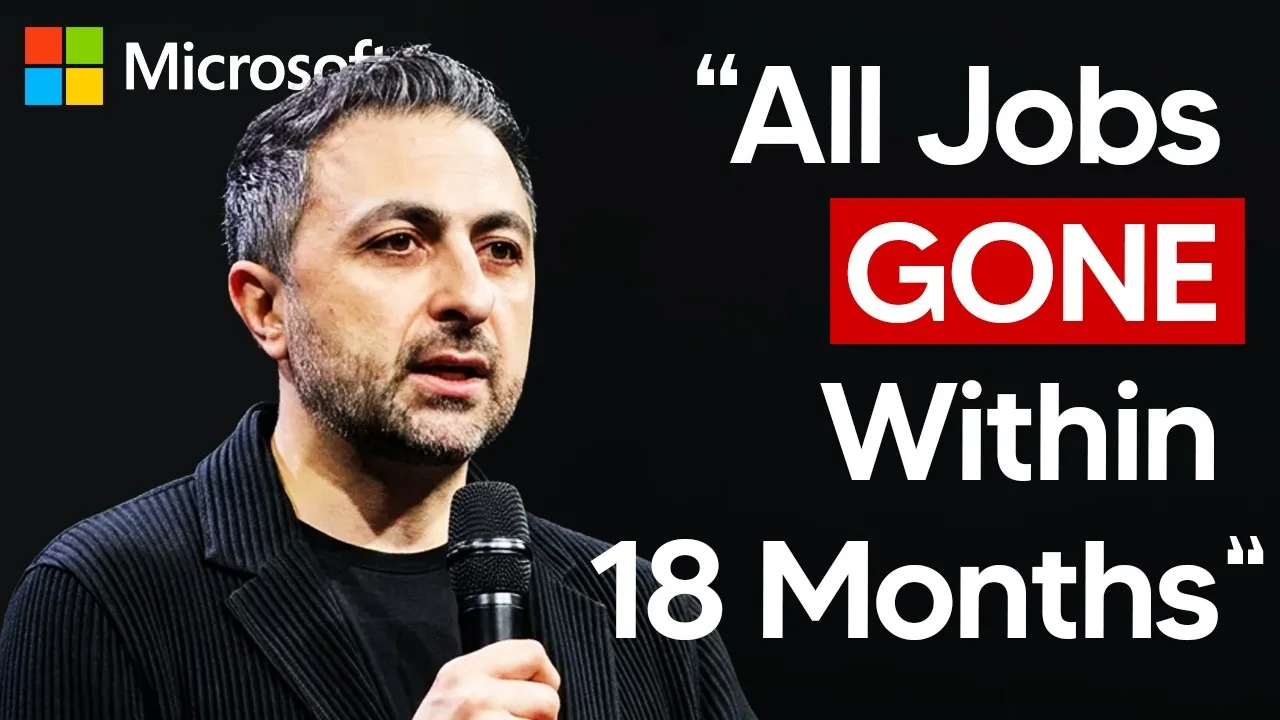
Microsoft’s AI chief, Mustafa Suleyman, has issued a stark warning: most white-collar jobs could be automated by artificial intelligence within the next 12 to 18 months. This prediction comes as AI models become increasingly capable of handling complex professional tasks, raising serious questions about the future of work.
AI’s Rapid Advance in Professional Tasks
Suleyman defines a professional-grade AI as one capable of performing most daily tasks done by a regular professional. He believes we are very close to achieving human-level performance across many professional fields. This means jobs like lawyers, accountants, project managers, and marketing professionals could see their core tasks fully automated by AI soon. We are already seeing this in software engineering, where many developers now use AI for most of their coding. Their roles are shifting towards tasks like debugging, strategic planning, and overseeing production, rather than writing code from scratch.
Experts Echo Concerns Over Job Displacement
Suleyman is not alone in his concerns. Dario Amodei, CEO of Anthropic, has also warned about AI’s potential to replace white-collar workers. Amodei suggests that entry-level white-collar jobs are particularly vulnerable. While initially augmented by AI, these roles could eventually be replaced, leading to a potential employment crisis. This contraction in early-stage white-collar work could significantly impact the job market.
Economic and Societal Implications
The prospect of widespread job displacement has fueled discussions about potential solutions. Some suggest that millions of college-educated workers could have their lives upended, leading to public outcry. This has brought topics like Universal Basic Income (UBI) back into focus as a way to cushion the blow. UBI, which provides a regular, unconditional income, has been explored as a potential safety net in an economy where AI performs many jobs.
Data Suggests Job Market Shifts Already Underway
Evidence suggests these changes may already be happening. Recent data shows that white-collar job openings have hit their lowest level since 2015. With only 1.6 openings per 100 employees, this indicates a tightening labor market for roles like analysts, marketers, HR, finance, and legal professionals – exactly the jobs AI excels at. The opportunities in these fields appear to be shrinking now, not just in the future.
Real-World Layoffs and AI’s Role
The impact of AI on employment is becoming visible in corporate decisions. Block, the company behind Square and Cash App, recently laid off over 4,000 employees, cutting its workforce by 40%. The company cited the use of AI tools, combined with smaller teams, as enabling a new, more efficient way of working. This move, which resulted in a profit increase and stock price jump, raises concerns about a perverse incentive for companies to replace workers for financial gain.
Legislative Attempts to Protect Jobs
In response to these concerns, some legislative efforts are emerging. A new bill proposes banning AI from providing professional advice in fields like medicine, law, engineering, and psychology. This marks a significant shift, as previous discussions about AI and job displacement primarily focused on blue-collar work. This bill represents an organized effort by professional groups to protect their jobs, using safety as a justification. However, it raises questions about how to regulate AI’s advice, especially in open-source models, and who would be liable for incorrect information.
The Future of Professional Careers
If AI can perform a significant portion of tasks for junior professionals, the career paths for new entrants into fields like law or medicine become uncertain. While legislation might temporarily delay these changes, it doesn’t solve the underlying issue. Graduates may enter professions that are artificially preserved, while the foundation of those jobs quietly erodes. The debate continues on whether these moves are to protect professionals or to prevent the widespread dissemination of information that AI can provide.
Analyzing AI’s Actual Workplace Impact
Companies like Anthropic are tracking AI’s real-world usage in the workplace through their AI Exposure Index. This data shows that while AI has high theoretical potential in fields like legal, management, and finance, its actual adoption is still in early stages. Office and administrative roles also show high theoretical exposure. However, current data suggests AI has had limited impact on overall unemployment since ChatGPT launched in 2022. There is an early warning signal for younger workers, with a notable drop in employment for those aged 22-25 in AI-exposed jobs.
Expert Forecasts and Workforce Transition
Industry analysts offer varying perspectives. Gartner predicts a neutral impact on global jobs through 2026, with AI potentially creating more jobs than it destroys by 2028. However, they also foresee significant disruption, with millions of jobs being transformed annually, requiring constant upskilling. Gartner also notes that many workers terminated by AI may be rehired, often at a higher cost, due to ineffective transition strategies. Examples like Clarna, which initially replaced hundreds of workers with AI but later began rehiring humans, highlight the messy reality of AI adoption.
The Messy Reality of AI Integration
The integration of AI into the workforce is proving to be more chaotic than a straightforward takeover. Companies may overcorrect, laying off staff only to realize they need to rehire. Workers can get caught in this back-and-forth, paying the price for failed experiments. The displacement is happening, but not in a linear fashion, making it unpredictable and perhaps scarier than a clean transition.
Skills of the Future: AI Literacy and Adaptability
Looking ahead, AI literacy is becoming a crucial skill. Gartner predicts that by 2027, 75% of hiring processes will include certifications for workplace AI proficiency. Companies are already realizing the need for AI-free skills assessments, as candidates increasingly use AI to complete tasks. This means hiring tests will likely become more rigorous, focusing on what individuals can achieve without AI assistance. AI literacy is evolving from a desirable trait to a formal credential.
Source: Microsoft’s AI Chief Terrifying Prediction Explained (YouTube)