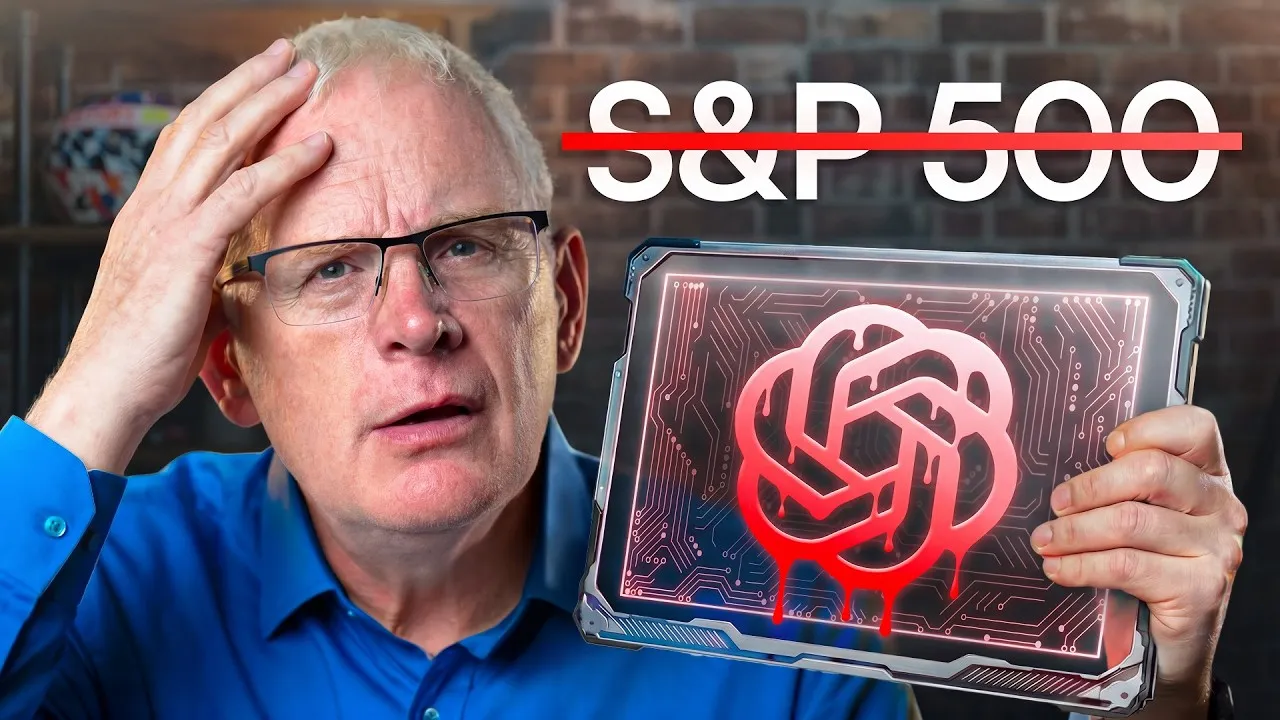
AI Fuels S&P 500 Bubble Fears, Investor Shifts Strategy
A seasoned investor, with 35 years of experience and millions earned primarily through low-cost S&P 500 index funds, is signaling a significant shift in their investment strategy, citing concerns over the accelerating influence of Artificial Intelligence (AI) on market valuations. The traditional approach of passively investing in the S&P 500, which historically offers an average annual return of over 10%, is now being re-evaluated in light of what the investor perceives as a potential AI-driven bubble.
The S&P 500 index, a benchmark for the largest 500 U.S. companies, is market-capitalization-weighted. This means that companies with higher market values command a larger proportion of the index. Currently, the top 10 companies within the S&P 500 account for approximately 40% of the entire index. Notably, this concentration is heavily skewed towards technology and AI-related firms. Companies like NVIDIA, Microsoft, Apple, Alphabet, Amazon, Broadcom, Meta, Tesla, Berkshire Hathaway, and JPMorgan Chase are the dominant players. NVIDIA alone represents an estimated 7-8% of every dollar invested in the S&P 500.
The AI Concentration Risk
The investor highlights that, excluding financial giants like Berkshire Hathaway and JPMorgan, the remaining dominant companies share a common trait: aggressive investment in AI. This has led to valuations that are not necessarily tied to current earnings but rather to future expectations. To justify their current market capitalizations, these leading AI-focused companies would collectively need to generate around $2 trillion in revenue, a figure that surpasses the combined 2024 revenue projections for NVIDIA, Microsoft, Apple, Alphabet, Amazon, and Meta. This reliance on future potential, concentrated in a single technological trend, raises concerns.
The situation is further complicated by the significant debt these companies are incurring to fund AI development. For instance, OpenAI’s CEO, Sam Altman, has reportedly expressed willingness to commit $1.4 trillion for AI infrastructure, despite the company’s current annual revenue being in the range of $13 billion to $20 billion. The investor suggests a complex feedback loop where large passive investments in these dominant companies inflate their stock prices, increasing their weighting in the S&P 500, which in turn attracts more passive investment. This dynamic can create an illusion of economic strength, with data from Deutsche Bank suggesting that AI spending might be masking an underlying recessionary pressure in the broader U.S. economy.
Exploring Alternatives: Equal-Weighting and Global Diversification
As a potential hedge against this concentration, the investor explored the concept of an equal-weighted S&P 500 index fund. In such a fund, each company in the index receives an equal allocation, reducing the dominance of the top players to around 2%. While this approach offers reduced exposure to the perceived AI bubble, it comes with its own drawbacks. Equal-weighted funds often employ a negative momentum strategy, which involves selling assets that have risen significantly and buying those that have underperformed to maintain balance. This constant rebalancing can lead to higher trading costs and potentially erode returns compared to market-cap-weighted funds that trade less frequently.
Consequently, while reducing exposure to the S&P 500, the investor plans to retain the majority of their stock market portfolio in the traditional market-cap-weighted version. The freed-up capital is being redirected towards a more globally diversified strategy. The historical performance of global stock markets shows that U.S. dominance has not been constant. Periods of U.K. and Japanese market leadership illustrate that economic power shifts over time. By investing solely in the S&P 500, investors miss out on significant global players like TSMC, Samsung, Toyota, Tencent, AstraZeneca, and HSBC.
A global stock market fund, such as the Vanguard FTSE All-World UCITS ETF (VWRP) or Fidelity’s International Index Fund (FSPSX) for U.S. investors, offers exposure to thousands of companies across developed and emerging markets. These funds automatically rebalance, adjusting to shifts in global economic leadership. For example, VWRP invests in approximately 3,700-3,800 companies across over 45 countries with a low expense ratio of 0.19%.
Seeking Opportunity in the ‘Overlooked Zone’
Beyond diversification, the investor identifies five key areas of strategic adjustment:
- Reduced S&P 500 Allocation: Acknowledging the concentration risk driven by AI valuations.
- Increased Global Diversification: Investing in global stock market funds to capture growth outside the U.S.
- Focus on Small and Mid-Cap AI Integrators: Shifting focus from AI developers to companies effectively leveraging AI at lower costs. The investor categorizes companies into four zones: the ‘crowded zone’ (large-cap, expensive tech), the ‘defensive zone’ (stable consumer staples), the ‘speculative zone’ (hyped, early-stage companies), and the ‘overlooked zone’ (small to mid-cap companies effectively using AI). The belief is that value will accrue to companies that utilize AI efficiently rather than those bearing the immense cost of developing foundational models. These companies, by offering AI solutions at competitive prices, can capture market share, similar to how basic gasoline remains in demand despite variations in quality.
- Increased Gold Reserves: Recognizing gold’s growing role as a global reserve asset, particularly with China’s significant gold accumulation and its reclassification as a Basel III Tier 1 asset. This reclassification allows central banks and financial institutions to hold more gold, driving demand. Bank of America has suggested gold reserves should increase from 20% to 30% for financial institutions, a move that could significantly impact gold prices.
- Higher Cash Holdings: Maintaining a larger cash reserve, mirroring moves by investors like Warren Buffett, to provide a safety net during market downturns and capitalize on buying opportunities.
Market Impact and Investor Considerations
The investor’s strategy reflects a growing sentiment that the current market leadership, heavily influenced by AI, may be unsustainable. The shift towards global diversification, smaller companies effectively integrating AI, and traditional safe-haven assets like gold suggests a move to de-risk portfolios from a potential tech-centric downturn while seeking value in less obvious areas.
What Investors Should Know:
- Concentration Risk: The S&P 500 is heavily weighted towards a few large technology companies, many of which are investing heavily in AI. This concentration poses a risk if the AI sector experiences a significant correction.
- Valuation Concerns: Many AI-focused companies are valued based on future growth expectations rather than current earnings, creating potential for volatility.
- Global Opportunities: Historically, market leadership shifts. Diversifying into international markets can provide access to growth drivers outside the U.S. and reduce single-market risk.
- The Value of Integration: The future value in AI may lie not just with the developers of core technology but with companies that effectively integrate AI into their products and services at a competitive cost.
- Gold as a Reserve Asset: Geopolitical shifts and regulatory changes are increasing gold’s appeal as a stable store of value for central banks and investors.
- Importance of Liquidity: Maintaining adequate cash reserves is crucial for weathering market volatility and seizing investment opportunities during downturns.
By adjusting their portfolio to include global equities, smaller-cap companies, gold, and increased cash reserves, the investor aims to navigate the potential instability brought by rapid technological advancement while positioning for future opportunities. This multi-faceted approach acknowledges the uncertainty of market movements and prioritizes resilience and diversified growth.
Source: I'm Changing How I Manage My Money Because of AI (YouTube)