AI Models Tackle Massive Memory, Build Worlds
This week in AI, we’re seeing breakthroughs in how artificial intelligence handles vast amounts of information and creates interactive digital spaces. New tools are making it easier for developers to build complex AI workflows, while researchers are pushing the limits of what AI can remember and generate.
Core AI’s Node Agent Simplifies Workflow Building
Core AI, a company known for its real-time AI image and video generation, has launched Node Agent. This tool allows users to create custom AI workflows by connecting different AI models. Think of it like building with digital LEGO bricks, where each brick is a specific AI task.
Node Agent appears on the side of the screen and automatically builds these workflows based on simple prompts. For example, it can combine photos and generate different angles or create a video from a set of images. A key feature is that once the AI builds the workflow, users can fully change it. They can swap out AI models, adjust prompts, or add new connections. The AI can then continue working with these modified setups.
This is designed for professional AI creators who need complex systems but want to save time. Traditionally, building these AI pipelines meant jumping between many different tools and managing each step manually. Node Agent aims to streamline this process. While it’s a powerful tool, it does require a Pro plan with Core AI, which costs $35 per month. This price might be a barrier for some newcomers.
Hugo’s AI Battle Royale Runs Locally
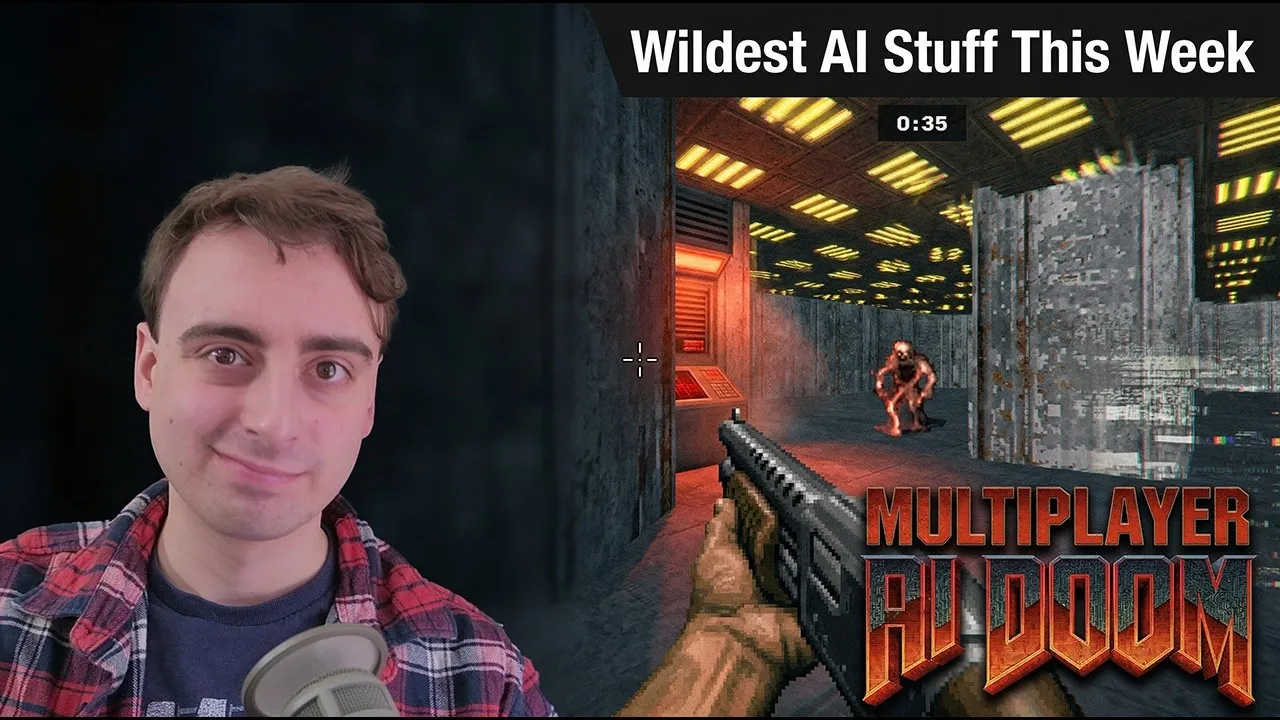
On the gaming front, a developer named Hugo has created the first multiplayer battle royale game that runs entirely within an AI world model, directly on your computer. While the graphics are basic, inspired by classic games like Doom, the game features 70 million AI parameters and real-time multiplayer action. The entire game world is generated and managed by AI.
In this game, you battle against other real players. The experience is described as a bit fuzzy and strange, with occasional visual glitches. However, the AI world remains coherent, and players can see a mini-map showing the game’s layout. This technology uses a low-resolution, small AI model, which makes it possible to run locally. It’s a fascinating early look at what AI-generated multiplayer games could become.
Microsoft’s Image Generator Gets an Update
Microsoft has also updated its image generation tool, previously known as Image Too. This model is performing well, ranking fifth on the Arena leaderboard for AI image generators. While it may not match top-tier models like Nano Banana 2 in terms of image clarity or realism, it shows strength in generating text and graphics within images. The images produced often feature good skin tones and smart color use, avoiding the overly bright or busy look that some other generators can produce.
To compare, the creator tested Microsoft’s tool against Nano Banana 2 for an infographic prompt. The Microsoft tool generated an infographic with creative names for parts of a theoretical lemon character, like “neural pulp interface.” However, it lacked detail and felt similar to older styles like SDXL. Nano Banana 2 produced a more detailed infographic, including descriptions and a cutout feature, showcasing its superior ability to follow complex instructions and deliver realistic results.
Google’s AI Studio Promises More Features
Google is planning to enhance its AI Studio, a tool that allows users to build AI applications. Future updates are expected to include a design mode, similar to tools used for creating apps and programs. Integrations with popular platforms like Figma, Google Workspace, and GitHub are also planned. A key addition will be a planning mode, where the AI first creates a detailed plan to approach a task before executing it step-by-step. This structured approach helps ensure more reliable and systematic results.
Other anticipated features include immersive user interfaces, the ability to spawn sub-agents from a main agent, and support for multiple chat windows within a single app. Google aims to make these tools accessible for free, helping people learn how to build applications and interact with AI effectively. Learning to communicate with AI models, known as prompting, is becoming a crucial skill for bridging the gap between human ideas and computer code.
Open-Source Tools for Cost Savings and Game Development
Several open-source projects are also making waves. Claw Router is designed to help AI agents save money by directing prompts to the most cost-effective AI model. It analyzes about 15 factors to find the best balance between performance and price, supporting over 44 different AI models. This could be a significant help for businesses using AI agents regularly.
Another open-source project, GoDoGen, uses AI to build entire game projects for the Godo 4 game engine. It works by having two AI agents collaborate: one plans the game structure, and the other executes the plan. This system can generate game assets, 2D textures, and even organize project files. It includes a feature that captures screenshots of the running game and uses them to identify and fix bugs, making the game development process more automated and efficient.
MSA: AI with Human-Scale Memory
A significant research paper introduces Memory Sparse Attention (MSA). This new AI architecture allows models to have extremely long-term memory without needing extra retrieval tools or brute-force methods. Instead, it builds memory directly into the AI’s core processing. This breakthrough could allow AI models to remember information over vastly longer periods, potentially reaching human-like memory scales.
Google’s Notebook LM, an AI tool that summarizes information from uploaded documents, has a new feature called cinematic video overviews. This feature, available to Pro users, can now create engaging video explanations of complex research papers. Using the MSA paper as an example, Notebook LM generated an 8-minute video explaining how MSA works. The video detailed how current AI models struggle with long-term memory, often losing details beyond a certain point (around 1 million tokens). MSA overcomes this by processing information more efficiently, allowing it to handle up to 100 million tokens. This is achieved through a new way of routing and storing information within the AI’s architecture, making it possible to process massive amounts of data without overwhelming the hardware. The researchers plan to release MSA as open-source, which is exciting for the future of AI development. While code and model weights are not yet available, they are expected soon.
Why This Matters
These developments highlight a rapid acceleration in AI capabilities. Core AI’s Node Agent and Google’s AI Studio point towards AI becoming a more accessible and integrated tool for creators and developers, simplifying complex tasks and fostering innovation. Hugo’s AI battle royale and the GodoGen project show the exciting potential of AI in interactive entertainment, moving towards dynamically generated game worlds. Meanwhile, the MSA research, especially with its planned open-source release, tackles a fundamental limitation of current AI—its memory capacity. This could unlock AI applications that require understanding and retaining vast amounts of context, from complex scientific research to more natural and long-lasting human-AI conversations. The ongoing release of powerful, often free or affordable, tools and research is democratizing AI development, allowing more people to experiment and build the future.
Source: I Played a Multiplayer AI World Model — Wildest AI Stuff This Week (YouTube)