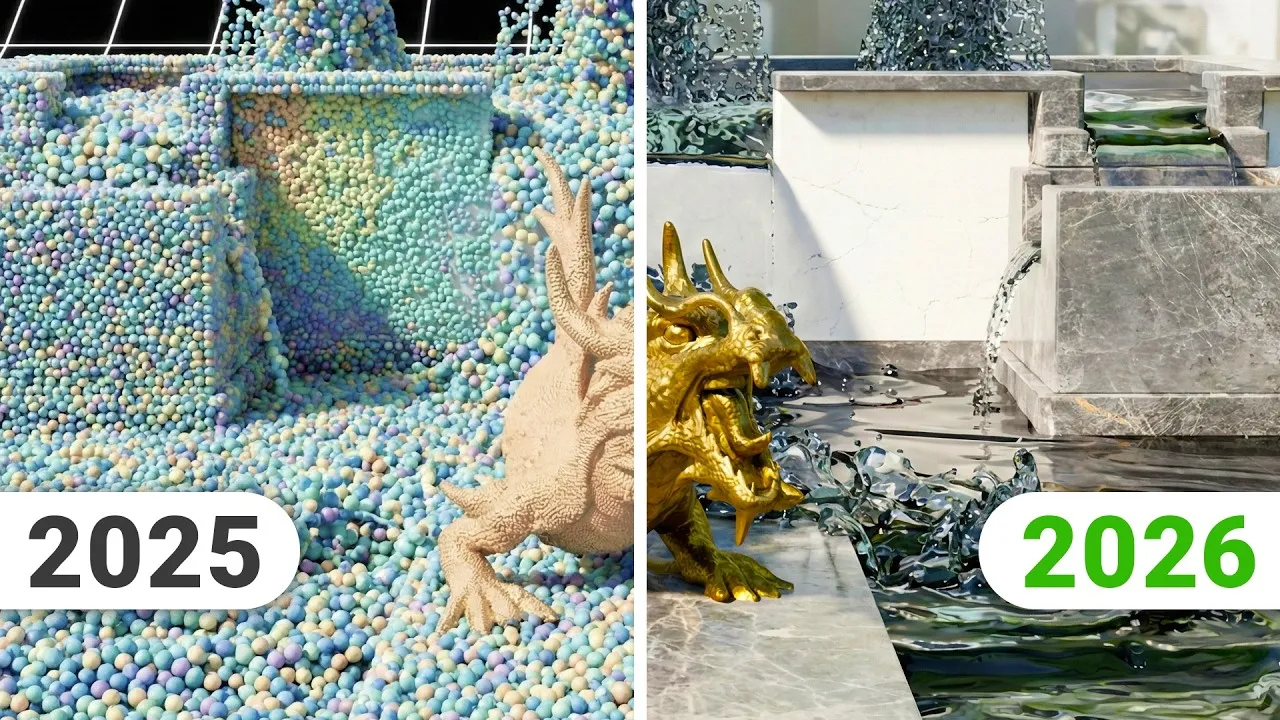
AI Revolutionizes Fluid Simulation with Octree Breakthrough
Researchers have unveiled a groundbreaking advancement in fluid simulation technology, leveraging a novel application of Octrees to achieve unprecedented realism and computational efficiency. This new method promises to overcome limitations that have long plagued traditional simulation techniques, opening doors for more sophisticated visual effects, scientific research, and interactive experiences.
The Challenge of Realistic Fluid Dynamics
Simulating the complex and chaotic behavior of fluids like water has historically been a computationally intensive task. Traditional approaches often rely on dividing the simulation space into a uniform grid. While effective for simpler scenarios, this method encounters significant challenges as the complexity increases. For instance, in a scene with a fountain emitting more particles, up to 3.5 million, the process of finding neighboring particles to calculate forces like density and pressure becomes exponentially more expensive. Uniform grids struggle to adapt, either wasting resources by checking empty grid cells or becoming bogged down by too many particles within a single cell. This inefficiency makes highly detailed and dynamic fluid simulations, such as a large wave generator with 9 million particles, practically impossible with older methods.
Octrees: A Smarter Way to Organize Space
The key to this new breakthrough lies in the innovative use of Octrees. An Octree is a tree data structure in which each internal node has exactly eight children. In the context of fluid simulation, it acts as a hierarchical spatial partitioning system. Unlike a rigid, uniform grid, an Octree dynamically adapts its resolution based on the density of particles in different areas of the simulation. This means that areas with a high concentration of particles, like the crest of a wave or intricate splashes, are divided into smaller, more detailed cells, while sparser areas, like deep water, are represented by larger cells. This adaptive approach ensures that computational resources are used efficiently, with just the right amount of detail where it’s needed.
Beyond Traditional Octrees: Branchless Computing
While Octrees themselves are not new, having been invented over 50 years ago, the researchers have significantly enhanced their application. Traditional Octree implementations often involve a process called “branching,” where the system must make decisions and check multiple paths at each level of the tree, similar to a driver stopping at every intersection to consult a map. This sequential decision-making process slows down computation, especially on modern parallel processing hardware.
The innovation introduced here is a “branchless” approach. This technique streamlines the Octree traversal, allowing the system to process data in larger, more uniform batches without constant conditional checks. Imagine driving on a perfectly designed highway where the lanes guide you directly to your destination without needing to stop and consult a map. This branchless property is highly favored by computer hardware, leading to substantial speedups. By processing data in big, clean batches, the simulation can run significantly faster.
Challenging the ‘Golden Rule’ of Fluid Simulation
Furthermore, the research challenges a long-standing “golden rule” in fluid simulations: that grid cell size should match the particle’s “neighborhood” radius. The neighborhood radius defines the area around a particle where it can influence or be influenced by other particles. The researchers have demonstrated that using slightly larger cells—approximately 1.5 times the support radius—can actually accelerate the simulation. This counter-intuitive finding is likened to using a slightly larger scoop for coffee beans; while you might pick up a few extra, the overall task is completed much faster because you’re not meticulously counting each bean.
Hybrid Particle Systems for Enhanced Detail and Efficiency
The new technique also enables the use of hybrid particle systems, combining particles of different resolutions within the same simulation. For example, high-detail, “fine” particles (shown in yellowish colors) can be used to capture intricate surface details and splashing effects, while “coarse” particles (shown in blue) represent the bulk of the fluid where less detail is perceptible. This allows for visually stunning realism in critical areas while conserving significant computing power by using simpler representations for less visible regions.
This capability is showcased in simulations involving complex interactions, such as the mixing of thick, viscous slime with water, or deformable objects like bunnies being tossed around by millions of fluid particles. The slime simulation, for instance, accurately depicts the slow deformation of high-viscosity material interacting with fast-moving water, culminating in a subtle splash. Similarly, simulations of deformable objects reacting to fluid forces demonstrate the system’s versatility.
Why This Matters
This advancement has profound implications across various fields:
- Visual Effects (VFX): Filmmakers and game developers can create more realistic and complex fluid effects—think hyper-realistic ocean waves, dynamic explosions, or intricate water simulations—in less time and with fewer computational resources.
- Scientific Research: Scientists studying phenomena like ocean currents, blood flow, weather patterns, or industrial fluid dynamics can achieve higher fidelity simulations, leading to better understanding and predictions.
- Engineering: Engineers designing everything from aircraft wings to medical devices can use these advanced simulations to test performance under various fluid conditions with greater accuracy.
- Virtual and Augmented Reality: More immersive and believable virtual environments can be created with realistic fluid interactions.
Previously, achieving such high levels of detail often meant sacrificing speed, with simulations taking weeks to compute. Conversely, faster simulations were often too coarse to be visually convincing. This new method offers the best of both worlds: incredible detail where it matters most, coupled with remarkable efficiency.
Availability and Future Outlook
While the research paper detailing this breakthrough was published approximately three years ago, its potential has remained largely under the radar. The researchers, identified as German scientists, developed the algorithm that supercharges the Octree traversal. The specific companies involved in the original research or potential commercialization are not detailed in the provided transcript. However, the underlying principles of Octree-based adaptive simulations and branchless computing are likely to be integrated into future fluid simulation software and game engines, potentially impacting a wide range of industries that rely on accurate and efficient fluid dynamics modeling.
Source: This Fluid Simulation Should Not Be Possible (YouTube)