AI Breakthrough Simulates Complex Grain Physics, Making the Impossible Possible
Researchers have unveiled a groundbreaking simulation technique that tackles a long-standing challenge in physics and computer graphics: accurately simulating the behavior of billions of interacting particles, such as grains of sand. This innovative approach, developed by Professor Chris Wojtan’s lab, bypasses the computational limitations of traditional methods, allowing for unprecedented realism in simulating granular materials. While not directly using AI, the technique employs advanced mathematical principles to achieve results previously considered unattainable.
Understanding Granular Physics: Drucker-Prager vs. Mohr-Coulomb
To grasp the significance of this new research, it’s essential to understand the complexities of simulating granular materials. Traditional physics simulations often rely on models that simplify the behavior of particles. The transcript highlights two such models:
- Drucker-Prager Model: This model simplifies granular behavior by treating particles as smooth, uniform objects, akin to slippery marbles. It’s computationally efficient but lacks the nuance to capture the intricate interactions of real-world grains.
- Mohr-Coulomb Model: This model offers a more realistic representation by acknowledging that real grains are jagged and interlock. It accounts for specific weak points where grains tend to slip, providing greater accuracy but increasing computational demands.
The challenge arises when simulating a vast number of particles. While these models work well for smaller quantities, scaling them to billions of grains becomes computationally prohibitive. The new technique, however, promises to overcome this hurdle.
Innovating with Shape: From Spheres to Hexapods
The research paper demonstrates its capabilities by simulating various grain shapes and their interactions. The visual examples provided are striking:
- Spherical Grains: Standard simulations with round grains show predictable behavior, flowing easily and collapsing under their own weight when forming structures like a sand bridge.
- Interlocking Shapes: Introducing more complex grain shapes, such as ‘hexapods’ (star-shaped grains) and ‘dolosse’ (doorhandle-like shapes), reveals significantly different behaviors. These shapes naturally hook and clump together, resisting flow and forming steeper piles.
- Extreme Interlocking: The most dramatic results come from ‘dodecafangs,’ grains with twelve fang-like hooks. These particles interlock so tightly that a pile of them behaves less like sand and more like a solid, elastic body.
These simulations showcase how the shape of individual grains dramatically influences the macroscopic properties of the material, from its flowability to its structural integrity.
The Siege Warfare Test: A Fortress of Grains
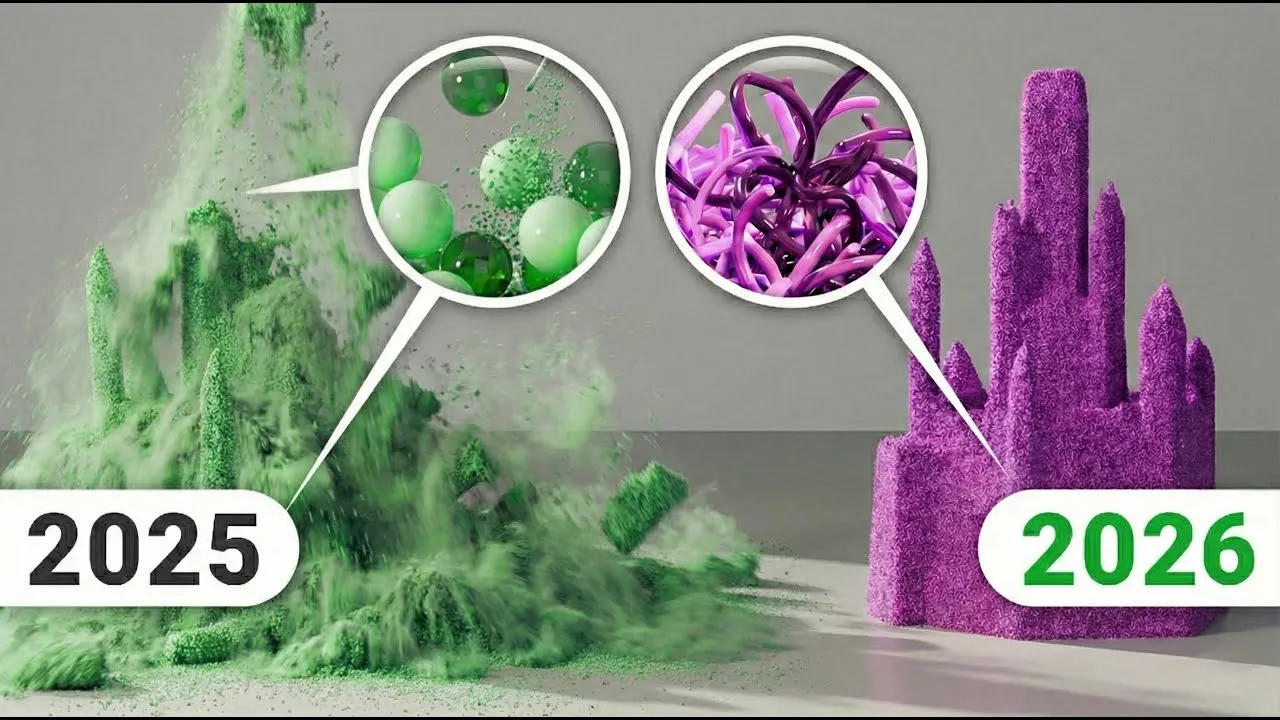
To truly test the capabilities of the simulation, the researchers pitted virtual castles made of different grain shapes against a high-speed projectile. The results were astonishing:
- Spherical Castle: Collapsed instantly upon impact, demonstrating a complete lack of cohesion.
- Dolosse Castle: Showed slightly more resilience due to interlocking, but still crumbled under the force.
- Hexapod Castle: Exhibited improved cohesion, breaking into larger chunks rather than disintegrating.
- Dodecafang Castle: This castle didn’t just survive; it absorbed the impact like a solid, elastic object, bouncing and jiggling before settling. This highlighted the material’s transformation from loose grains to a unified structure.
The visual evidence of the dodecafang castle absorbing and returning energy was particularly compelling, demonstrating a level of realism previously unachievable.
The Secret: Numerical Homogenization
The question arises: how can such complex simulations be run without requiring immense computational power, potentially melting data centers? The answer lies in a clever technique called numerical homogenization.
Instead of simulating every single grain in a massive scene, the researchers employ a two-step process:
- Microscopic Simulation: They take a small ‘box’ containing a few thousand grains of a specific shape. This box is subjected to various forces and pressures thousands of times to measure its exact resistance and behavior. This process essentially ‘teaches’ the computer the mathematical rules governing how these specific grains interact and form a cohesive unit.
- Macroscopic Simulation: The mathematical rules derived from the small box are then applied to a much larger, faster simulation. This ‘homogenized’ model treats the collection of grains as a continuous material with predictable properties, rather than simulating each individual particle. This is akin to treating the box of grains as a repeating 3D wallpaper that extends infinitely.
This method drastically reduces the computational load, allowing for the simulation of massive scenes with complex granular interactions in a fraction of the time.
The Math Behind the Magic (Simplified)
The researchers use complex mathematical tools, including integrals and tensor products, to calculate the ‘homogenized Cauchy stress tensor.’ In simpler terms, this allows them to determine the average pressure and force distribution within the material without needing to calculate the forces on every single grain. The analogy used is measuring the pressure against the walls of a room to understand the force of a mosh pit, rather than asking each person how squished they feel.
Why This Matters
This breakthrough has significant implications across various fields:
- Computer Graphics and Entertainment: Realistic simulations of sand, soil, snow, and other granular materials can enhance visual effects in movies and video games, creating more immersive and believable environments.
- Engineering and Construction: Understanding how different materials will behave under stress is crucial for designing everything from bridges and buildings to protective barriers and agricultural systems. Simulating soil mechanics, for instance, can improve construction safety and efficiency.
- Scientific Research: The ability to accurately model complex granular systems opens new avenues for research in fields like geology, materials science, and even astrophysics (for simulating asteroid collisions or planetary formation).
- Product Design: From the flow of coffee beans in a grinder to the behavior of powders in pharmaceuticals, precise simulation can optimize product design and manufacturing processes.
Limitations and Future Potential
While revolutionary, the technique has some limitations:
- Computational Cost for Learning: Learning the rules for a single new grain shape (like the hexapods) required approximately 705 hours of computation – almost a month. However, this is a one-time cost per shape.
- Material Assumption: The current method assumes grains are rigid. It cannot yet simulate materials like jelly beans or other deformable objects.
Despite these constraints, the researchers emphasize that this is a foundational step. Future work will focus on optimization and expanding the technique’s applicability. The principle of ‘numerical homogenization’ has made the previously impossible possible, paving the way for even more advanced simulations in the future.
Conclusion: A Triumph of Ingenuity
This research stands as a testament to human ingenuity, solving complex physical problems through sophisticated mathematical modeling without relying on AI. It highlights the importance of often-overlooked scientific advancements that push the boundaries of what we can simulate and understand about the physical world. The ability to accurately model billions of interacting particles, from the simple flow of sand to the robust structure of a dodecafang castle, marks a significant leap forward in computational physics and graphics.
Source: They Said It Was Impossible… This Simulation Solved It (YouTube)