AI Visualizers Launch: Claude and ChatGPT Go Interactive
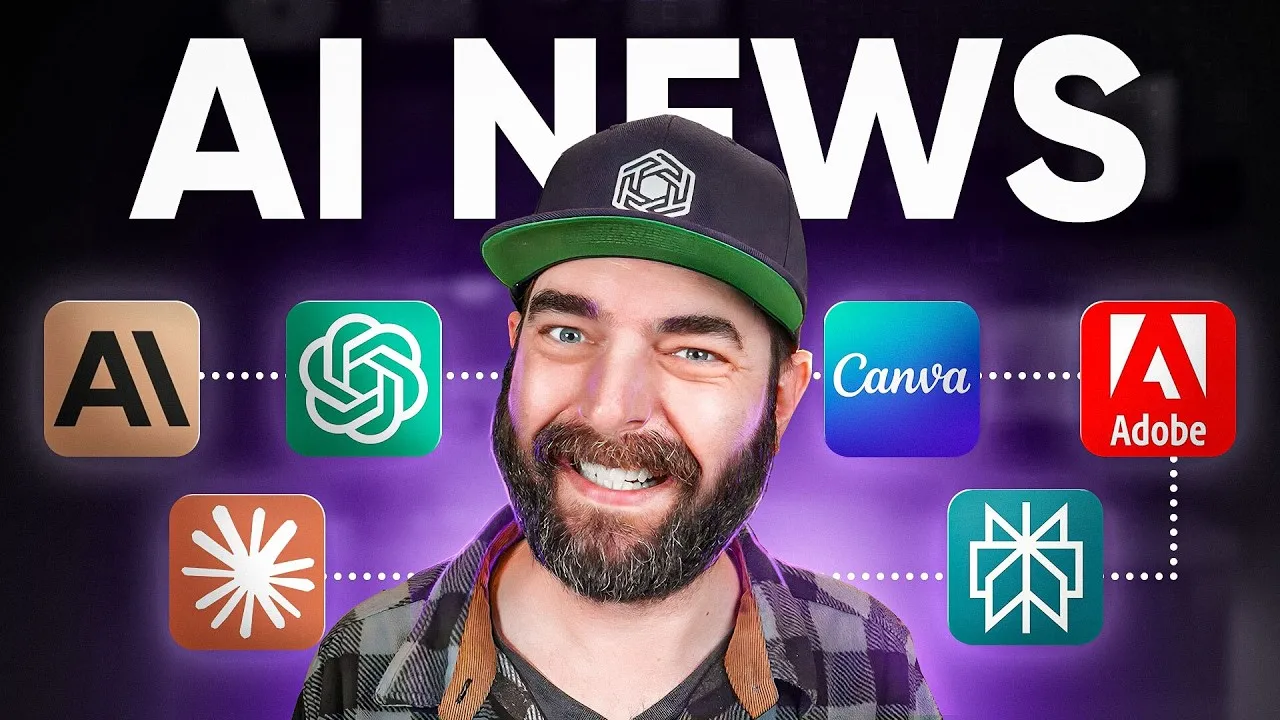
This past week in AI has been defined by a surprising wave of simultaneous innovation, with major players like Anthropic (Claude) and OpenAI (ChatGPT) rolling out strikingly similar features: interactive visualizations. These new tools aim to make complex concepts more accessible by allowing users to manipulate dynamic charts, diagrams, and simulations directly within their chat interfaces.
Claude’s Interactive Visualizations
Anthropic’s Claude has introduced a feature that enables the creation of interactive charts, diagrams, and visualizations. During a demonstration, elements like an interactive periodic table were showcased, where clicking on different elements provided detailed information. Another example illustrated how varying loads affect roof structures. The system also demonstrated its ability to visualize abstract concepts like compound interest. Users can adjust sliders for initial investment, interest rates, and time periods, with the visualization updating in real-time to show the impact on the final amount. For instance, a $10,000 initial investment at 7% interest over 20 years grows to $38,697 without additional contributions, but balloons to $6.3 million with a $1,000 monthly addition. Adjusting the time frame to 30 years or increasing the interest rate to 10% dynamically alters the projected outcome.
Claude can also generate interactive timelines, such as one depicting major AI model releases from 2018 to 2026. This feature, while taking a minute or so to generate, allows users to filter by AI category, like image or code generation, to see specific milestones. Additionally, Claude attempted to create an interactive map of top AI companies, though the accuracy and rendering of the world map were noted as imperfect. A visualization of how neural networks learn was also demonstrated, though the interactive elements appeared to malfunction in testing.
Notably, this visualization feature is available to all Claude users, including those on the free plan.
ChatGPT’s Interactive Learning
OpenAI launched a very similar feature, dubbed ‘Interactive Learning,’ just days before Claude’s announcement. This feature allows ChatGPT users to explore concepts through interactive visuals. Demos included explanations of the ideal gas law, where sliders adjust variables like volume and gas molecule count, and geometric shape manipulations. The Pythagorean theorem was also visualized, allowing users to adjust side lengths and see how it affects the equation.
When prompted to visualize compound interest, ChatGPT generated a response almost instantly, significantly faster than Claude. However, a key distinction emerged: ChatGPT’s interactive visuals are largely drawn from a pre-built library of supported concepts. While this makes generation rapid, it means users cannot dynamically create entirely new, custom simulations for every prompt. The system matches queries to a catalog of pre-existing visualizations. Supported categories include mathematical concepts like slope-intercept form, circle area, and Ohm’s law, which can be explored via interactive sliders and animations.
ChatGPT’s interactive learning feature is rolling out to all logged-in users.
Why This Matters
The simultaneous release of interactive visualization tools by both Claude and ChatGPT signifies a significant shift in how users can engage with AI. These features move beyond simple text-based responses to provide dynamic, visual learning experiences. For students, educators, researchers, and professionals, this offers a powerful new way to understand complex subjects, from financial planning and scientific principles to historical trends and technological developments. The ability to manipulate variables and see immediate results can dramatically improve comprehension and retention.
The difference in implementation – Claude’s generative approach versus ChatGPT’s library-based method – highlights different philosophies in AI development. Claude’s method, while slower, offers greater flexibility for novel visualizations, whereas ChatGPT’s approach prioritizes speed and reliability for common educational topics.
Other Notable AI Developments
Perplexity Computer Expands Autonomous Capabilities
Perplexity has significantly broadened the availability of its ‘Perplexity Computer,’ an AI agent designed to perform tasks autonomously. Previously limited to higher-tier plans, it can now understand goals, utilize various tools, and continue working after a user disconnects. The service offers a ‘personal computer’ that merges local files with Perplexity’s capabilities, running 24/7 on dedicated Mac Minis. Users can orchestrate tasks and access tools like Slack, Notion, and Gmail. Demonstrations showed the computer finding job candidates, generating slide decks from reports, and creating sophisticated data dashboards, such as a personalized financial terminal that pulls data from brokerage accounts via Plaid. While the exact level of autonomous decision-making versus sophisticated data aggregation is still being clarified by users, the tool is now accessible to users on most paid Perplexity plans.
Canva’s Magic Layers Revolutionizes Image Editing
Canva has launched ‘Magic Layers,’ a feature that can decompose images, including AI-generated ones, into individual layers. This allows users to reposition, resize, or even remove elements within an image. For example, a self-portrait with a brain on fire could be separated into the skull, brain, body, and background, enabling recomposition. This tool works on both AI-generated and real-world photographs, offering unprecedented flexibility for graphic design, thumbnail creation, and ad development. Magic Layers is available across all Canva plans.
Adobe Photoshop Integrates AI Assistant
Adobe has integrated an ‘AI Assistant’ into Photoshop for the web and mobile. This feature allows users to describe desired edits using text prompts, such as adding an explosion to a background. The assistant leverages generative AI, similar to tools like Nano Banana, to apply these changes, offering multiple options for the user to choose from.
New AI Models Emerge
Nvidia released ‘Neuron 3 Super,’ an open-weight 120 billion parameter model available for local or cloud deployment and fine-tuning. Google launched ‘Gemini Embedding 2,’ a natively multimodal embedding model capable of processing and understanding text, images, video, audio, and documents within a single embedding space, aimed at developers building sophisticated cross-modal applications.
FutureTools.io Relaunches with Enhanced Design
The AI tool aggregator FutureTools.io has undergone a redesign, offering a cleaner interface while retaining its comprehensive database of AI tools. The site also features an improved AI news page with TL;DR summaries for articles, sourced even from paywalled content through cross-referencing other reports.
Google Maps and Workspace Get AI Upgrades
Google Maps now features conversational AI capabilities, allowing users to plan road trips or find specific locations like public restrooms along a route. Google Workspace applications (Docs, Sheets, Slides) are integrating Gemini features for paid subscribers, enabling tasks like drafting essays, polishing text, filling data in spreadsheets, and creating presentations from prompts.
ChatGPT for Excel and Groq Updates
A ChatGPT integration for Excel has been released, allowing users to build and update spreadsheet models, run analyses, and generate reports using natural language prompts within a sidebar. Groq, an AI inference engine, has added audio options for reading long-form articles on iOS and enhanced media protection to prevent unauthorized editing of uploaded images.
Claude Code Enhancements
Anthropic’s Claude Code has introduced scheduled tasks for automated code reviews and dependency audits. A new agent-based code review system dispatches multiple agents to find, verify, and rank bugs in pull requests, providing consolidated feedback.
Microsoft Copilot Health
Microsoft’s Copilot Health now allows users to integrate medical data, wearable information, and health history to create a coherent health narrative.
Source: AI News: They All Launched the Same Thing! (YouTube)