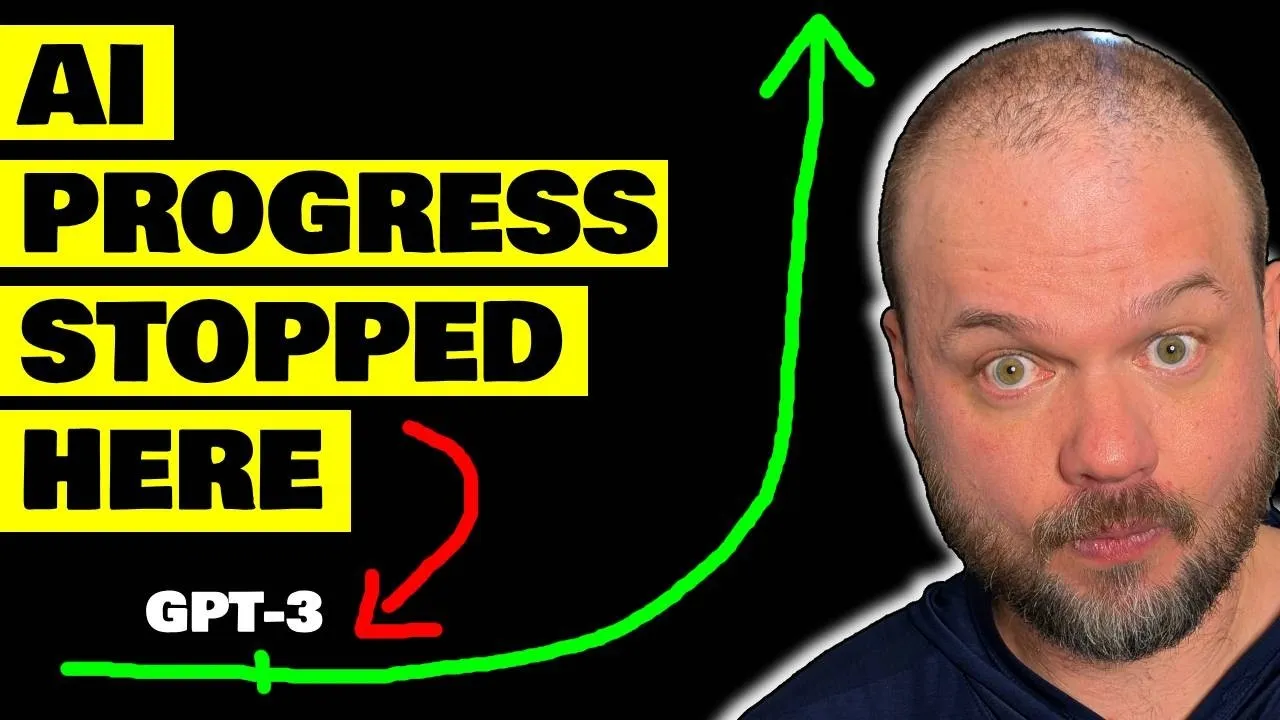
AI’s Pace of Progress Under Scrutiny Amidst Conflicting Views
The artificial intelligence landscape, characterized by rapid advancements and ambitious predictions, is now the subject of intense debate regarding the true pace and nature of its progress. A recent viral article, “Something Big Is Happening” by Matt Schumer, suggested an accelerating curve of AI capabilities, particularly in coding and complex problem-solving. However, prominent AI critic Cal Newport has challenged these assertions, arguing that progress has, in fact, slowed down, a perspective the author of this piece finds fundamentally flawed and contrary to observed developments.
Challenging the Narrative: Newport vs. Schumer
Matt Schumer’s article, aimed at a general audience, painted a picture of AI development accelerating dramatically around 2025, driven by new techniques that led to increasingly powerful models released at shorter intervals. He described a personal experience where AI could now complete complex coding tasks, such as building entire applications, in a matter of hours, with results often exceeding human capabilities. This narrative suggests a significant inflection point, where AI’s general intelligence is rapidly expanding.
Cal Newport, a respected voice in technology and productivity, countered this by suggesting that the period of truly impressive, exponential leaps occurred earlier, specifically with the advancements from GPT-2 to GPT-3 and GPT-3.5 to GPT-4. According to Newport, the period around 2025 marked a slowdown in general capability improvements, forcing AI companies to shift focus to optimizing specific tasks and excelling in narrow benchmarks, rather than achieving broad breakthroughs. He posits that the perceived acceleration is an illusion, potentially driven by a focus on inference-time compute and specialized post-training rather than fundamental progress.
Decoding AI Progress: Benchmarks and Capabilities
The core of the disagreement lies in how AI progress is measured and interpreted. The author of this piece highlights that the period Newport describes as a slowdown, the era of models like GPT-4, Claude Opus, and Gemini, has actually been marked by stunning progress for many users and observers. This includes AI models achieving gold medals in the International Mathematical Olympiad and autonomously solving complex mathematical problems previously considered decades away from AI solutions.
Newport’s analysis, as presented, seems to interpret a shift from pre-training scaling to techniques like chain-of-thought prompting and extended inference time as a sign of stagnation. However, the author argues this is akin to mistaking the invention of jet engines for a slowdown in aviation because propeller speeds stopped increasing. These new techniques, far from being mere tricks, have unlocked significant new capabilities.
Furthermore, the article disputes Newport’s characterization of coding as a “narrow” application. With software underpinning a significant portion of the global economy, advancements in AI’s ability to write, test, and debug code have profound economic implications. The author provides a personal case study of building a functional website entirely through AI agents, requiring zero lines of code written by themselves, a testament to the practical, real-world capabilities of current AI models.
The “Innovator’s Dilemma” and Expert Bias
A key argument against Newport’s perspective is the historical tendency for experts to underestimate disruptive technologies. Drawing on Clayton Christensen’s “The Innovator’s Dilemma,” the article points out that judging the potential of new technologies by how established experts use them is a common mistake. Professional photographers initially dismissed early digital cameras, and executives doubted the utility of personal computers. Similarly, early reactions to YouTube and Wikipedia often focused on perceived flaws rather than their disruptive potential for broader audiences.
The author argues that Schumer’s description of AI capabilities, while perhaps sounding extraordinary, aligns with the experiences of many users who are not comparing AI to the absolute best human-created alternatives but to having no solution at all. For instance, the ability for an individual to create a complex website or functional application through natural language prompts, even if not perfectly polished, is a monumental improvement over having no such capability or requiring extensive technical expertise and resources.
Why This Matters: The Real-World Impact of AI Acceleration
The debate over AI’s progress is not merely academic; it has significant real-world implications. If AI capabilities are indeed accelerating at an unprecedented rate, as suggested by Schumer and observed by many users, then society needs to prepare for transformative changes across industries. This includes the potential for widespread job displacement, the creation of entirely new economic sectors, and fundamental shifts in how we work, learn, and interact.
Conversely, if AI progress has indeed plateaued in terms of general intelligence, as Newport’s view implies, then the immediate societal disruption might be less dramatic, allowing more time for adaptation. However, even incremental improvements in specialized areas, like coding or scientific discovery, can have substantial impacts.
The author’s personal experience building a website and various AI-powered demos using models like Anthropic’s Opus 4.6 and Google’s Gemini models underscores the tangible benefits available today. These tools, while perhaps not yet capable of autonomously building enterprise-level, mission-critical software without human oversight in all cases, are demonstrably empowering individuals and small teams to achieve complex technical feats previously out of reach. The ability to iterate rapidly, delegate tasks to AI agents, and leverage advanced models for creative and technical work marks a significant step forward, regardless of whether one frames it as a continuation of an earlier trend or the beginning of a new, accelerated phase.
Ultimately, the differing interpretations highlight the challenge of accurately assessing AI’s trajectory. While benchmarks and expert opinions offer valuable insights, the lived experiences of users and the broader economic impact may provide a more comprehensive, albeit sometimes less clear-cut, picture of AI’s evolving capabilities and its transformative potential.
Source: Cal Newport AI takes are WILD… (YouTube)