Anthropic Revolutionizes AI Agents with Advanced Tool Calling
Anthropic has unveiled a suite of significant updates to its tool-calling capabilities, a development poised to dramatically enhance the performance and efficiency of AI agents, particularly those designed for complex, long-running tasks. These advancements move beyond the traditional, often cumbersome, method of AI function invocation, introducing more sophisticated and deterministic ways for AI models to interact with the real world.
Understanding Tool Calling: The Foundation of AI Agents
Tool calling, or function calling, is a cornerstone technology for building AI agents. It allows large language models (LLMs) to transition from simply generating text to producing structured data, typically in JSON format, which can then be used to trigger external APIs or functions. This capability transforms LLMs into active agents that can perform actions beyond their inherent text-generation abilities.
Traditionally, the process involved defining a set of tools with their descriptions and required parameters. When a user posed a query, the LLM would receive the user’s request alongside these tool definitions and decide which tool to call, generating the necessary parameters. A backend system would then execute the function, return the result, and this result would be fed back to the LLM along with the conversation history for a final, synthesized response. While this process appears seamless to the end-user, it involves multiple back-and-forth exchanges between the LLM and the execution environment.
Limitations of Traditional Tool Calling
The primary limitation of the traditional approach has been its efficiency, especially for intricate tasks requiring multiple tool invocations in sequence. Relying solely on the LLM to generate parameters for each step can lead to non-deterministic behavior and significant waste of tokens within the model’s context window. For instance, an agent tasked with finding emails from a specific sender might first search for emails, receive a list of IDs, and then need to call a separate function for each ID to retrieve the email content. This repeated generation of parameters and the inclusion of unnecessary data from tool responses can rapidly consume the context window, even in models with very large context lengths, as the *effective* context window is often smaller than the theoretical maximum.
Anthropic’s Breakthroughs: A New Era for AI Agents
Anthropic’s latest updates address these limitations head-on, introducing several key innovations:
1. Programmatic Tool Calling
Perhaps the most impactful advancement is programmatic tool calling. Inspired by concepts like executable code actions, this feature allows the LLM to output a piece of code that can invoke multiple functions and manage data flow between them. Instead of the LLM acting as a simple intermediary for each tool call, it can now generate code to orchestrate complex workflows, utilize loops, conditionals, and pass results between functions deterministically and efficiently. This approach mirrors findings that LLMs are often more adept at generating code than structured JSON for tool invocation.
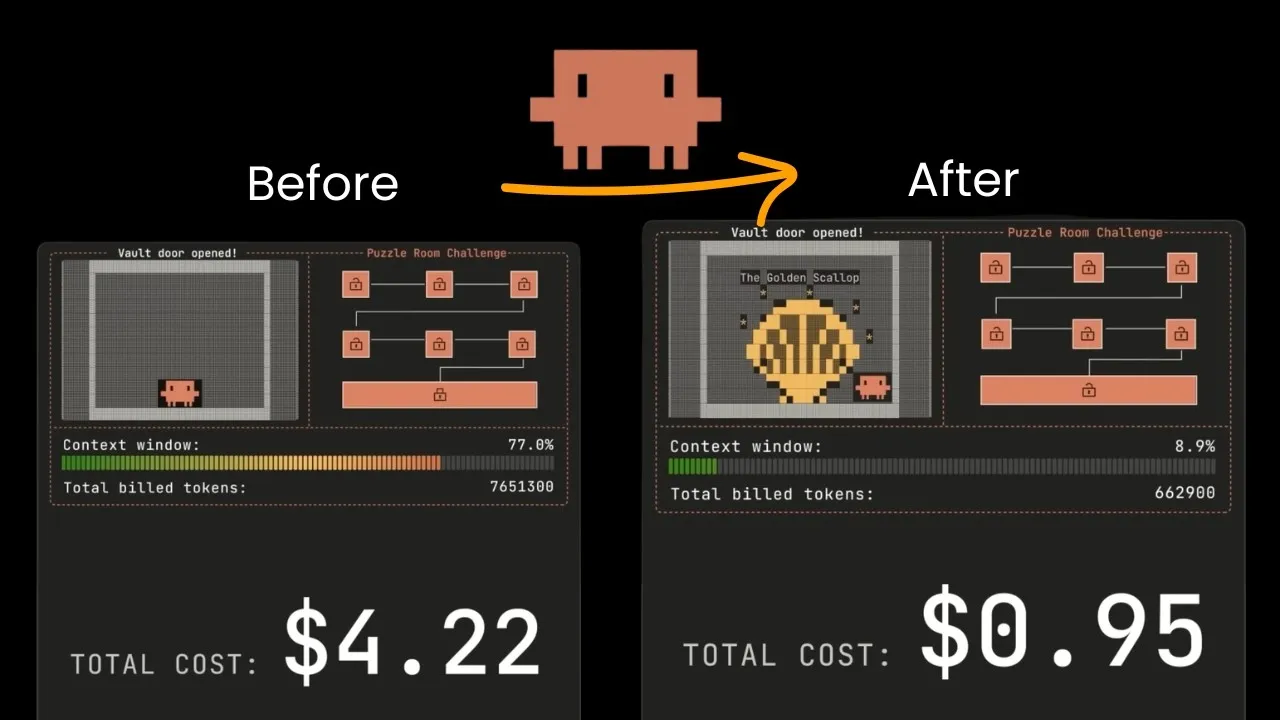
How it Works: To enable programmatic tool calling, developers integrate a `code_execution` tool, acting as a sandbox, into the agent’s environment. Tools made available to the LLM can be configured with an `allowed_caller` parameter pointing to this `code_execution` tool. When the LLM receives a complex request, it can now output code that calls multiple functions. The agent runtime then executes this code, performing the necessary API calls. Results are fed back to the LLM, which can then synthesize a final response. This significantly reduces the number of LLM round trips, potentially cutting token consumption by 30-50% and speeding up agent execution. This is particularly beneficial for tasks involving large dataset aggregation or sequences of deterministic operations.
2. Dynamic Filtering for Web Fetch
Web scraping often involves retrieving large HTML documents, much of which is irrelevant to the agent’s task. Anthropic’s dynamic filtering for the `web_fetch` tool addresses this by introducing a filtering layer. Instead of returning the entire HTML, it processes the content to extract only the relevant information before it enters the LLM’s context window. Anthropic’s testing indicates this can reduce token consumption by an average of 24%. Activation is straightforward, requiring the use of a specific version of the `web_fetch` tool.
3. Tool Search
As agents gain access to more tools and APIs (often grouped into MCPs or Multiple API Collections), managing and loading all their definitions into the LLM’s context becomes inefficient. Anthropic’s `tool_search` concept offers a solution. Instead of loading hundreds of tool schemas, agents can use a single `tool_search` tool to dynamically retrieve only the relevant tools for a given query. This can lead to context window optimizations of up to 80%. Tools can be marked for ‘deferred loading,’ meaning they are only fetched when explicitly needed via the `tool_search` tool, significantly reducing the initial token overhead.
4. Tool Use Examples
For complex tools with numerous parameters or intricate logic, LLMs can struggle to understand how to use them correctly. Anthropic has introduced `input_examples` within tool definitions. By providing array-based examples of how a tool should be called, including expected parameter formats and interdependencies, agents can achieve higher accuracy. Anthropic’s experiments show that using tool examples can improve accuracy from 72% to 90% in handling complex parameter scenarios.
Why This Matters
These advancements from Anthropic represent a significant leap forward in AI agent development. Programmatic tool calling, in particular, moves agents closer to true autonomous operation by enabling them to manage complex, multi-step processes with greater reliability and efficiency. Dynamic filtering and tool search directly combat the token-efficiency challenges that have plagued LLM development, making agents more cost-effective and performant. Tool use examples further refine the interaction between LLMs and external tools, ensuring more accurate and robust execution of tasks.
The implications are far-reaching: more capable customer service bots, sophisticated data analysis agents, streamlined automation tools, and more. By making AI agents smarter, faster, and more resource-efficient, Anthropic is paving the way for a new generation of AI applications that can tackle increasingly complex real-world problems.
For developers interested in leveraging these capabilities, Anthropic provides detailed tutorials and examples, often shared through communities like AI Builder Club, alongside regular workshops featuring industry experts.
Source: Anthropic killed Tool calling (YouTube)