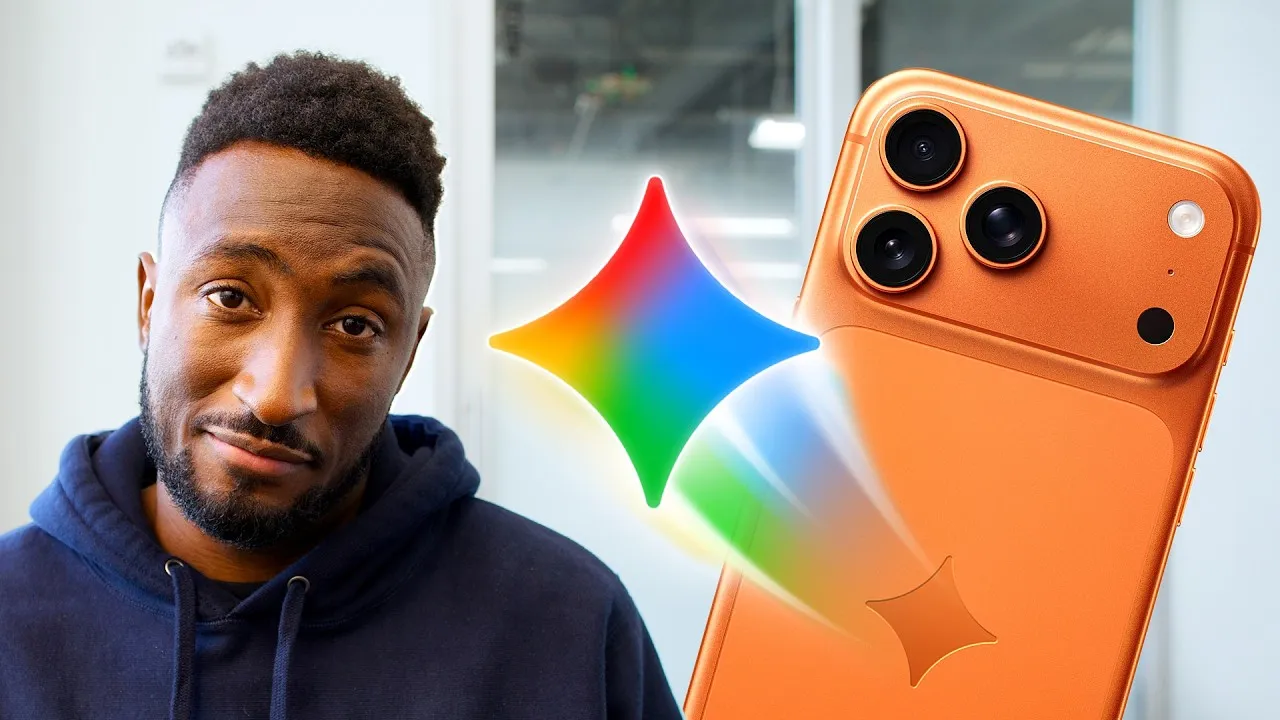
Apple Partners with Google for Major Siri AI Upgrade
In a surprising move that confirms long-standing rumors, Apple is set to significantly revamp its virtual assistant, Siri, by integrating Google’s advanced AI models. The much-anticipated update, expected to roll out in 2026, aims to address Siri’s persistent shortcomings and bring it closer to the capabilities offered by competitors.
A Necessary Leap for Siri
For years, users and critics have pointed to Siri as a weak link in Apple’s otherwise robust ecosystem. Despite repeated promises and updates, Siri has struggled to keep pace with the rapid advancements in artificial intelligence, often failing to understand complex queries or perform multi-step tasks. This perceived AI deficit has led to discussions about an ‘Apple AI crisis’ and has put pressure on the tech giant to innovate.
Apple’s official statement confirmed the partnership: “After careful evaluation, we’ve determined that Google’s technology provides the most capable foundation for Apple foundation models, and we’re excited about the innovative new experiences it will unlock for our users.” While the statement is characteristically measured, the underlying news is significant for a company of Apple’s stature, often assumed to be at the forefront of technological innovation.
The Google Connection: A Familiar Partnership
This isn’t the first time Apple and Google have collaborated. Notably, Google has paid Apple billions of dollars over the years to maintain its position as the default search engine in Apple’s Safari browser. This new deal, however, appears to involve Apple paying Google for access to its AI foundation models. The logic mirrors the search engine deal: Apple wants to provide its users with the best available AI experience, and rather than perfecting its own models from scratch, it has opted to build upon Google’s established technology.
Implications for Existing Partnerships and Features
The integration of Google’s models raises questions about Apple’s existing AI partnerships, particularly with OpenAI. Previously, complex Siri requests that exceeded its capabilities were routed to ChatGPT. With Google’s models powering a more robust Siri, it’s unclear if this reliance on OpenAI will continue. The new Siri is expected to leverage Google’s foundation models to understand user requests more deeply and handle more complex tasks internally.
Apple’s commitment to privacy remains a key consideration. While using Google’s models, the company emphasizes that data processing is designed to maintain user privacy, with many operations potentially handled on-device rather than sending extensive data to external servers. This approach aims to offer the enhanced capabilities of advanced AI without compromising Apple’s stringent privacy standards.
Potential New Features: Circle to Search and Beyond
A significant potential benefit of this partnership could be the introduction of features akin to Google’s popular ‘Circle to Search’ functionality. Currently, Apple offers a limited version of this on iPhones with its ‘Apple Intelligence’ features, allowing users to highlight a portion of a screenshot for a contextual search. The integration with Google’s AI could potentially bring the full power of ‘Circle to Search’ to the iPhone, enabling users to circle any content on their screen – text, images, or objects – to initiate an instant search or gather more information.
This move underscores a broader strategic shift in the AI landscape. The article posits that controlling the user interface and the overall user experience might be more critical than owning the underlying AI models. Tools like Raycast, a Spotlight search replacement for Mac, demonstrate this by allowing users to choose from various AI models (like ChatGPT, Gemini, or Grok) through a single, user-friendly interface. In this model, Raycast retains the user by providing a seamless experience, regardless of the AI model powering it.
Why This Matters
For Apple, this partnership is a strategic move to retain users and prevent them from switching to competing platforms like Android, which have increasingly showcased advanced AI features. By integrating Google’s powerful AI models, Apple aims to ensure that its ecosystem remains competitive and desirable, particularly for users who might consider AI capabilities a deciding factor in their next device purchase. The success of this integration could mean a significantly improved Siri that feels more intelligent, helpful, and integrated into the Apple experience, potentially revitalizing a key aspect of the iPhone and other Apple devices.
Looking Ahead
The full impact of this collaboration will likely become clearer at Apple’s Worldwide Developers Conference (WWDC) in June 2026, where the revamped Siri is expected to be formally unveiled. The tech world will be watching closely to see how effectively Apple integrates Google’s AI prowess into its ecosystem and whether this partnership signals a new era of collaboration in the fast-evolving AI race.
Source: The New Siri is… Google (Explained) (YouTube)