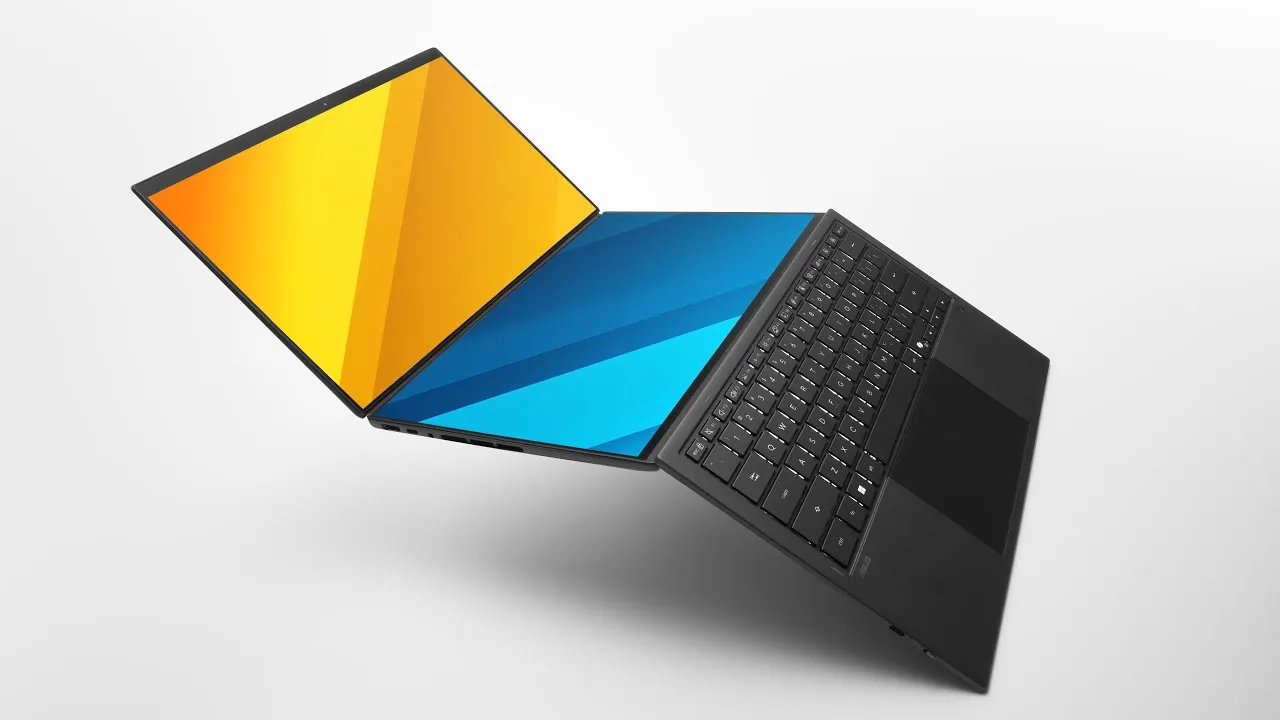
Asus’ 2026 Laptop Lineup Redefines Innovation with Dual Screens and Next-Gen Chips
Asus is making a bold statement with its 2026 laptop lineup, showcasing a significant leap in hardware engineering and design. Headlining the refresh is the much-anticipated Asus ZenBook Duo, a dual-screen powerhouse that finally lives up to its full potential, thanks to the integration of Intel’s latest Core Ultra Series 3 chip. This isn’t just an incremental update; it’s a complete redesign built from the ground up to leverage the new silicon, promising a transformative user experience for multitaskers and creatives alike.
ZenBook Duo: A Dual-Screen Masterpiece
The most striking visual change on the new ZenBook Duo is the adoption of Asus’s proprietary ‘CeramiHeat’ material across the entire chassis – top panel, keyboard deck, and bottom. This unique, stone-like matte texture is not only aesthetically pleasing but exceptionally durable, resisting scratches and wear even with rigorous use. Having personally tested a previous version for over a year under demanding conditions, the resilience of this material is a game-changer for laptop longevity.
Complementing the new material is a completely redesigned hinge. Inspired by the aesthetics of foldable phones, this new hinge technology elegantly reveals and conceals itself as the laptop opens and closes. Beyond its slick appearance, the primary benefit of this advanced hinge is a significantly reduced gap between the two displays when open. While it’s important to note these are two distinct 14-inch OLED panels rather than a single foldable display, the reduction in the physical break is substantial.
Both 14-inch OLED displays boast a crisp resolution, a fluid 144Hz refresh rate with variable refresh rate support, making them incredibly responsive for both productivity and entertainment. Asus has optimized the dual-screen experience, allowing for versatile configurations. The vertical stacking is ideal for focused work, while the side-by-side layout excels at multitasking. The integrated kickstand further enhances usability in both orientations, making the ZenBook Duo a remarkably adaptable tool.
The physical separation between the screens means the ZenBook Duo isn’t designed for spanning a single image across both. Instead, it shines as a platform for simultaneously running multiple applications or managing numerous windows within a single application, effectively doubling your usable screen real estate within a standard laptop footprint. This is a workflow enhancement that, as the reviewer puts it, “most workflows in this world would just benefit from more screen. How could it not?”
The detachable Bluetooth keyboard has also seen improvements. While still comfortable and responsive, the integration is now seamless. Magnetic pogo pins on the chassis pop up to connect with the keyboard, facilitating both charging and data transfer. This thoughtful engineering makes switching between different screen modes feel intentional and polished, a significant upgrade from previous iterations where the keyboard integration felt like an afterthought.
Under the hood, the Intel Core Ultra Series 3 chip is the star. While benchmark numbers are embargoed, early impressions suggest a powerful and energy-efficient processor with a capable integrated GPU, perfectly suited for the demands of a dual-screen device. Coupled with a 99Wh battery, split into two for better weight distribution, Asus is promising significantly improved battery life compared to its predecessors. The laptop also features 45W total TDP, pen support for the displays, and impressive speakers, all packed into a surprisingly normal-looking form factor.
ZenBook S Series and ZenBook A Series: Chip Refreshes and ARM Power
The new Intel Core Ultra Series 3 chip also finds its way into the updated ZenBook S16 and S14 models. These represent a straightforward refresh, offering upgraded CPU and GPU performance, improved energy efficiency, and subtle design tweaks, including the CeramiHeat material on the top panel. The rest of the chassis on these models remains aluminum.
Shifting gears to ARM architecture, Asus is introducing the ZenBook A14 and A16, powered by the Qualcomm Snapdragon X2 Elite chip. Building on the promise of last year’s models, these new devices aim to overcome the limitations of the first-generation chip and software ecosystem. Qualcomm claims substantial gains in CPU and GPU performance while demanding less power, potentially leading to exceptional battery life.
Early testing indicates these performance claims are legitimate, showing significant bumps in both CPU and GPU capabilities. The real test, however, will be with more mature drivers and software optimization. Asus is touting an incredible 35 hours of video playback for these models, a figure that, if accurate, would be revolutionary. Early indications suggest these are indeed multi-day battery devices.
The ZenBook A16 features the more powerful Snapdragon X2 Elite Extreme chip, running at higher clock speeds and boasting a faster memory bus, complemented by a more robust cooling system in its larger chassis. For the ZenBook A14, it utilizes the standard Snapdragon X2 Elite.
Software compatibility for ARM-based Windows machines has improved considerably, notably with Microsoft’s Prism emulator now supporting AVX and AVX2 instructions. This means most Windows games should run, though edge cases and specific applications, like those with kernel-level anti-cheat systems (e.g., Vanguard for Valorant), may still present issues. However, the hardware advancements are expected to drive further software support and emulation improvements.
Both the A14 and A16 feature a versatile port selection: two USB-C ports and one USB-A. The A16 includes a full-size SD card reader, while the A14 omits it. Both models sport stunning 120Hz OLED displays, making them excellent for work, content consumption, and gaming. Weight is a key highlight: the A14 tips the scales at an astonishing 990g, while the A16 is a still-impressive 1.2kg. Both devices utilize the durable CeramiHeat material across their entirety and feature a refined hinge that allows for one-handed opening – a testament to Asus’s engineering prowess, especially on such lightweight chassis.
ProArt PX13: A GoPro Collaboration for Creators
Rounding out the lineup is the ProArt PX13, a unique collaboration with GoPro. This 13-inch laptop runs on AMD’s Ryzen AI HX 300 series processor with an integrated Radeon 700M series GPU, a chip built for performance, particularly in video editing. The design language is heavily influenced by GoPro, featuring custom packaging and a dedicated GoPro button for quick access to the GoPro software suite. It also includes the Asus Dial for creative workflows. This niche product is tailored for users deeply embedded in the GoPro ecosystem, offering a color-accurate OLED panel and specialized tools for content creators.
Asus’s 2026 laptop lineup signals a strong commitment to innovation, pushing the boundaries of dual-screen technology, ARM performance, and creative tool integration. With compelling hardware and thoughtful engineering, these new ZenBooks are poised to make a significant impact on the market.
Source: Double Screen Laptops are FINALLY Good (YouTube)