Brazil’s PC Market: Navigating High Tariffs and Local Solutions
In a world increasingly dominated by globalized tech supply chains, Brazil presents a fascinating case study in how extreme import tariffs can shape a domestic market. For decades, Brazil has grappled with significant import taxes on electronics, forcing consumers and builders to get creative. This article delves into the unique landscape of the Brazilian PC market, exploring how local brands and unconventional sourcing methods create builds that are distinctly different from what you’d find elsewhere.
The “All Brazil PC” Challenge
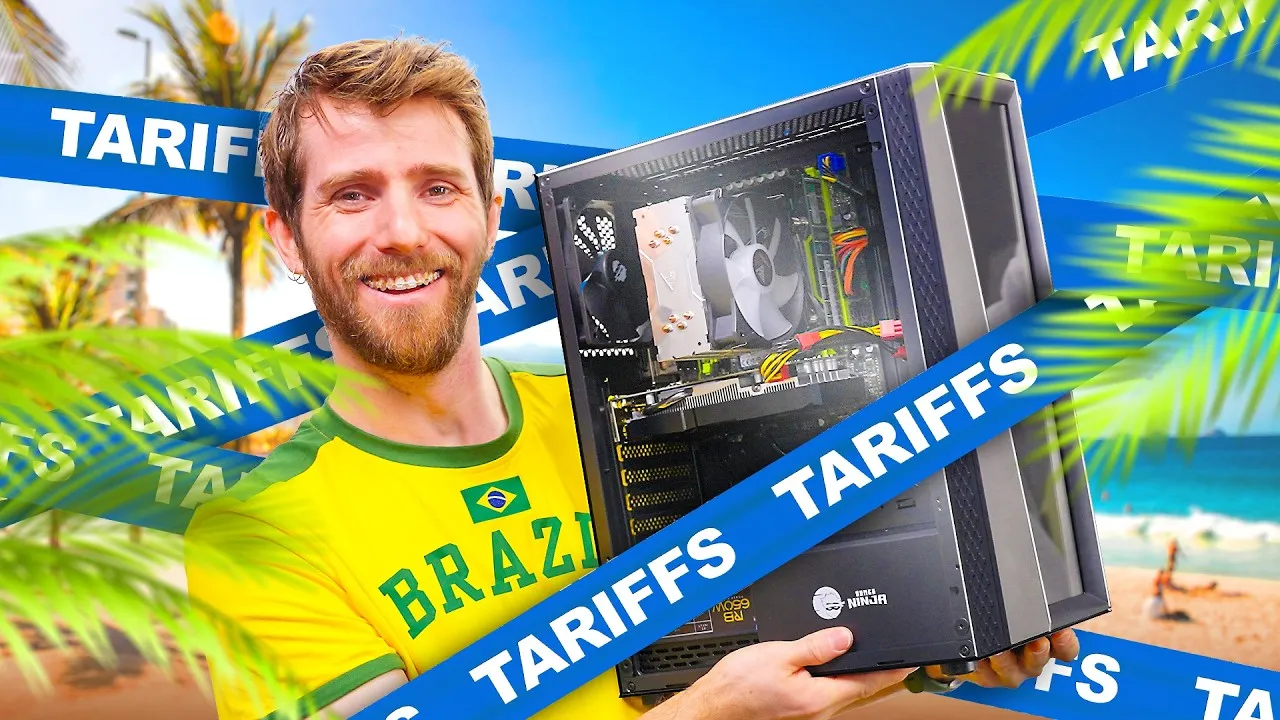
To understand these challenges firsthand, we procured components to build two distinct PCs within Brazil. The goal was to see what’s possible when faced with a government that aims to take a substantial cut (up to 93%) on imported electronics. This led us to explore brands like Superframe, whose strategy involves importing components in bulk, performing final assembly locally, and leveraging tax exemptions. This approach allows for more competitive pricing, though it typically means focusing on mid-range to lower-end components rather than the absolute highest-end parts.
Building the “Sauce”: Ricardo’s Gaming PC
Ricardo’s build, described as having “more sauce” or “mo,” represents a more enthusiast-oriented, albeit still budget-conscious, Brazilian PC. Key components include:
- Motherboard: Superframe B450M (a white-labeled ASRock board)
- CPU: Ryzen CPU with 3D V-Cache (exclusive to Latin America, offering affordability without easy price comparison elsewhere)
- RAM: DDR4 3200MHz
- Storage: Kingston NV2 NVMe SSD
- Case: Superframe ATX Mid-Tower (glass side panel, equivalent to ~$85 USD)
- CPU Cooler: 360mm RGB AIO (equivalent to ~$55 USD)
- Graphics Card: NVIDIA RTX 3060 8GB
- Power Supply: Dux Pulse 800W (tested by labs, deemed reliable)
- Monitor: 1440p 180Hz IPS panel (~$130 USD)
This build highlights the use of locally branded components that leverage international manufacturing, like Superframe. The choice of a Ryzen CPU with 3D V-Cache is a strategic move to balance performance and affordability while navigating pricing complexities in the Latin American market. Even the graphics card, an RTX 3060, is a competent choice for gaming, though its 8GB of VRAM and PCIe lane configuration are noted considerations for future-proofing and compatibility with older motherboards.
The Ultra-Budget Build: Mac’s “Gamer Ninja Eraser”
In stark contrast, the second build focuses on extreme cost-saving, embodying the spirit of making do with less. This system, dubbed the “Gamer Ninja Eraser,” came in at a fraction of the cost of Ricardo’s setup, largely due to unconventional sourcing and older components:
- Motherboard: Harvested chipset from retired server motherboards, modified via BIOS (sourced from AliExpress for ~$56 with CPU and RAM)
- CPU: 12-core Xeon (part of the ~$56 AliExpress bundle)
- RAM: 16GB DDR4 ECC Server Memory (part of the ~$56 AliExpress bundle)
- Storage: Kingston NV2 NVMe SSD
- Case: Gamer Ninja Eraser (~$29.7 USD, notable for its LED switch and included doodle board)
- CPU Cooler: Gambia Borious heatsink (cheaper than Ricardo’s AIO)
- Graphics Card: AMD Radeon RX 580 8GB (a 2017 card, popular due to crypto mining)
- Power Supply: BRX 650W (tested by labs, found to be unreliable, capping at ~400W)
- Monitor: 75Hz, HDMI/VGA only (significantly more basic than Ricardo’s)
The sourcing of the motherboard, CPU, and RAM from AliExpress for a mere $56 is a testament to the lengths Brazilians must go to. However, this also comes with risks, such as the unreliability of the BRX power supply, which failed to meet its rated wattage in testing. The choice of an RX 580, while dated, is a practical one for popular esports titles in Brazil, especially the 8GB version, which was widely available due to its popularity with crypto miners.
Navigating the Tax Maze and Sourcing Strategies
The impact of Brazil’s tariffs is profound. The 93% tax on AliExpress orders over $50 forces consumers into a variety of workarounds:
- Ordering parts piecemeal to stay under the threshold.
- Having friends or family traveling abroad bring components back in their luggage.
- Purchasing from local retailers who have already absorbed some of the import costs, albeit at a higher price point.
The prevalence of Buy Now, Pay Later (BNPL) schemes is also a significant factor, with installment plans being a standard way of purchasing goods, even everyday items like lunch. This financial flexibility is crucial for making larger purchases more manageable.
Performance and Verdict
In gaming benchmarks, Ricardo’s build significantly outperformed the budget system, delivering 2-4 times the performance in many scenarios. However, it also cost roughly three times as much. For its intended purpose, the budget build was still considered playable for esports titles, demonstrating that even with severe constraints, a functional PC experience is achievable.
The article concludes by acknowledging the ingenuity and resilience of Brazilian consumers and builders. While the components and strategies employed are unlikely to be recommended for North American markets at present, the situation serves as a stark reminder of how policy can shape technology access and innovation. The “All Brazil PC” is not just about building a computer; it’s about adapting and thriving within a unique economic and regulatory environment.
Specs & Key Features
Ricardo’s “Sauce” Build
- Motherboard: Superframe B450M
- CPU: Ryzen with 3D V-Cache
- RAM: DDR4 3200MHz
- Storage: Kingston NV2 NVMe SSD
- Case: Superframe ATX Mid-Tower
- CPU Cooler: 360mm RGB AIO
- GPU: NVIDIA RTX 3060 8GB
- PSU: Dux Pulse 800W
- Monitor: 1440p 180Hz IPS
Mac’s “Gamer Ninja Eraser” Build
- Motherboard/CPU/RAM Bundle: AliExpress Server Board + Xeon + 16GB DDR4 ECC
- Case: Gamer Ninja Eraser
- CPU Cooler: Gambia Borious heatsink
- GPU: AMD Radeon RX 580 8GB
- PSU: BRX 650W (underperforming)
- Monitor: 75Hz (HDMI/VGA)
Source: The All Brazil PC (YouTube)