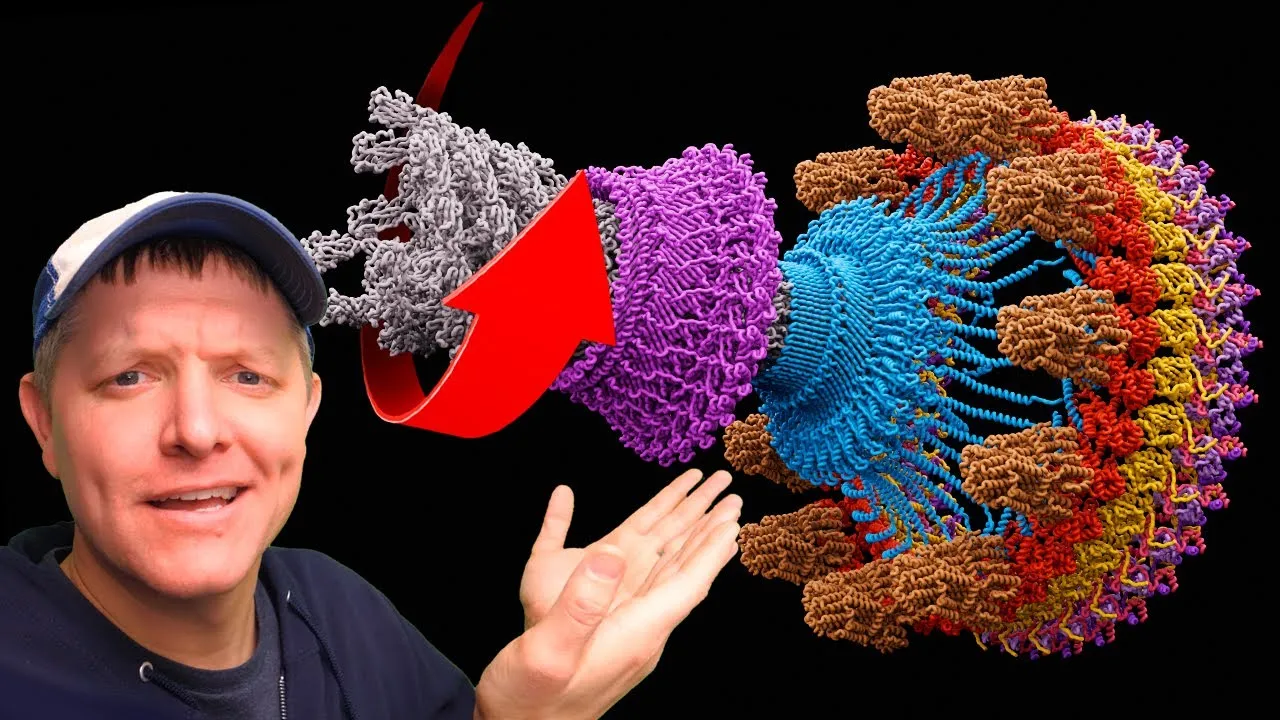
Unveiling the Secrets of the Bacterial Flagellar Motor
In this article, we delve into the fascinating world of the bacterial flagellar motor, a microscopic marvel that powers single-celled organisms. You’ll learn how this intricate molecular machine works, how scientists visualize its complex structure, and the incredible process of recreating it in a lab setting. We’ll break down the steps involved in understanding and even modeling this biological powerhouse.
Understanding the Flagellar Motor’s Function
The flagellum, often described as a whip-like appendage on bacteria and sperm cells, is crucial for locomotion. However, the true marvel lies beneath this ‘whip’ – the flagellar motor. This motor is responsible for rotating the flagellum, enabling the organism to move. It operates using a proton gradient, where a higher concentration of hydrogen ions (protons) on the outside of the bacterial cell drives the motor’s rotation, much like water turning a turbine in a dam.
The Proton Gradient: Nature’s Power Source
Imagine a dam filled with water. The potential energy stored in the water’s height can be harnessed to do work. Similarly, bacteria maintain a difference in proton concentration across their membranes. This electrochemical gradient provides the energy needed for the flagellar motor to spin. Protons flow from an area of high concentration to an area of low concentration through specific protein channels within the motor, converting potential energy into kinetic energy.
Sensing and Direction: The Bacteria’s Navigation System
Bacteria aren’t just mindless machines; they possess a sophisticated system for navigating their environment. Sensors on the bacterial surface detect chemical signals. When a signal indicates a need to move (e.g., towards a food source or away from a toxin), a cascade of internal signals is triggered. A key protein, often referred to as CheY, binds to the motor, signaling it to rotate in a clockwise direction. Without this signal, the motor defaults to counter-clockwise rotation.
Movement Strategies: Straight Lines and Tumbling
The direction of rotation dictates the bacterium’s movement:
- Counter-clockwise Rotation: When the motor spins counter-clockwise, multiple flagella bundle together, acting like a single, powerful propeller. This coordinated action allows the bacterium to swim in a straight line.
- Clockwise Rotation: When the motor switches to clockwise rotation, the flagellar bundle disperses. This causes the bacterium to ‘tumble,’ essentially pausing its forward motion and reorienting itself.
This alternating pattern of straight runs and tumbles results in a ‘biased random walk,’ allowing bacteria to efficiently explore their surroundings and find favorable conditions. This complex behavior, known as chemotaxis, happens in milliseconds.
Visualizing the Molecular Machine: Cryo-Electron Microscopy
Understanding the intricate structure of the flagellar motor, down to the level of individual amino acids, requires advanced imaging techniques. Researchers utilize cryo-electron microscopy (cryo-EM) to achieve this high resolution.
The Cryo-EM Process: A Step-by-Step Breakdown
- Sample Preparation: The bacterial motor proteins are first isolated and purified. This purified sample is then applied to a small copper grid.
- Plunge Freezing: The grid with the sample is rapidly frozen in liquid ethane. This process, called vitrification, traps the proteins in a thin layer of non-crystalline (vitreous) ice, preserving their native structure without the formation of damaging ice crystals.
- Screening: The frozen sample is loaded into a screening microscope (e.g., a Glacius). This allows researchers to quickly assess the quality of the ice and the distribution of the protein particles.
- High-Resolution Imaging: Promising samples are then transferred to a high-resolution cryo-electron microscope (e.g., a 200-300 kVA microscope). Here, an electron beam is transmitted through the sample.
- Image Acquisition: Because molecules at this scale are constantly in motion, multiple images (often 50 or more) are taken of each individual motor from slightly different angles. This is done to capture enough data to reconstruct a stable 3D model.
Reconstructing the 3D Model: From Images to Structure
The raw images obtained from cryo-EM are essentially 2D projections of the 3D molecule. The process of reconstructing a detailed 3D model involves several computational steps:
Step 1: Particle Picking
Using specialized software, researchers identify and ‘pick’ individual motor particles from the thousands of images. This is a manual or semi-automated process where clear images of the motor are selected.
Step 2: 2D Classification
The selected particles are then grouped into classes based on their visual similarity. This step helps to sort out good particles from noise or debris and identifies different views (e.g., top, side) of the motor.
Step 3: 3D Reconstruction
The different 2D class averages are then computationally combined to generate an initial 3D model of the motor. This model represents the overall shape and arrangement of the protein complex.
Step 4: High-Resolution Refinement
The initial 3D model is further refined using more detailed data to achieve a higher resolution, often down to the level of individual amino acids. This process involves removing ‘bad’ data and enhancing the clarity of the structure.
Step 5: Atomic Model Building
Once a high-resolution electron density map is obtained, researchers build an atomic model. They use their knowledge of protein structures (like alpha-helices and coils) and the known amino acid sequences to fit the individual amino acids into the density map, essentially solving a biochemical puzzle.
Expert Note: The ability to visualize and model these molecular machines has profound implications. It allows scientists to understand how these motors function, how they evolved, and potentially how to interfere with their function, which could lead to new strategies for combating bacterial infections.
Recreating the Motor: Transformation, Expression, and Purification
To study the flagellar motor in detail, researchers often need to produce large quantities of it. This is achieved by using other bacteria as ‘factories’.
- Transformation: The genetic instructions (DNA) for building the flagellar motor are extracted from the bacteria that naturally possess it (like Salmonella). This DNA is then introduced into a different type of bacterium, such as E. coli, which has been engineered to be a host for producing proteins. This process is called transformation.
- Expression: Once inside the E. coli cell, the introduced DNA instructs the cell’s machinery to start producing the components of the flagellar motor. This production process is known as expression.
- Purification: After the E. coli cells have produced a significant amount of the motor components, the cells are broken open, and the flagellar motor proteins are isolated and purified from the cellular mixture. This purified protein complex is then ready for cryo-EM imaging and analysis.
The Bigger Picture: Implications and Philosophical Questions
The existence of such a complex molecular machine as the flagellar motor raises profound questions about the origin of life. Its intricate design, where numerous parts must work together perfectly for the motor to function, leads some to question how such complexity could arise through gradual evolutionary processes. Scientists continue to explore these questions, studying related systems like the Type 3 secretion system, which shares some structural similarities.
Ultimately, the flagellar motor serves as a powerful reminder of the incredible complexity and elegance of the natural world. It inspires awe and wonder, encouraging critical thinking and a deeper appreciation for the intricate mechanisms that underpin life itself.
Source: Nature's Incredible ROTATING MOTOR (It’s Electric!) – Smarter Every Day 300 (YouTube)