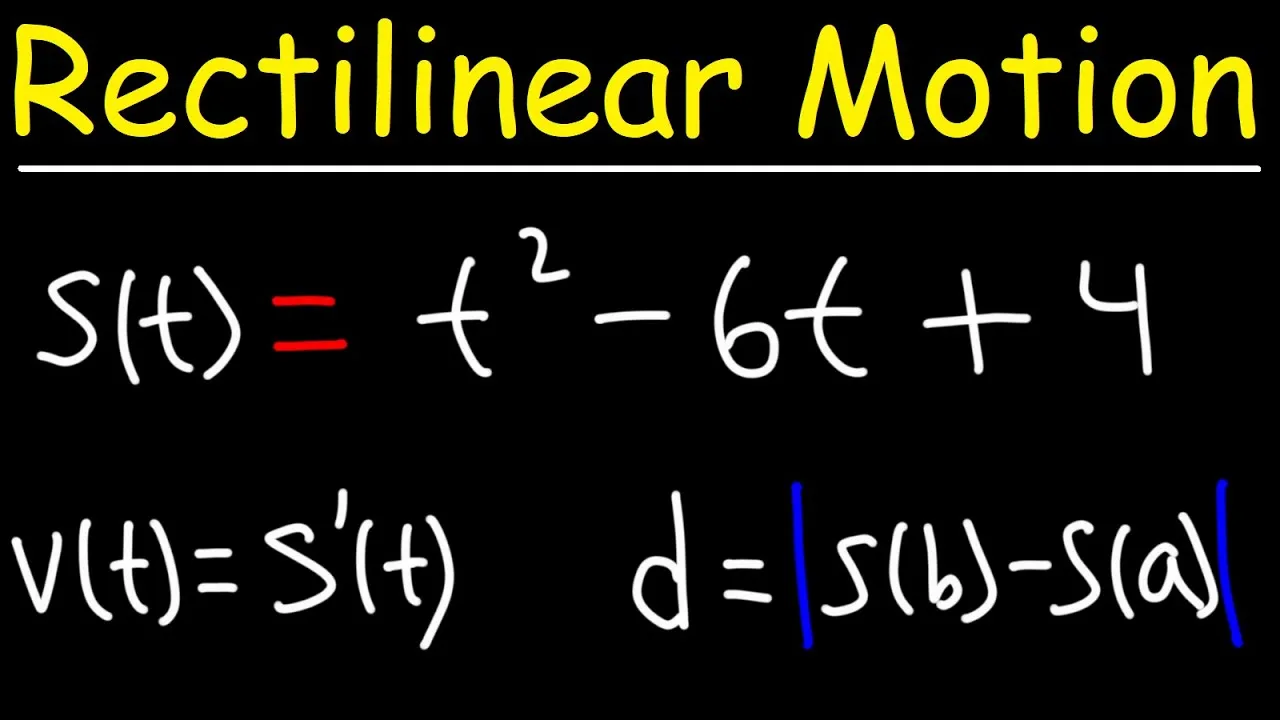
How to Calculate Particle Velocity and Total Distance Traveled
In this tutorial, you will learn how to analyze the motion of a particle along the x-axis given its position function. We will cover how to find the particle’s velocity at a specific time, determine when the particle is at rest, identify when it is moving in a particular direction (left or right), and calculate the total distance it travels over a given time interval. This process involves understanding derivatives and how to interpret the sign of the velocity function.
Prerequisites
- Basic understanding of calculus, specifically derivatives.
- Familiarity with algebraic manipulation to solve equations.
Steps
1. Find the Velocity Function
The velocity of a particle is the rate of change of its position with respect to time. In calculus terms, this is the derivative of the position function, s(t).
- Given the position function, s(t) = t2 – 6t + 4.
- To find the velocity function, v(t), take the derivative of s(t):
- The derivative of t2 is 2t.
- The derivative of -6t is -6.
- The derivative of the constant 4 is 0.
- Therefore, the velocity function is v(t) = 2t – 6.
2. Calculate Velocity at a Specific Time
To find the velocity of the particle at any given time ‘t’, substitute that value of ‘t’ into the velocity function v(t).
- We need to find the velocity at t = 5 seconds.
- Substitute t = 5 into the velocity function v(t) = 2t – 6:
- v(5) = 2(5) – 6
- v(5) = 10 – 6
- v(5) = 4
Result: The velocity of the particle at t = 5 seconds is 4 meters per second (m/s).
3. Determine When the Particle is at Rest
A particle is considered to be at rest when its velocity is zero. To find the time(s) when this occurs, set the velocity function equal to zero and solve for ‘t’.
- Set the velocity function v(t) = 0:
- 2t – 6 = 0
- Add 6 to both sides:
- 2t = 6
- Divide by 2:
- t = 3
Result: The particle is at rest at t = 3 seconds.
4. Identify When the Particle is Moving Left or Right
The direction of the particle’s motion is determined by the sign of its velocity:
- If v(t) > 0, the particle is moving to the right.
- If v(t) < 0, the particle is moving to the left.
- If v(t) = 0, the particle is at rest.
We know the particle is at rest at t = 3. We can test values of ‘t’ on either side of 3 to determine the direction of motion.
- For t > 3 (moving right): Let’s test t = 4.
- v(4) = 2(4) – 6 = 8 – 6 = 2. Since v(4) is positive, the particle moves to the right when t > 3.
- For t < 3 (moving left): Let’s test t = 2.
- v(2) = 2(2) – 6 = 4 – 6 = -2. Since v(2) is negative, the particle moves to the left when t < 3.
Result: The particle is moving to the left when t < 3 seconds. It is important to note that time cannot be negative in this context, so the most precise answer is 0 ≤ t < 3 seconds.
5. Calculate the Total Distance Traveled
Calculating the total distance traveled requires accounting for any changes in direction. If the particle changes direction within the time interval, you must calculate the distance traveled in each segment separately and then sum them.
We want to find the total distance traveled in the first 7 seconds (from t=0 to t=7).
- Identify critical points: The critical points are the start time (t=0), the end time (t=7), and any time(s) the particle is at rest and potentially changes direction. We found the particle is at rest at t=3.
- Calculate positions at critical points:
- At t = 0: s(0) = (0)2 – 6(0) + 4 = 4 meters.
- At t = 3: s(3) = (3)2 – 6(3) + 4 = 9 – 18 + 4 = -5 meters.
- At t = 7: s(7) = (7)2 – 6(7) + 4 = 49 – 42 + 4 = 11 meters.
- Calculate distance traveled in each segment:
- Segment 1 (t=0 to t=3): The particle moves from s(0) = 4 to s(3) = -5. The distance traveled is the absolute difference: |s(3) – s(0)| = |-5 – 4| = |-9| = 9 meters.
- Segment 2 (t=3 to t=7): The particle moves from s(3) = -5 to s(7) = 11. The distance traveled is the absolute difference: |s(7) – s(3)| = |11 – (-5)| = |11 + 5| = |16| = 16 meters.
- Sum the distances from each segment:
- Total Distance = Distance (Segment 1) + Distance (Segment 2)
- Total Distance = 9 meters + 16 meters = 25 meters.
- Velocity at t=5 s: 4 m/s
- Particle at rest: t = 3 s
- Particle moving left: 0 ≤ t < 3 s
- Particle moving right: t > 3 s
- Total distance traveled in the first 7 seconds: 25 meters
Expert Note: If the particle did not change direction within the interval, the total distance traveled would simply be the absolute difference between the final and initial positions, i.e., |s(7) – s(0)|. However, since the particle changed direction at t=3, we must sum the distances of the individual segments to get the correct total distance.
Summary of Results
Source: Rectilinear Motion – Finding the Velocity and Total Distance Given the Particle Position Function (YouTube)