How to Calculate the Rate of Water Level Change in a Cylindrical Tank
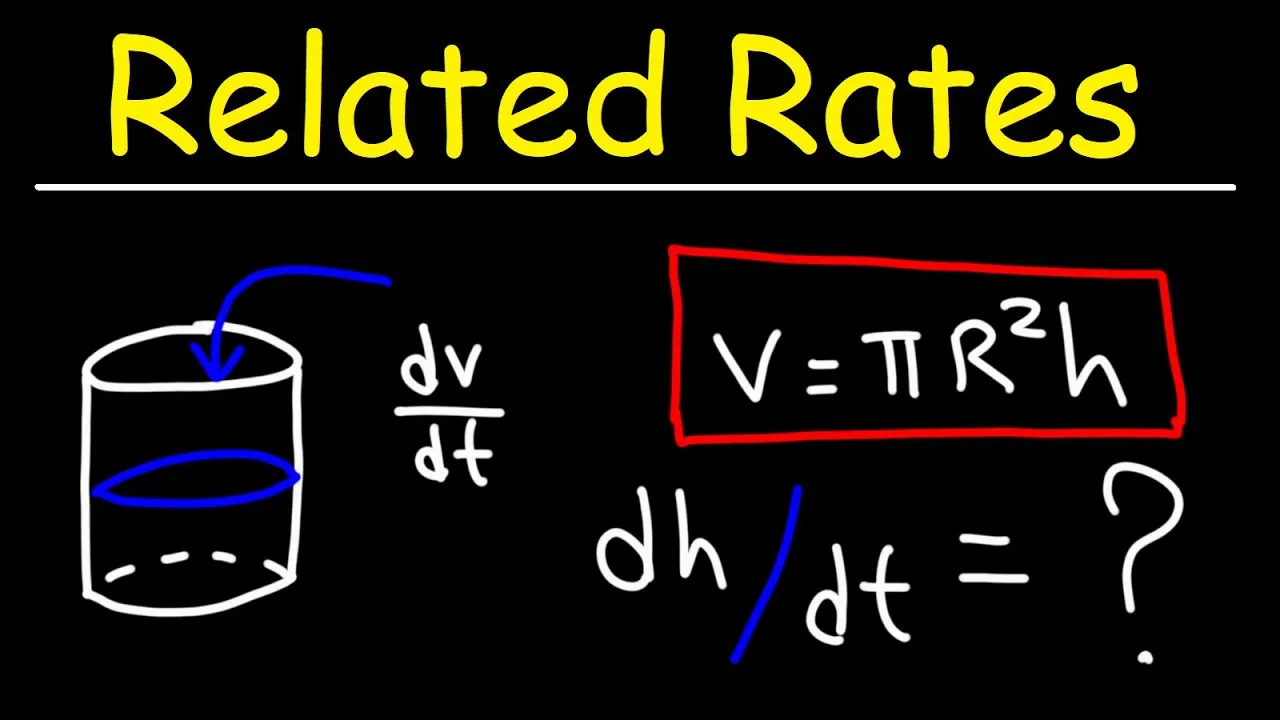
This tutorial will guide you through calculating how quickly the water level rises in a cylindrical tank when water is being added at a known rate. We will use related rates and the formula for the volume of a cylinder to find the rate of change of the water’s height.
Prerequisites
- Basic understanding of calculus, specifically differentiation.
- Familiarity with geometric formulas, particularly the volume of a cylinder.
Steps
Identify Given Information and What to Find
Begin by carefully reading the problem and identifying all the known values and the unknown value you need to solve for. In this problem, we are given:
- The rate at which water flows into the tank (volume flow rate): 40 cubic feet per minute. This is represented as ( frac{dV}{dt} = 40 text{ ft}^3/text{min} ).
- The radius of the cylindrical tank: 6 feet. Since the tank is cylindrical, the radius of the water level will remain constant as water is added. This is represented as ( r = 6 text{ ft} ).
We need to find how fast the height of the water level is changing. This is represented as ( frac{dH}{dt} ), where ( H ) is the height of the water.
Visualize the Problem and Draw a Diagram
Imagine a cylindrical tank. As water is poured into it, the volume of water increases, and consequently, the height of the water level rises. The key observation is that the radius of the water surface remains constant because the tank’s shape is a cylinder. This means the rate of change of the radius, ( frac{dr}{dt} ), is 0.
Expert Note: In problems involving cylinders, the radius is often treated as a constant unless otherwise specified.
Write Down the Relevant Formula
Since we are dealing with the volume of water in a cylinder and the rate of change of volume and height, the formula for the volume of a cylinder is essential:
[ V = pi r^2 H ]
Where:
- ( V ) is the volume of water in the tank.
- ( r ) is the radius of the cylinder.
- ( H ) is the height of the water in the cylinder.
Differentiate the Formula with Respect to Time
To relate the rates of change, we need to differentiate the volume formula with respect to time (t). Remember that ( V ) and ( H ) are functions of time, while ( r ) is a constant in this scenario.
Differentiating ( V = pi r^2 H ) with respect to ( t ):
[ frac{d}{dt}(V) = frac{d}{dt}(pi r^2 H) ]
Since ( pi ) and ( r^2 ) are constants, they can be pulled out of the derivative:
[ frac{dV}{dt} = pi r^2 frac{dH}{dt} ]
Tip: When differentiating a product where one factor is a constant (like ( pi r^2 )), treat the constant part as a coefficient.
Isolate the Unknown Rate of Change
Our goal is to find ( frac{dH}{dt} ). To do this, rearrange the differentiated equation to solve for ( frac{dH}{dt} ):
[ frac{dH}{dt} = frac{1}{pi r^2} frac{dV}{dt} ]
This equation shows that the rate at which the height changes is equal to the rate at which the volume changes, multiplied by the reciprocal of the base area of the cylinder (( pi r^2 )).
Substitute Known Values and Calculate
Now, substitute the given values into the rearranged equation:
- ( frac{dV}{dt} = 40 text{ ft}^3/text{min} )
- ( r = 6 text{ ft} )
[ frac{dH}{dt} = frac{1}{pi (6 text{ ft})^2} (40 text{ ft}^3/text{min}) ]
[ frac{dH}{dt} = frac{1}{pi (36 text{ ft}^2)} (40 text{ ft}^3/text{min}) ]
[ frac{dH}{dt} = frac{40}{36pi} frac{text{ft}^3/text{min}}{text{ft}^2} ]
[ frac{dH}{dt} = frac{10}{9pi} text{ ft/min} ]
Interpret the Result
The result, ( frac{10}{9pi} text{ ft/min} ), tells us the rate at which the water level is rising. To get a more intuitive understanding, we can approximate this value:
[ frac{10}{9pi} approx frac{10}{9 imes 3.14159} approx frac{10}{28.27431} approx 0.3536 text{ ft/min} ]
So, the height of the water level is increasing by approximately 0.35 feet per minute. This makes sense because as water is added to a cylinder, the height should increase, and the rate of change of height depends on the base area of the cylinder.
Warning: Always check your units. In this case, ( text{ft}^3 / text{ft}^2 ) correctly simplifies to ( text{ft} ), which is the unit for height. The time unit (minutes) is also preserved.
Source: Related Rates – Water Flows into a Cylindrical Tank (YouTube)