Discover the ‘Six Degrees of Separation’ Phenomenon
Have you ever wondered how interconnected our world truly is? The concept of ‘six degrees of separation’ suggests that any two people on Earth can be connected through a chain of acquaintances with no more than five intermediaries. This fascinating idea, often referred to in social science as the ‘small world problem,’ implies that despite living in local clusters, we are surprisingly close to everyone else on the planet. This article will guide you through understanding this phenomenon and how it applies to our global social network.
Understanding the Core Concept
Imagine the entire population of Earth, approximately 8 billion people, arranged in a vast circle. If each person knows, on average, 100 people (50 to their left and 50 to their right within this circle), the furthest person you could directly reach is about 50 steps away. To connect to someone on the opposite side of the planet through a chain of mutual acquaintances, it would theoretically take around 80 million steps. Connecting any two random people would average about 40 million steps. However, the ‘six degrees of separation’ principle argues that the actual number of steps required is dramatically lower.
The Paradox of Our Connected World
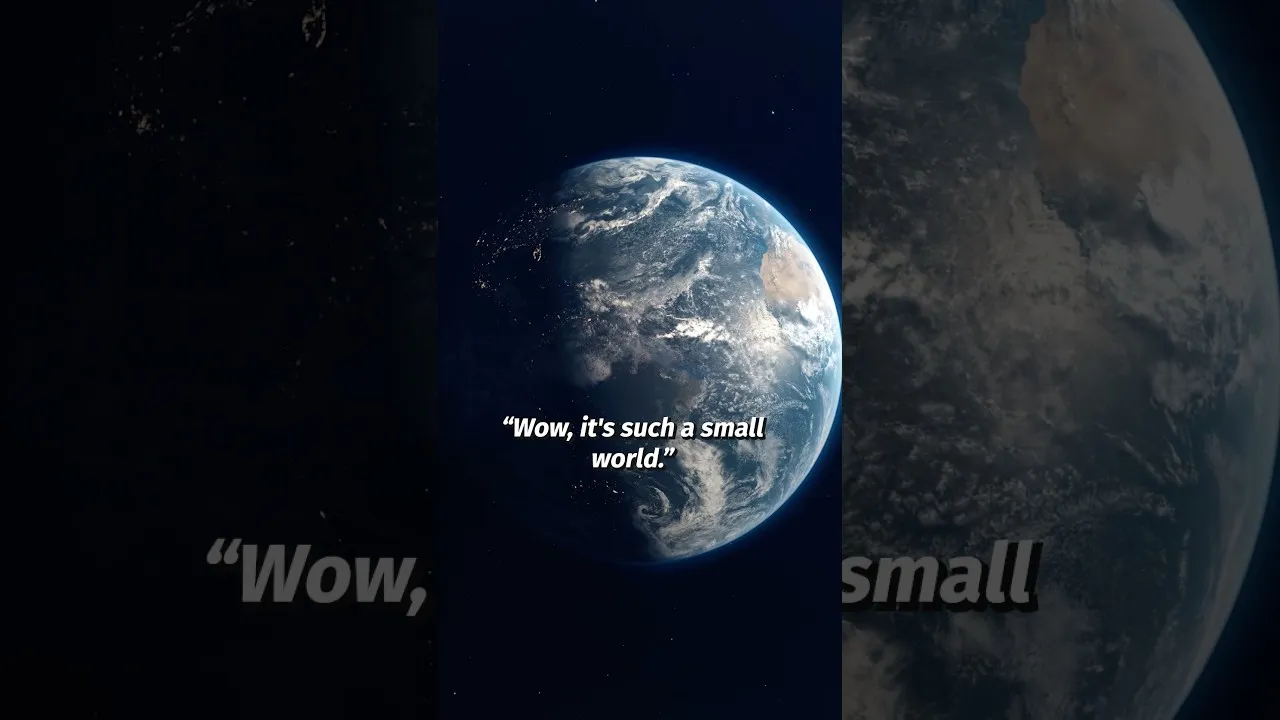
The paradox lies in the contrast between our perception of local social circles and the reality of global connectivity. We tend to think of our social lives as confined to friends, family, and colleagues within our immediate vicinity. Yet, the ‘small world problem’ highlights how easily we can bridge vast geographical and social distances. It’s that moment when you meet someone new, perhaps while traveling, and discover they know your best friend, leading you to exclaim, “It’s such a small world!” This isn’t just a coincidence; it’s a demonstration of the underlying interconnectedness of human social networks.
The Mathematical Basis (Simplified)
While the initial thought experiment involving 8 billion people in a circle might suggest millions of steps, the ‘six degrees’ concept is rooted in network theory. In such networks, the number of connections grows exponentially. Even with a relatively small number of direct connections (like 100), the potential reach expands incredibly fast. To illustrate, consider this:
- Step 1: You know 100 people.
- Step 2: Each of those 100 people knows 100 *new* people (on average), giving you a potential reach of 100 * 100 = 10,000 people.
- Step 3: Those 10,000 people know 100 new people each, potentially reaching 10,000 * 100 = 1,000,000 people.
- Step 4: This expands to 1,000,000 * 100 = 100,000,000 people.
- Step 5: Reaching 100,000,000 * 100 = 10,000,000,000 people.
- Step 6: This potentially covers more than the entire global population.
This simplified model demonstrates how quickly the network expands. The actual number is refined by considering overlapping connections and the non-uniform distribution of social ties, but the principle remains: a few steps can bridge vast distances.
Real-World Experiments and Observations
The concept of six degrees of separation isn’t just theoretical. It has been explored through various studies and experiments. For instance, a decade ago, an experiment involving viewers of a popular science channel found that the average viewer was only 2.7 degrees of separation from the channel’s host. This suggests that, in practice, the number of steps might even be less than six for many people within active online communities.
The ‘Small World Problem’ in Practice
The ‘small world problem’ describes this phenomenon where seemingly random encounters reveal hidden connections. It’s the observation that social networks, despite their size, have short average path lengths between any two nodes (people). This is due to a combination of local clustering (people knowing others in their immediate circle) and a few ‘long-range’ connections that bridge different clusters.
Conclusion: Embracing Our Interconnectedness
The ‘six degrees of separation’ concept, and the broader ‘small world problem,’ reveals a profound truth about humanity: we are far more connected than we often realize. While we maintain our local communities, these communities are linked by a surprisingly thin web of relationships, allowing us to reach almost anyone on the planet in a handful of steps. Understanding this phenomenon encourages us to see the world not as a collection of isolated individuals, but as a vast, interconnected social network.
Source: You're Only 6 Steps Away From Anyone On Earth (YouTube)