Discover the Magic of Pinhole Projection
Have you ever noticed those mesmerizing little circles of light that appear on the ground on a sunny day, especially when dappled light filters through tree leaves? You might have wondered how these perfect circles form, even when the gaps in the leaves are irregular. This phenomenon is a beautiful demonstration of a fundamental optical principle, and it all comes down to the concept of a pinhole camera. In this guide, you’ll learn how to recreate this effect yourself and understand why seemingly different shapes can all produce a circular projection. Get ready to see the sun in a whole new light!
Understanding the Pinhole Camera Principle
The core idea behind this illusion is the pinhole camera. A pinhole camera is essentially the simplest form of a camera, consisting of a light-proof box with a tiny hole (the pinhole) in one side. When light from an external scene passes through this pinhole, it projects an inverted image of that scene onto the opposite side of the box. In our case, we’re not building a box, but rather using a simple piece of cardboard with a hole in it to observe a projection of the sun.
Why a Circle?
The key to understanding why we see a circle, regardless of the shape of the hole, lies in what we are actually observing. When the hole in the cardboard is held at a sufficient distance from the surface where the light is projected, you are no longer just looking at the light passing through that specific hole. Instead, you are observing a projection of the light source itself – the sun.
The sun, being a celestial body, is essentially round. Therefore, when its light is projected through a small aperture, the resulting image on a surface will be a representation of the sun’s shape. Think of it like this: if the sun were a triangle pointing upwards, the projection on the ground would be a triangle pointing downwards. Because the sun is round, the projection is also round, irrespective of the shape of the opening through which its light passes.
How to Observe the Shadow Illusion
You can easily replicate this fascinating optical effect with simple materials. Here’s how:
Gather Your Materials:
You will need:
- A sunny day with direct sunlight.
- A piece of stiff cardboard or thick paper.
- Scissors or a craft knife to cut a hole in the cardboard.
- A clear surface to project the light onto (e.g., the ground, a wall, or a piece of paper).</li
Prepare the Pinhole Cardboard:
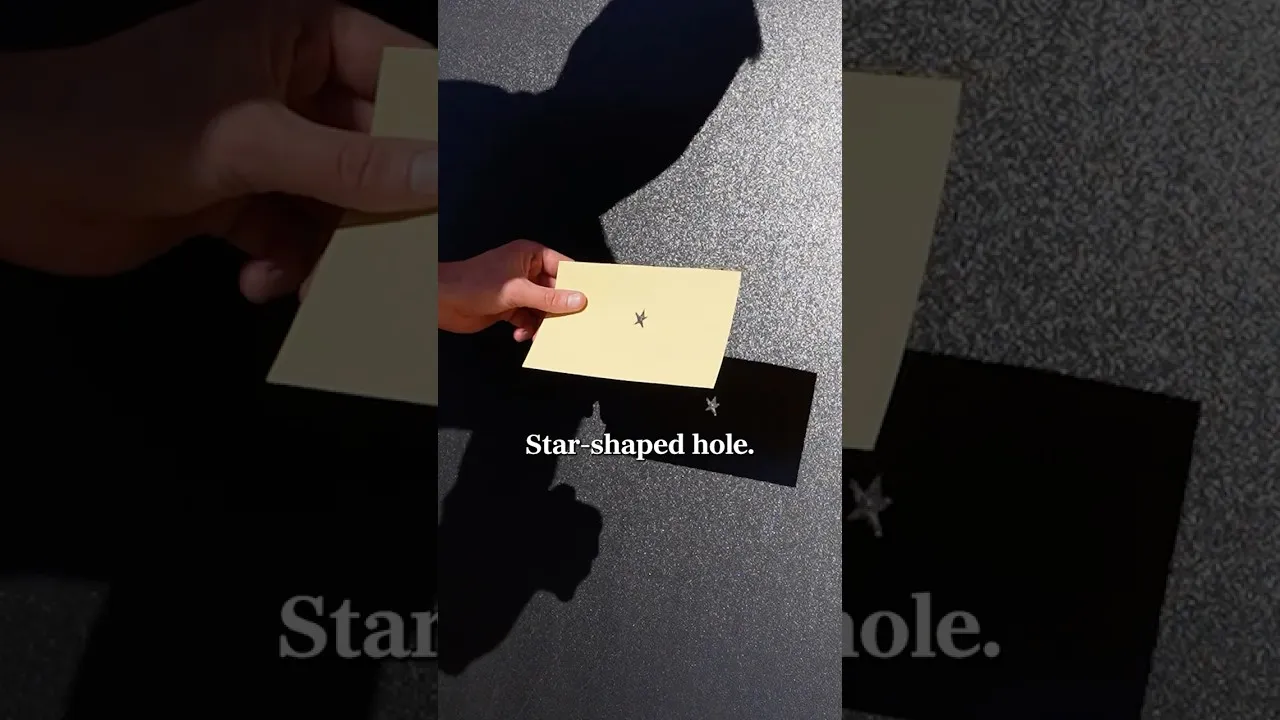
Using your scissors or craft knife, carefully cut a small hole in the center of the cardboard. The shape of this hole can be anything you like – a square, a triangle, a star, or even an irregular shape. A hole around 1-2 cm in diameter is usually effective.
Position Yourself for Observation:
Find a location where the sun is shining directly. Stand with your back to the sun, holding the cardboard in front of you. You will be projecting the light onto the surface behind you.
Adjust the Distance:
Hold the cardboard at a moderate distance from the projection surface. Start by holding it close, and then slowly move it further away. As you move the cardboard away from the surface, you will notice that the image of the hole starts to blur.
Observe the Transformation:
Continue to slowly lift the cardboard higher (or move it further away from the surface). You will see the blurred shape of the hole gradually morph into a distinct, perfect circle. This circle is the projected image of the sun.
Experiment with Different Hole Shapes:
If you cut multiple pieces of cardboard with different shaped holes (e.g., square, triangle, star), you can repeat the process with each one. You will observe that no matter the shape of the hole you cut, the projected image remains a circle, as long as the cardboard is held at a sufficient distance.
Expert Tip: The Importance of Distance
The crucial element in observing the circular projection of the sun is the distance between the pinhole and the projection surface. When the cardboard is held very close to the surface, you are essentially seeing a direct shadow of the hole’s shape. However, as you increase the distance, the light rays from different parts of the sun passing through the pinhole spread out, and the collective projection begins to resemble the shape of the sun itself.
Warning: Never Look Directly at the Sun
It is extremely important to never look directly at the sun, even through a pinhole. The intense light can cause permanent eye damage. Always project the sun’s image onto a surface and observe the projection indirectly.
Real-World Examples
This pinhole projection principle is at play in many natural phenomena. The most common example is the dappled light you see on sidewalks or forest floors on a sunny day, filtered through the leaves of trees. The gaps between the leaves act as tiny pinholes, and because the sun is round, the patterns of light projected onto the ground are made up of countless small circles.
By understanding and recreating the shadow illusion with a piece of cardboard, you gain a hands-on appreciation for the workings of optics and the fundamental nature of light projection. It’s a simple yet profound experiment that reveals a hidden aspect of our everyday world.
Source: The Shadow Illusion (YouTube)