Desk Job Relief: Simple Yoga Moves Combat Sitting Pain
Spending hours at a desk can lead to stiffness and discomfort, especially in the low back and chest. Fortunately, a few simple yoga-inspired movements can help counteract the effects of prolonged sitting. These accessible exercises, demonstrated by yoga instructor Adriene Mishler, focus on releasing tension and improving mobility, making them ideal for anyone who spends their day seated.
Start with Gentle Movement
Begin by standing with your feet hip-width apart, or slightly wider. Gently rock your body from side to side, bringing awareness to your feet and how they connect with the ground. You can do this in shoes, but removing them allows for a better feel of the earth beneath you. Next, shift your weight to create easy circles with your hips. This can be done with hands on your waist for a larger range of motion or kept smaller if you’re in a tight space, like a small office cubicle. Reverse the direction of these circles to loosen up the hips in both directions, remembering to keep a soft bend in your knees.
Release the Low Back and Chest
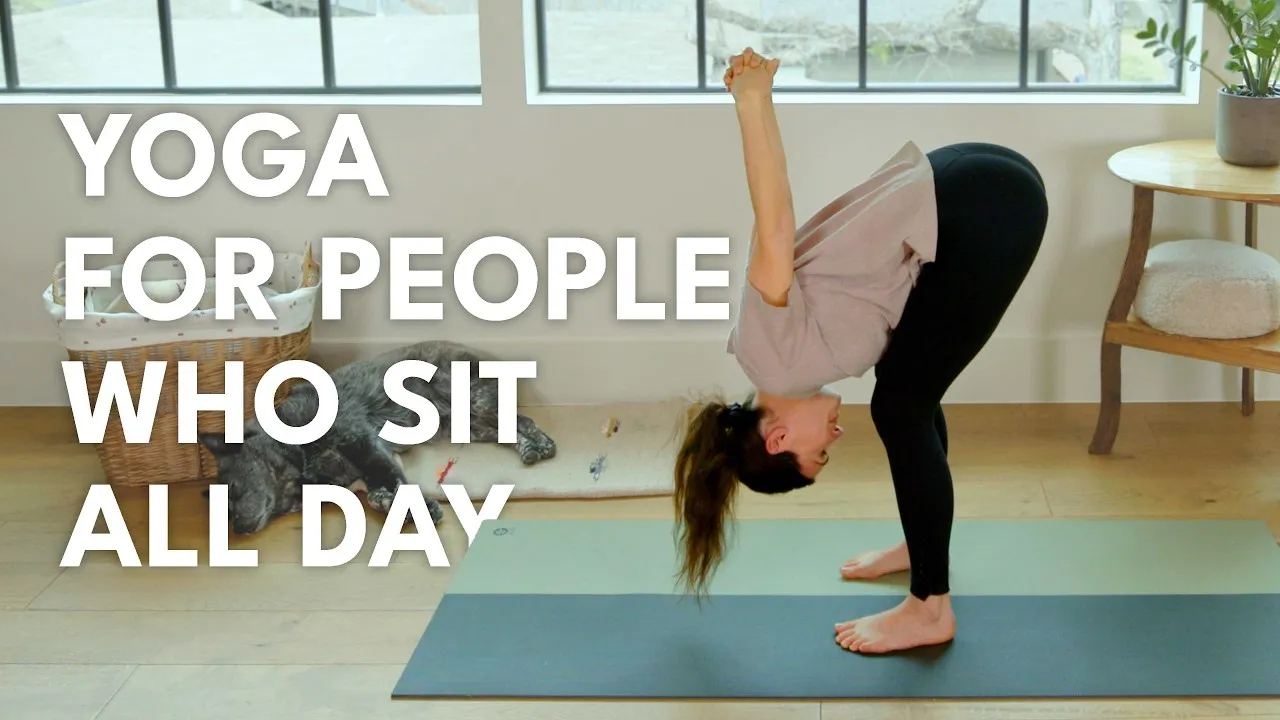
From standing, inhale and reach your arms overhead for a full-body stretch. As you exhale, begin to release your upper body forward, starting with your chin to your chest. Let your knees stay bent as you fold forward, allowing your arms and head to hang loosely. This gentle forward fold, with bent knees, is especially beneficial for releasing tension in the low back. You can rest your hands on your thighs for support or let your arms dangle freely. After a few breaths, engage your legs and slowly rise back to a standing position, focusing on protecting your low back by grounding through your feet.
Next, interlace your fingertips behind your back, drawing your hands away from your body. Keep a soft bend in your knees and focus on your breath. This movement helps to open up the chest and pectoral muscles, which can become tight from hunching over a desk. As you release this bind, inhale your arms back up towards the sky.
Engage and Energize
Try a simple flow of reaching your arms up on an inhale and pressing your palms down as you exhale. For an added challenge, you can lift onto your toes as you inhale and slowly lower your heels as you exhale. This movement helps to engage your calf muscles and can be done with or without the arm motion, depending on your preference and balance. Finding a focal point can help improve stability during these calf raises.
Return to interlacing your fingers behind your back, but this time, add gentle movement to your neck. You can nod your head up and down, shake it gently from side to side, or make small circles with your nose. This helps release tension held in the neck and upper shoulders. Afterward, release your hands and bring your arms in front of you.
Eagle Arms for Spinal Mobility
Move into a pose called Eagle Arms (Garudasana arms). Bring your right arm underneath your left, bending your elbows. You don’t need to wrap your hands; simply bringing your forearms together or giving yourself a hug is effective. Inhale, lift your elbows up, and bend your knees, sinking back as if moving into a chair. Round your spine forward, tucking your chin. This creates a rounded, cat-like spine. Then, inhale to rise, straightening your legs and lifting your elbows, finding extension. Exhale and round forward again. Repeat this movement, feeling the spine articulate. Switch to the other side, bringing your left arm underneath your right, and repeat the seated, rounded, and extended poses. This sequence mobilizes the spine and releases tension in the shoulders and upper back.
Final Stretches and Balance
Return to interlacing your fingers behind your back, focusing on opening the chest and drawing your shoulder blades together. With bent knees, lead with your heart space and hips back, coming into a forward fold with your knuckles reaching towards the sky. This deepens the chest opener and stretches the hamstrings. Allow your breath to move you in this shape. Release your arms with control, bend your knees, and slowly roll up to standing, stacking your spine one vertebra at a time.
Finish with shoulder rolls, moving them forward, up, and back. To work on balance and leg strength, shift your weight onto one foot. Rotate your ankle in both directions. Then, lift your knee towards your chest, squeezing gently if available, or simply march in place by lifting one leg at a time. This is a great way to engage the leg muscles and improve stability.
Conclude with a final inhale, reaching your arms overhead, perhaps rising onto your toes one last time. Exhale, bringing your hands to your heart center. Take one last deep breath together before concluding. These movements offer a quick and effective way to reset your body during a long day of sitting.
Key Health Takeaways
- Prolonged sitting can lead to muscle tightness and discomfort, particularly in the back and chest.
- Gentle standing movements like hip circles and side-to-side rocking can help loosen stiff joints.
- Forward folds with bent knees are beneficial for relieving low back tension.
- Interlacing hands behind the back and opening the chest can counteract hunching.
- Eagle arms combined with spinal flexion and extension mobilize the spine and shoulders.
- Ankle rotations and knee lifts improve circulation and balance.
- Regular short movement breaks throughout the day are crucial for overall well-being.
Disclaimer: This information is for educational purposes only and is not a substitute for professional medical advice. Always consult with your doctor or a qualified healthcare provider before beginning any new exercise program.
Source: Yoga for People Who Sit All Day (YouTube)