How to Differentiate Radical Functions Using Chain and Quotient Rules
This tutorial will guide you through the process of finding the derivative of a radical function that involves both the chain rule and the quotient rule. We will break down the steps, starting with rewriting the radical expression and then systematically applying the necessary differentiation rules to arrive at the simplified derivative.
Prerequisites
- Understanding of basic derivative rules (Power Rule).
- Familiarity with the Chain Rule.
- Familiarity with the Quotient Rule.
- Ability to manipulate exponents and fractions.
Steps to Find the Derivative
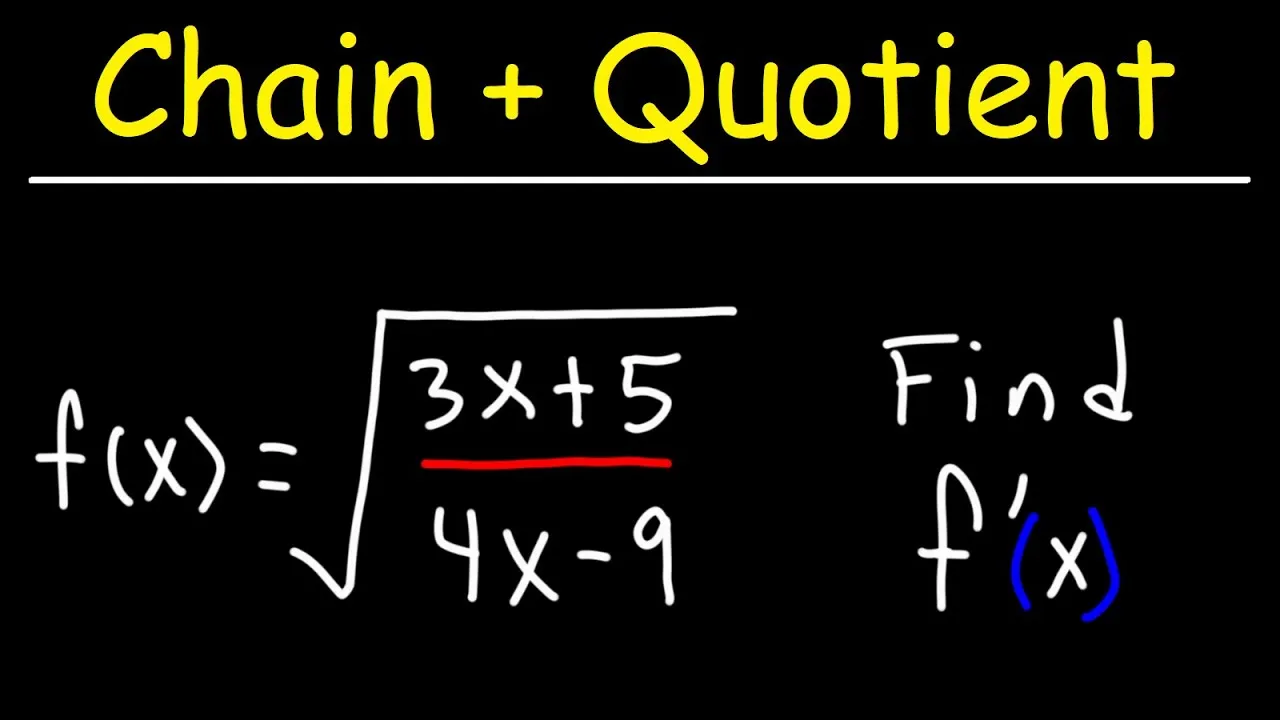
We will find the derivative of the function $f(x) = sqrt{frac{3x + 5}{4x – 9}}$.
Rewrite the Radical Expression
Before applying any differentiation rules, rewrite the square root as an exponent of 1/2. This allows us to use the power rule as part of the chain rule.
The function becomes: $f(x) = left(frac{3x + 5}{4x – 9}right)^{frac{1}{2}}$
Apply the Chain Rule (Power Rule Component)
The chain rule states that the derivative of $u^n$ is $n u^{n-1} u’$. In our case, $u = frac{3x + 5}{4x – 9}$ and $n = frac{1}{2}$. First, bring the exponent $n$ to the front and reduce the exponent by 1.
$n – 1 = frac{1}{2} – 1 = frac{1}{2} – frac{2}{2} = -frac{1}{2}$
So, the first part of the derivative is: $frac{1}{2} left(frac{3x + 5}{4x – 9}right)^{-frac{1}{2}}$
Find the Derivative of the Inner Function (u’) using the Quotient Rule
Now we need to find the derivative of $u = frac{3x + 5}{4x – 9}$. We use the quotient rule, which is $left(frac{f}{g}right)’ = frac{g f’ – f g’}{g^2}$.
- Let $f = 3x + 5$. Then $f’ = 3$.
- Let $g = 4x – 9$. Then $g’ = 4$.
Applying the quotient rule formula:
$u’ = frac{(4x – 9)(3) – (3x + 5)(4)}{(4x – 9)^2}$
Simplify the numerator:
$u’ = frac{12x – 27 – (12x + 20)}{(4x – 9)^2}
$u’ = frac{12x – 27 – 12x – 20}{(4x – 9)^2}
$u’ = frac{-47}{(4x – 9)^2}$
Combine the Parts of the Derivative
Now, multiply the result from step 2 by the result from step 3 ($u’$).
$f'(x) = frac{1}{2} left(frac{3x + 5}{4x – 9}right)^{-frac{1}{2}} times frac{-47}{(4x – 9)^2}$
Simplify the Expression
Deal with the negative exponent by flipping the fraction inside the parentheses. Then, combine the terms.
$f'(x) = frac{1}{2} left(frac{4x – 9}{3x + 5}right)^{frac{1}{2}} times frac{-47}{(4x – 9)^2}$
Apply the exponent to the fraction:
$f'(x) = frac{1}{2} frac{(4x – 9)^{frac{1}{2}}}{(3x + 5)^{frac{1}{2}}} times frac{-47}{(4x – 9)^2}$
Multiply the fractions:
$f'(x) = frac{-47 (4x – 9)^{frac{1}{2}}}{2 (3x + 5)^{frac{1}{2}} (4x – 9)^2}$
Combine Terms with the Same Base
Notice that we have $(4x – 9)^{frac{1}{2}}$ in the numerator and $(4x – 9)^2$ in the denominator. When dividing terms with the same base, subtract the exponents. We can rewrite this as a single term with $(4x-9)$ in the numerator.
The exponent for $(4x-9)$ becomes $frac{1}{2} – 2 = frac{1}{2} – frac{4}{2} = -frac{3}{2}$.
So, the expression is: $f'(x) = frac{-47}{2 (3x + 5)^{frac{1}{2}} (4x – 9)^{- frac{3}{2}}}$
To make the exponent positive, move the term $(4x – 9)^{-frac{3}{2}}$ to the denominator:
$f'(x) = frac{-47}{2 (3x + 5)^{frac{1}{2}} (4x – 9)^{frac{3}{2}}}$
Convert Back to Radical Form (Optional but Recommended)
Rewrite the fractional exponents back into radical notation.
$f'(x) = frac{-47}{2 sqrt{3x + 5} sqrt[2]{(4x – 9)^3}}$
This can be written as:
$f'(x) = frac{-47}{2 sqrt{3x + 5} (4x – 9)^{frac{3}{2}}}$
Further Simplification (Optional)
The term $(4x – 9)^{frac{3}{2}}$ can be written as $(4x – 9)^1 cdot (4x – 9)^{frac{1}{2}}$. This allows for some simplification if desired.
$(4x – 9)^{frac{3}{2}} = (4x – 9) sqrt{4x – 9}$
Substituting this back into the expression:
$f'(x) = frac{-47}{2 sqrt{3x + 5} (4x – 9) sqrt{4x – 9}}$
Combine the radicals:
$f'(x) = frac{-47}{2 (4x – 9) sqrt{(3x + 5)(4x – 9)}}$
Expert Notes
- When simplifying, there might be multiple acceptable forms of the answer. Always check your instructor’s preferred format.
- Remember to carefully distribute negative signs, especially when applying the quotient rule.
- Pay close attention to exponent rules when combining terms with the same base.
Source: Finding Derivatives of Radical Functions Using the Chain Rule and Quotient Rule (YouTube)