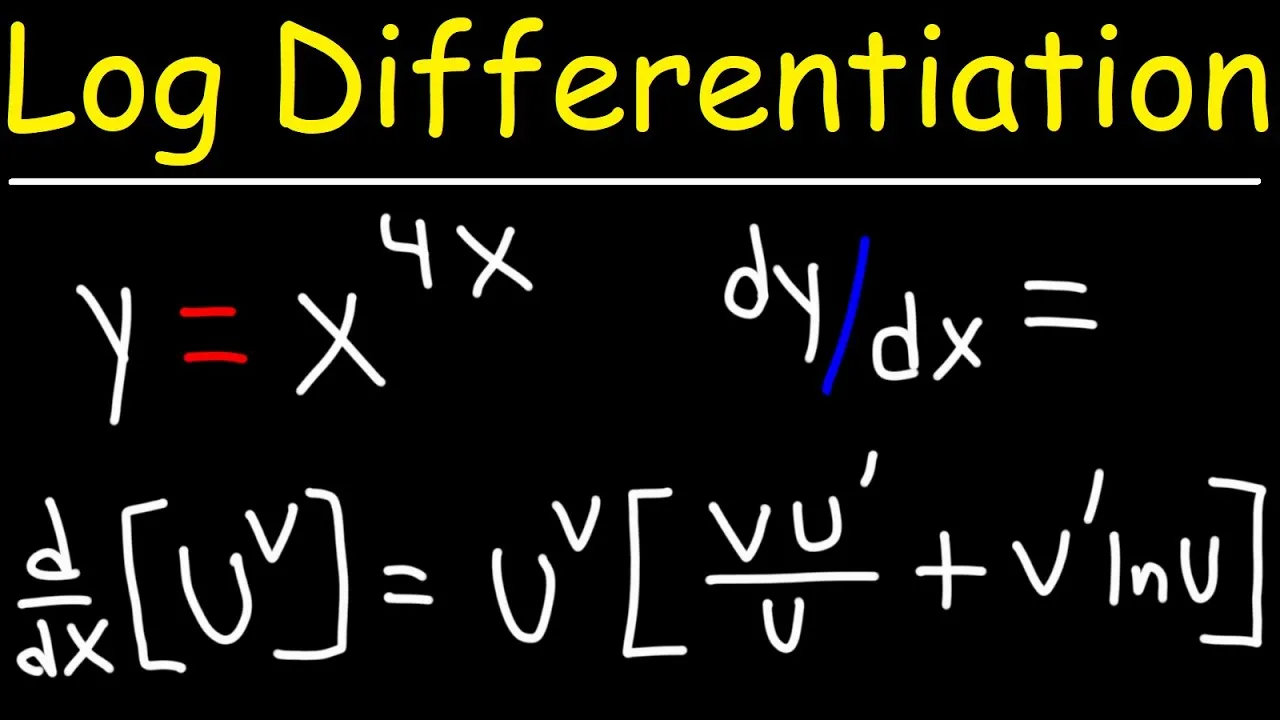
How to Differentiate x^4x Using Logarithmic Differentiation
This tutorial will guide you through the process of finding the derivative of a function where the base and exponent are both variables, specifically focusing on differentiating y = x4x. You will learn two methods: applying a direct formula and using the step-by-step technique of logarithmic differentiation, which is essential for showing your work in free-response scenarios.
Prerequisites
- Basic understanding of differentiation rules (power rule, product rule).
- Knowledge of natural logarithm properties (e.g., log(ab) = b log(a)).
- Familiarity with implicit differentiation.
Method 1: Using the General Formula
For functions of the form y = uv, where both u and v are functions of x, there’s a direct formula to find the derivative dy/dx:
dy/dx = uv * (v * u’/u + v’ * ln(u))
Let’s apply this formula to our specific problem, y = x4x.
- Identify u and v:
- In y = x4x, the base is u = x.
- The exponent is v = 4x.
- Find the derivatives of u and v:
- The derivative of u (x) with respect to x is u’ = 1.
- The derivative of v (4x) with respect to x is v’ = 4.
- Substitute into the formula:
Plug u, v, u’, and v’ into the formula:
dy/dx = x4x * ( (4x * 1) / x + 4 * ln(x) )
- Simplify the expression:
- Simplify the term inside the parentheses:
- (4x / x) = 4
- So, the expression becomes: dy/dx = x4x * (4 + 4 * ln(x))
- Factor out the 4 from the terms inside the parentheses:
- dy/dx = x4x * 4 * (1 + ln(x))
- Rearrange for clarity:
- dy/dx = 4 * x4x * (1 + ln(x))
Expert Note: This formula is a shortcut derived from logarithmic differentiation. While useful for multiple-choice questions, understanding the step-by-step method is crucial for demonstrating your work.
Method 2: Logarithmic Differentiation (Step-by-Step)
This method involves taking the natural logarithm of both sides of the equation and then using implicit differentiation. It’s the preferred method for showing detailed work.
- Start with the original equation:
y = x4x
- Take the natural logarithm of both sides:
ln(y) = ln(x4x)
- Use logarithm properties to simplify the right side:
The property ln(ab) = b * ln(a) allows us to bring the exponent down:
ln(y) = 4x * ln(x)
- Differentiate both sides with respect to x:
We will differentiate both sides implicitly.
- Left side: The derivative of ln(y) with respect to x is (1/y) * (dy/dx) using the chain rule.
- Right side: We need to use the product rule for 4x * ln(x). The product rule states that the derivative of (f * g) is f’g + fg’.
- Let f = 4x, so f’ = 4.
- Let g = ln(x), so g’ = 1/x.
- Applying the product rule: (4) * ln(x) + (4x) * (1/x)
- Simplify the right side: 4 * ln(x) + 4
So, the differentiated equation is: (1/y) * (dy/dx) = 4 * ln(x) + 4
- Isolate dy/dx:
- First, you can factor out a 4 from the right side:
- (1/y) * (dy/dx) = 4 * (ln(x) + 1)
- Multiply both sides by y to solve for dy/dx:
- dy/dx = 4 * y * (ln(x) + 1)
- Substitute the original expression for y back into the equation:
Recall that y = x4x. Substitute this back:
dy/dx = 4 * x4x * (ln(x) + 1)
- Final Answer:
The derivative is dy/dx = 4x4x(1 + ln(x)). This matches the result obtained using the direct formula.
Warning: Remember to correctly apply the chain rule when differentiating ln(y) and the product rule when differentiating the right side. Small errors in these steps can lead to an incorrect final answer.
Source: Logarithmic Differentiation of x^4x with a General Formula (YouTube)