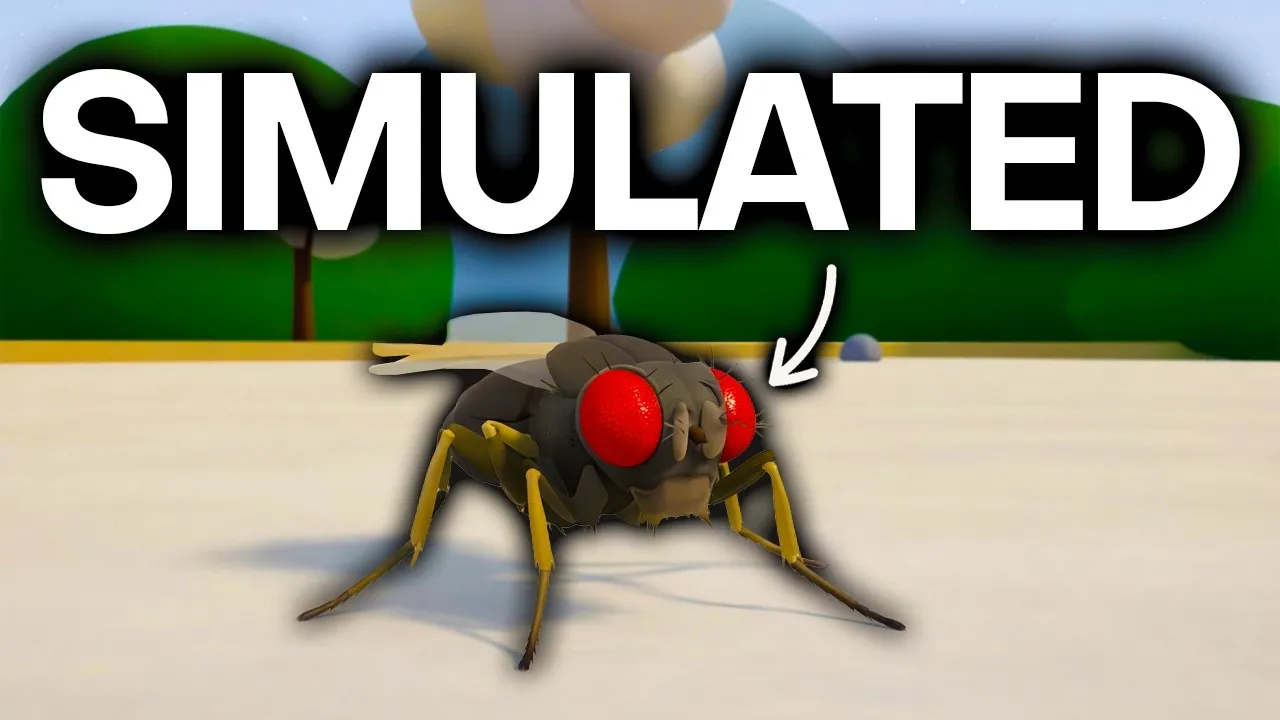
Digital Flies Walk: Brain Emulation Sparks Simulation Debate
In a groundbreaking development that blurs the lines between biology and computation, scientists have successfully emulated a fruit fly’s brain, enabling a simulated body to exhibit complex behaviors without any prior AI training. This achievement, spearheaded by researchers at Flywheel.ai, has not only demonstrated the potential for whole-brain emulation but has also reignited philosophical discussions about consciousness, simulation theory, and the future of intelligence.
From Biology to Binary: The Fruit Fly Emulation
The core of this breakthrough lies in the meticulous mapping of a real fruit fly’s brain. Researchers captured the connectome – the complete map of neural connections – and applied a simplified neuron model to control a physics-simulated fly. The result is a digital entity that, according to its creators, displays 91% behavioral accuracy compared to its biological counterpart. This was achieved by understanding four key aspects of neural function:
- Graph of Connections: Identifying how each neuron is linked to others.
- Weights (Synapses): Quantifying the strength of connections, akin to parameters in AI models, which influence behavior prediction.
- Excitatory and Inhibitory Neurons: Differentiating between neurons that signal ‘go’ (e.g., “food is good, get it”) and ‘stop’ (e.g., “fire is hot, don’t touch”).
- Leaky Integrate-and-Fire Model: A rule set dictating how neurons actually fire based on incoming signals.
Michael Andreg, a key member of the research team, emphasized the significance of this work, stating, “We’ve uploaded a fruitfly. We took the connectome of the fruitfly brain, applied a simple neuron model and used it to control a physics simulated body, closing the loop from neural activation to action.” The team views this emulated fly as a “real uploaded animal,” taking the possibility of its subjective experience seriously and aiming to provide it with a rich simulated environment.
Beyond the Fly: The Broader Implications
While the immediate achievement is remarkable, the researchers highlight three major benefits stemming from successful brain emulation:
- Understanding and Treating Brain Diseases: By simulating entire brains, scientists can model neurological disorders, observe malfunctions, and test potential solutions in a controlled digital environment, accelerating medical research.
- Discovering Intelligence Algorithms: Evolution, the “most expensive training run in history,” has optimized biological brains over millions of years. Emulating these brains could unlock the inherent intelligence algorithms developed by nature, potentially leading to more efficient and powerful AI than current methods can achieve.
- Consciousness Uploading: The ultimate, and perhaps most profound, implication is the possibility of uploading human consciousness. If a human brain can be fully simulated, the question arises whether this digital replica would truly represent our consciousness, potentially offering a form of digital immortality or enhanced cognitive abilities.
The concept of digital superintelligence is further explored, with the idea that a simulated human brain could operate orders of magnitude faster than a biological one, with parallel processing capabilities. Imagine a “superpowered” brain, or millions of such brains collaborating, while still retaining a human in the loop.
Nature’s Training vs. AI’s Billions
The current AI landscape, dominated by large language models (LLMs) like those from OpenAI and Anthropic, requires immense computational resources and vast datasets for training. The Flywheel.ai approach offers a radical alternative: leveraging the millions of years of evolutionary ‘training’ already embedded in biological neural structures. “Imagine we just leveraged evolution which has basically trained every model on Earth, every human brain, every animal brain,” the researchers suggest. “We don’t actually need to do the training run. Nature already did it for us.” This process, known as whole-brain emulation (WBE), aims to replicate the brain’s structure and function, creating a digital copy that behaves like the original.
The Path Forward: From Flies to Humans
The fruit fly, with its approximately 125,000 neurons, is a significant leap from previous emulation attempts, such as the C. elegans worm project which involved only 302 neurons. The researchers acknowledge the increasing complexity and the neuronal counts of various species, from ants (250,000 neurons) and honeybees (nearly 1 million) to octopuses (500 million) and humans (estimated at 86 billion neurons). The Flywheel.ai website provides interactive 3D visualizations of fruit fly neuron mappings, allowing users to explore the intricate connections.
Simulation Theory and the Future of Consciousness
This advancement inevitably draws parallels to simulation theory – the philosophical idea that our reality might be an artificial simulation, much like a sophisticated video game. If we can create a fully functioning digital fly, and potentially a human brain, the question of who is running the simulation and for what purpose becomes more pertinent. The massive data centers being built for AI development could, in theory, also be capable of simulating human consciousness.
In a related, yet distinct, development that underscores the rapid pace of scientific advancement, a petri dish containing human brain cells has been demonstrated to learn and play the video game Doom. This highlights the inherent computational capabilities of biological neural networks, even in simplified forms, and hints at future possibilities for using cultured brain cells for complex tasks.
The Ethical Quandary
As we accelerate towards the capability of fully simulating and potentially uploading human brains, profound ethical questions emerge. If a digital replica of a human brain behaves indistinguishably from the original, is it a human? Does it possess consciousness? Does it have rights? Could this technology offer a form of immortality, or even grant enhanced abilities through computational tuning? The convergence of AI, neuroscience, and computing power suggests these are no longer purely theoretical discussions but imminent challenges we must confront.
The journey from a digital fruit fly to a simulated human consciousness is fraught with technical hurdles and philosophical quandaries. However, the progress made by teams like Flywheel.ai indicates that the future of intelligence, consciousness, and even reality itself, may be far more complex and digitally intertwined than we currently imagine.
Source: Does This Worm Prove We're In a Simulation? (YouTube)