How to Predict the Outcome of Cutting a Green Rope in a Suspended System
This tutorial will guide you through analyzing a physics setup involving suspended weights and ropes. You will learn to predict the movement of a weight when a connecting rope is cut, based on the initial configuration and the properties of the system. By the end of this article, you’ll understand the principles at play and be able to determine whether the weight will move up, down, or remain stationary.
Understanding the Setup
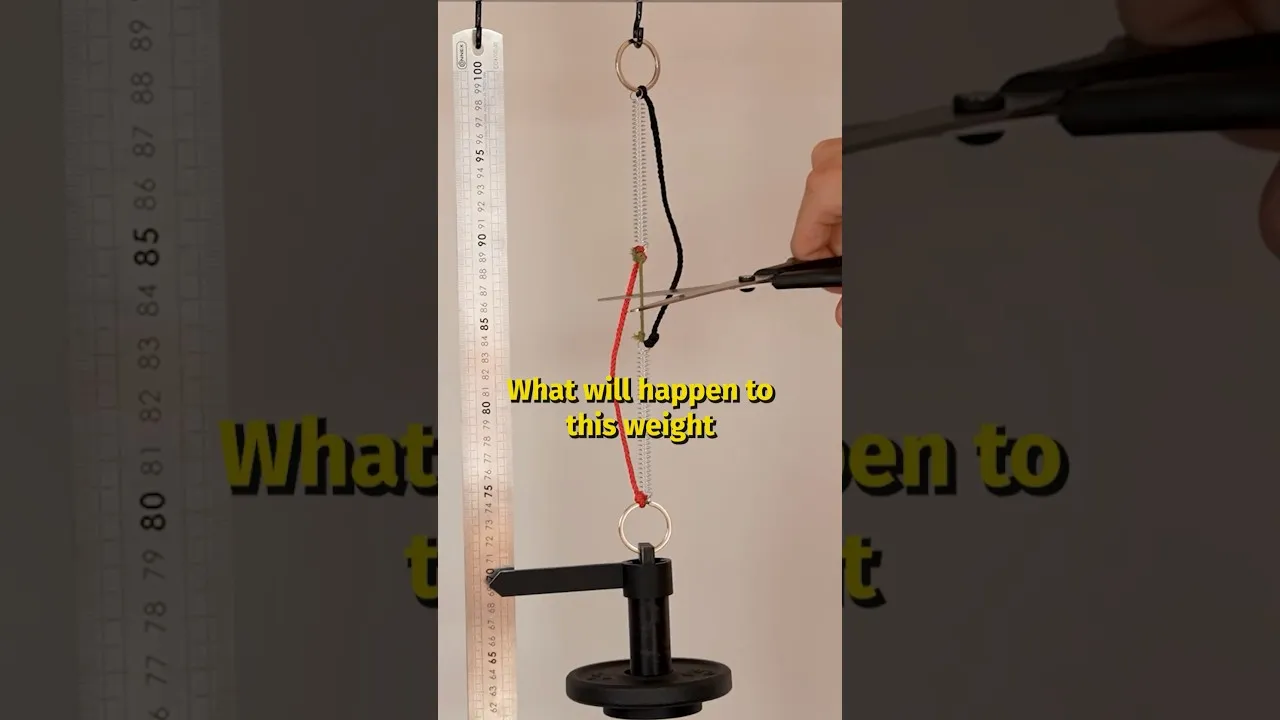
We are presented with a system where a weight is suspended by a series of ropes and springs. Let’s break down the components:
- Top Hook: The entire system is anchored to a hook at the top.
- First Spring: A spring hangs directly from the top hook.
- Green Rope: This rope connects the bottom of the first spring to the top of a second spring.
- Second Spring: This spring is attached to the green rope and suspends the weight at the bottom.
- The Weight: The object whose movement we are interested in.
- Red Rope: An additional rope that is currently slack and not under tension.
- Black Rope: Another additional rope that is also currently slack and not under tension.
Analyzing the Initial State
Before we consider cutting the green rope, it’s crucial to understand the forces acting on the system. The weight is supported by the second spring, which in turn is supported by the green rope. The green rope transmits the tension from the second spring to the first spring. The first spring then supports the combined tension. The red and black ropes are not contributing to the support of the weight; they are slack, meaning they are not under tension and therefore exert no force on the system.
The Question: What Happens When the Green Rope is Cut?
The central question is: what will be the immediate effect on the weight when the green rope is severed? Will it fall, rise, or stay put?
Step-by-Step Prediction
Step 1: Identify the Direct Support of the Weight
The weight is directly attached to the second spring. Therefore, the second spring is what is currently holding the weight up and counteracting gravity.
Step 2: Understand the Role of the Green Rope
The green rope is the critical link. It connects the second spring (which holds the weight) to the first spring. The tension in the second spring, which is supporting the weight, is being transmitted through the green rope to the first spring. The first spring is then counteracting the force from the second spring.
Step 3: Consider the Effect of Cutting the Green Rope
When the green rope is cut, the connection between the first spring and the second spring (and thus the weight) is broken. The first spring will no longer be under tension from the second spring.
Step 4: Determine the Forces Acting on the Weight After the Cut
Immediately after the green rope is cut, the second spring is no longer being pulled upwards by the green rope. The only significant force acting on the weight will be gravity, pulling it downwards. The second spring will now be free to contract or extend based on its own properties and the absence of the load from the green rope.
Step 5: Predict the Movement of the Weight
Since gravity is now the primary force acting downwards on the weight, and there is no upward force to counteract it (as the green rope is gone), the weight will begin to fall. The second spring will likely recoil or change its extension as the tension is removed.
Observed Outcome
In the experiment shown, when the green rope was cut, the weight surprisingly moved upwards.
Expert Analysis of the Unexpected Outcome
This result is counter-intuitive. Typically, if a supporting rope is cut, the weight it supports will fall due to gravity. The fact that the weight moved upwards suggests that the springs involved have properties that cause this behavior under the specific conditions of the experiment. It’s possible that the first spring, once released from the tension of the second spring, recoiled upwards with enough force to lift the weight, or that the second spring’s extension caused an upward pull as it adjusted to the sudden release of tension from the green rope.
Expert Note: In standard physics problems without specific spring properties that would cause upward movement, one would expect the weight to fall. The upward movement indicates that the springs’ elastic potential energy and their reaction to the sudden change in load are the dominant factors here, overriding the simple expectation of gravitational descent.
Conclusion
While intuition suggests the weight should fall when the green rope is cut, the experiment demonstrates a surprising upward movement. This highlights the importance of considering the stored energy and dynamic reactions within the springs, rather than just static forces, when analyzing such systems.
Source: What happens if you cut the green rope? (YouTube)