Estimate Function Values Using Linearization with Derivatives
This tutorial will guide you through the process of finding the linearization of a function at a specific point and using it to estimate function values. Linearization, which is essentially finding the equation of the tangent line to a function at a given point, provides a powerful tool for approximating function outputs, especially for values close to the point of tangency. This method can save you time and the need for a calculator for quick estimations.
Understanding Linearization
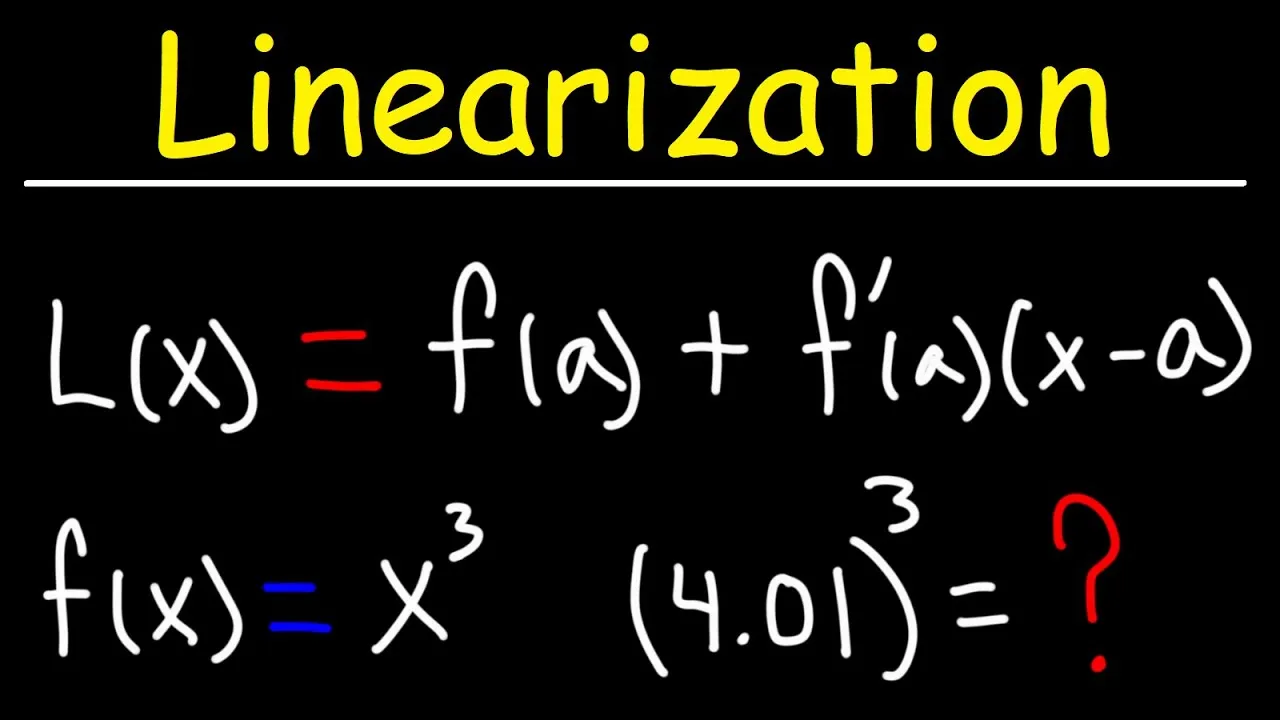
The linearization of a function f(x) at a point x = a, denoted as L(x), is the equation of the tangent line to f(x) at x = a. The formula for linearization is derived from the point-slope form of a line:
L(x) = f(a) + f'(a) * (x – a)
Where:
- f(a) is the value of the function at point ‘a’.
- f'(a) is the value of the derivative of the function at point ‘a’.
- ‘a’ is the point at which we are finding the linearization.
- ‘x’ is the input value for which we want to estimate the function’s output.
This formula is analogous to the point-slope form of a linear equation, y – y1 = m(x – x1), where L(x) represents ‘y’, f(a) represents ‘y1’ (the y-coordinate of the point of tangency), and f'(a) represents ‘m’ (the slope of the tangent line).
Steps to Find the Linearization and Estimate a Value
Step 1: Identify the Function, the Point of Approximation ‘a’, and the Value ‘x’
First, clearly identify the function f(x) you are working with. Determine the point ‘a’ at which you will find the tangent line. This is typically a value where f(a) and f'(a) are easy to calculate. You will also need to identify the value ‘x’ for which you want to estimate f(x). This ‘x’ value should be close to ‘a’ for the linearization to provide an accurate estimate.
Step 2: Calculate f(a)
Substitute the value of ‘a’ into the function f(x) to find the y-coordinate of the point of tangency.
Example: If f(x) = x^3 and a = 4, then f(a) = f(4) = 4^3 = 64.
Step 3: Find the Derivative of the Function, f'(x)
Calculate the derivative of the function f(x) with respect to x. This will give you the formula for the slope of the tangent line at any point x.
Example: If f(x) = x^3, then its derivative f'(x) = 3x^2.
Step 4: Calculate f'(a)
Substitute the value of ‘a’ into the derivative function f'(x) to find the slope of the tangent line at the point x = a.
Example: If f'(x) = 3x^2 and a = 4, then f'(a) = f'(4) = 3 * (4^2) = 3 * 16 = 48.
Step 5: Construct the Linearization Function L(x)
Plug the values of f(a), f'(a), and ‘a’ into the linearization formula: L(x) = f(a) + f'(a) * (x – a).
Example: Using the values from the previous steps, f(a) = 64, f'(a) = 48, and a = 4. So, the linearization function is L(x) = 64 + 48 * (x – 4).
Step 6: Estimate the Function Value f(x) using L(x)
Substitute the value of ‘x’ (the value for which you want to estimate f(x)) into the linearization function L(x). The result will be your estimated value for f(x).
Example: We want to estimate the value of 4.01^3. Here, x = 4.01 and a = 4. We use our linearization function L(x) = 64 + 48 * (x – 4). Plugging in x = 4.01:
L(4.01) = 64 + 48 * (4.01 – 4)
L(4.01) = 64 + 48 * (0.01)
L(4.01) = 64 + 0.48
L(4.01) = 64.48
Therefore, the estimated value of 4.01^3 is 64.48.
Step 7: Compare with the Exact Value (Optional)
To appreciate the accuracy of linearization, you can calculate the exact value of f(x) using a calculator and compare it with your estimate. You’ll often find that the linearization provides a very close approximation, especially when ‘x’ is near ‘a’.
Example: Calculating 4.01^3 directly using a calculator gives approximately 64.481201. Our estimate of 64.48 is remarkably close.
Tips and Considerations
- Accuracy: The closer ‘x’ is to ‘a’, the more accurate the linearization estimate will be. As ‘x’ moves further away from ‘a’, the tangent line will diverge more significantly from the actual function curve, leading to a less precise estimate.
- Choice of ‘a’: Select ‘a’ such that f(a) and f'(a) are easy to compute. Often, this will be a whole number or a simple fraction close to your desired ‘x’ value.
- Applications: Linearization is fundamental in calculus and has applications in physics, engineering, and economics for approximating complex behaviors with simpler linear models.
Prerequisites
- Basic understanding of functions and function notation.
- Knowledge of differentiation rules to find the derivative of a function.
- Familiarity with the concept of a tangent line.
Source: Finding the Linearization of Functions and Value Estimation Using Derivatives (YouTube)