Discover How Borders Shape Identity in Latin American Literature
This article delves into how Latin American authors use the concept of borders—both geographical and societal—to explore themes of identity, belonging, and transformation in their writing. You will learn about experimental literary techniques, the impact of migration and exile on creative expression, and how authors redefine cultural and personal boundaries.
Understanding Borders and Identity
Borders are not static lines on a map; they are dynamic forces that shape our realities, identities, and experiences. For many Latin American writers, the act of crossing borders—whether by choice or by force due to political upheaval—has profoundly influenced their perspectives, fueled their imaginations, and inspired them to push the boundaries of literature itself.
Step 1: Examine Julio Cortázar’s Experimental Narrative
During the literary “Boom era” of the 1960s and ’70s, many Latin American writers found themselves in exile in Europe. Julio Cortázar, frustrated with the political climate in Argentina, moved to Paris. This displacement inspired him to break traditional literary molds. His 1963 novel, Rayuela (Hopscotch), exemplifies this experimental approach.
Understanding Rayuela’s Structure
Rayuela begins as a story about an Argentine expatriate in Paris and his relationship with a character named La Maga. The novel is divided into three sections: “From the Other Side” (Paris), “From This Side” (Argentina), and an “expendable” section called “From Diverse Sides.” However, the novel offers a unique reading experience through its “table of instructions.” Readers can choose to read linearly or follow a numbered chart that jumps between its 155 chapters. This non-linear structure, which can lead to an infinite loop between specific chapters, challenges conventional narrative expectations, making it an “antinovela”—a novel that defies typical structures.
The Reader as Accomplice
Cortázar’s work invites the reader to become an active participant, a lector cómplice (reader as accomplice), in constructing the narrative. This interactive element is central to the novel’s design.
Linguistic Innovation
Beyond its structure, Rayuela experiments with language. Cortázar employs an Argentine dialect of Spanish and even invents a language called “glíglico” for specific passages, showcasing how language itself can be a site of playful innovation and boundary-pushing.
Metaphor of the In-Between
At its core, Rayuela explores the experience of leaving behind one’s familiar world. A key scene involves a character, Talita, crossing a precarious bridge between two buildings. Her fear and desire to turn back, despite encouragement to continue, serves as a powerful metaphor for the unease of existing “in-between” two places—unable to fully return to the past and not yet fully arrived in the new.
Step 2: Explore Hyphenated Identities and Reclamation
The feeling of being “in-between” can lead to a sense of displacement, where individuals may feel they don’t fully belong to either culture. This is often experienced with hyphenated identities, such as “Salvadoran-American,” which can feel like being split between two worlds without a true home in either. In response, many Latin American cultures have embraced terms that focus on a unified sense of self rather than perceived divisions.
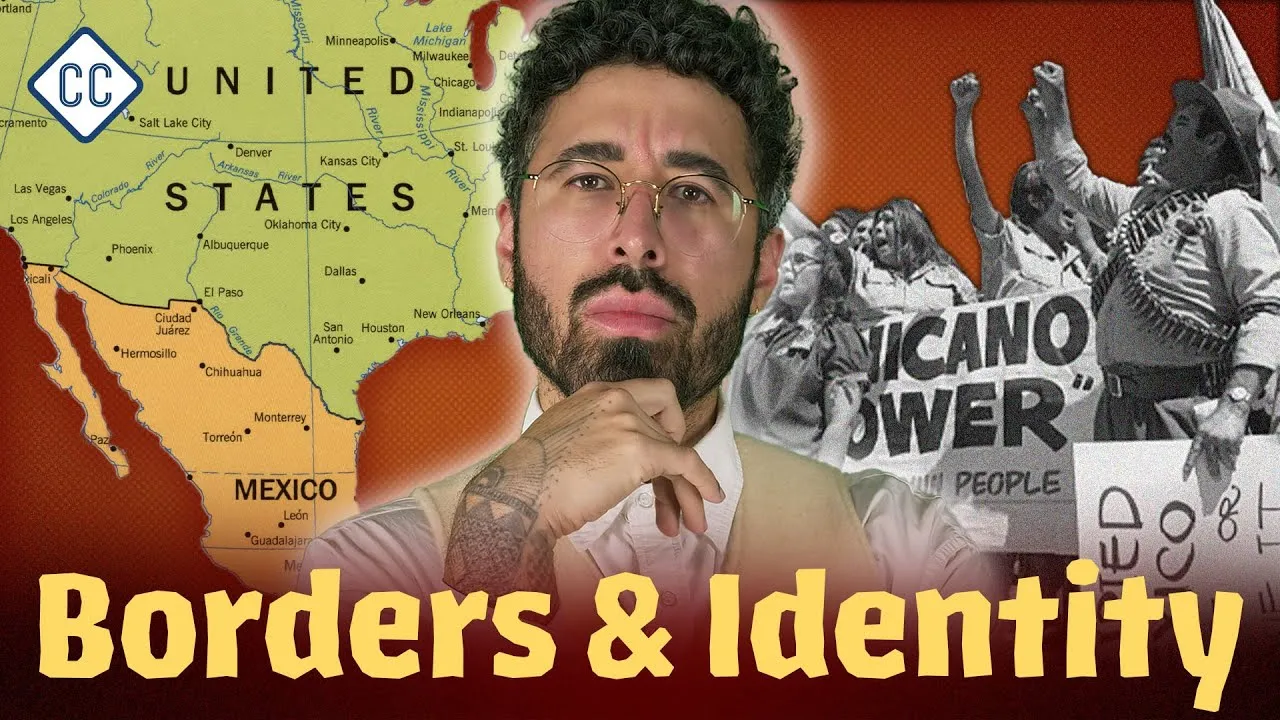
The Chicano Movement
In the 1960s and ’70s, Americans of Mexican descent began embracing the term “Chicano.” This word, previously used as an insult, was reclaimed as a term of pride, signifying belonging to both Mexican and American cultures. The Chicano Movement, or El Movimiento, celebrated Chicanismo as an expression of cultural pride and a catalyst for social and civil rights activism, challenging decades of discrimination.
Chicana Feminism
By the 1980s, the Chicana literature movement brought attention to the dual oppression faced by women of Mexican descent—as Chicanas and as women. This movement highlighted the intersectionality of their experiences.
Step 3: Analyze Gloria Anzaldúa’s Borderlands Philosophy
Gloria Anzaldúa, a writer from South Texas, identified as a “border woman.” For her, borders extended beyond geographical lines to encompass the invisible societal expectations that divide people based on class, gender, sexuality, race, and ethnicity.
“Borderlands/La Frontera: The New Mestiza”
In her seminal 1987 book, Borderlands/La Frontera: The New Mestiza, Anzaldúa explores these multifaceted borders through her own identity. As a mestiza (of Indigenous and European ancestry), queer, and a Mexican-American woman in Texas, she embodies multiple intersections. She uses the Nahuatl concept nepantla, meaning “the in-between,” to describe these complex intersections. Anzaldúa views this “in-between” state not as a division, but as a space for creative synthesis, where disparate elements combine to form a new whole. She famously states, “I’m not half of this and half of that! I’m a whole lotta all of it.”
Multilingual and Multigenre Approach
Anzaldúa’s writing reflects her philosophy by fluidly moving between English, Spanish, and Nahuatl, creating a “Chicano Spanish.” Furthermore, Borderlands blends genres—poetry, essays, memoir, and fiction—demonstrating that innovation thrives in these liminal spaces, much like cultural blending occurs in real-world borderlands.
Step 4: Explore Yuri Herrera’s “Signs Preceding the End of the World”
Mexican author Yuri Herrera’s 2009 novel, Señales que precederán al fin del mundo (Signs Preceding the End of the World), further examines the “in-between” spaces and the challenges of crossing borders.
Makina’s Journey
The novel follows Makina, a young switchboard operator in rural Mexico who connects people and information across languages. She acts as a mediator, a “door” between worlds, rather than a traveler. When her brother falls for false promises and crosses the border into the U.S., Makina embarks on a perilous journey to bring him back.
Navigating Myth and Reality
Makina’s journey exposes her to the harsh realities faced by Mexican migrants, including harassment and violence. Her story also echoes ancient Greek and Mesoamerican myths of journeys through the underworld, involving challenges like crossing a river with “invisible water monsters.” This blending of myth and reality underscores the extraordinary nature of the migrant experience.
Embracing the Intermediary Tongue
Initially determined to return home immediately after her mission, Makina becomes fascinated by the people she encounters beyond the border. She is drawn to their “intermediary tongue,” a language that is malleable, permeable, and acts as a hinge between cultures. This linguistic and cultural blend represents a “nebulous territory between what is dying out and what is not yet born,” a space of exciting new possibilities.
Conclusion: Borders as Spaces of Creativity
Latin American writers like Cortázar, Anzaldúa, and Herrera demonstrate that borders are not just divisions but also dynamic spaces of interaction, creativity, and possibility. By crossing and exploring these boundaries, both literally and literarily, they challenge our perceptions and reveal the fluid nature of identity and culture.
Expert Note: The Power of Nepantla
The concept of nepantla, or “the in-between,” is crucial for understanding how these authors navigate complex identities. It represents a state of flux and potential, where new meanings and forms emerge from the convergence of different elements. Embracing nepantla allows for a more holistic and creative approach to identity and artistic expression.
Further Exploration
The themes explored in this article highlight how literature can serve as a powerful lens through which to understand the complexities of identity, migration, and cultural exchange. The “in-between” spaces, often challenging, are also fertile ground for innovation and the creation of new narratives.
Source: Borders & Identity: Crash Course Latin American Literature #7 (YouTube)