Expert Analyst Critiques Viral Finance TikToks, Exposing Investment Pitfalls
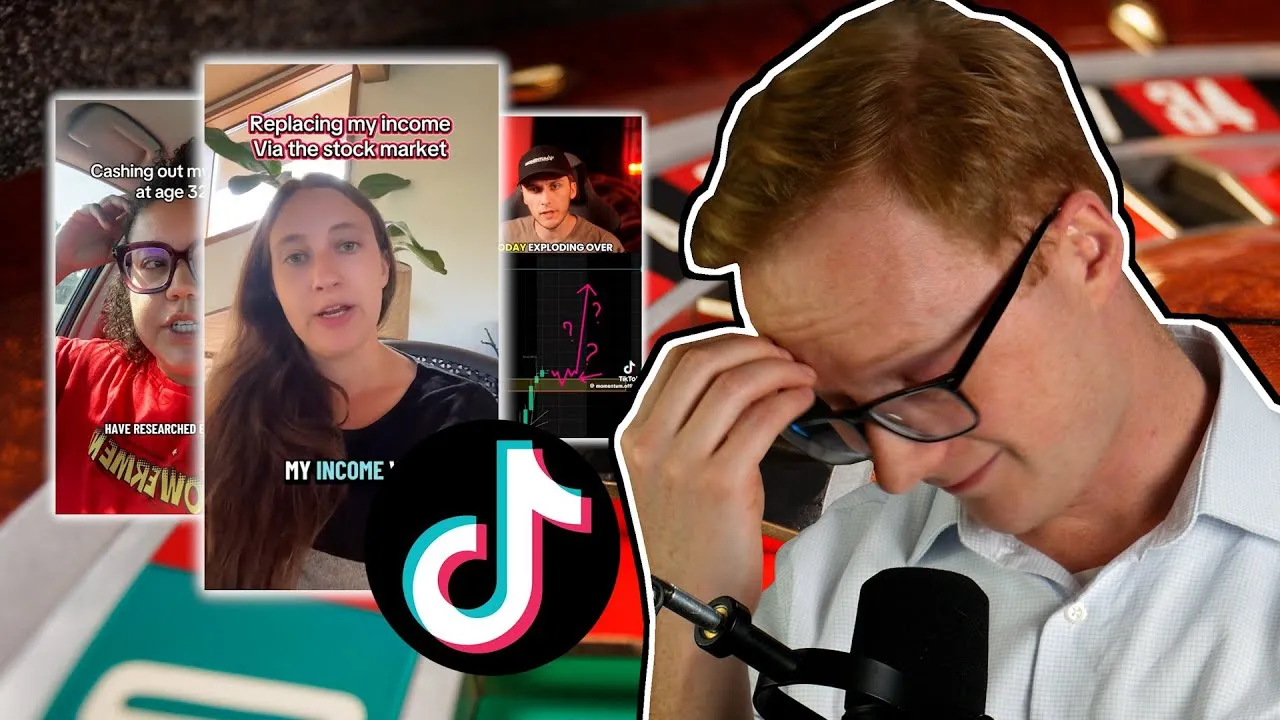
In a special extended edition of his series, registered portfolio manager and CFA charterholder Richard Coffin dissects popular Finance TikToks, offering a professional perspective on common investment strategies and misconceptions circulating on social media. Coffin, also a CFP professional, aims to provide constructive, educational insights, particularly highlighting the risks associated with simplified investment advice often presented in short-form video content.
ETF Allocation and Diversification Concerns
The analysis begins with a TikTok creator’s plan to invest $1,000 in 2025, allocating funds across QQQ, VTI, STRF, and Bitcoin. Coffin points out potential issues with the proposed ETF allocation, specifically the heavy concentration in US tech-heavy large-cap companies within QQQ. He notes that the overlap between QQQ and VTI (which represents the total US stock market) is significant, with approximately half of their holdings by weight being the same. This reduces the intended diversification benefit, making it more of an active bet on a concentrated sector rather than broad market exposure.
“These aren’t as diversified of funds as they used to be. I think Nvidia, for example, is like 10% of QQQ now. And between these two funds, there’s also a lot of overlap… So, you aren’t actually really diversifying that much by buying these two different funds.”
Skepticism Around High-Yield Investments
A significant portion of Coffin’s critique focuses on the suggestion to invest in STRF (Stripe, a preferred share sold by a Bitcoin treasury company) for a 10% dividend yield with purported downside protection. Coffin expresses strong reservations, explaining that STRF acts as a leveraged Bitcoin proxy. He highlights that the promised 10% yield is not backed by underlying cash flow; instead, the company raises money to buy Bitcoin and uses new investor funds or Bitcoin sales to pay dividends. This structure bears resemblance to a Ponzi scheme, Coffin suggests, and carries substantial risk if Bitcoin’s value declines. Furthermore, he disputes the claim of “downside protection,” noting that preferred shares, while offering fixed payments, lack the maturity dates or face values of traditional bonds and are technically classified as equity, meaning dividends are not legally obligated. He also questions the “consistency” of the dividends, as only two have been paid to date.
Options Trading: Leverage and Risk
The analysis then shifts to a TikTok demonstrating how to make $10,000 as a trader using options with a small starting capital of a few hundred dollars. Coffin explains the mechanics of Exponential Moving Averages (EMAs) as indicators for identifying uptrends and downtrends, often used in conjunction with support and resistance levels. However, he cautions viewers about the oversimplification of such strategies. He points out instances where the presented EMA strategy failed, leading to losses, and emphasizes that past performance can be cherry-picked to make any strategy look attractive in hindsight. Coffin stresses that while options offer leverage, amplifying potential returns, they equally amplify downside risk, significantly increasing the chance of losing the entire investment. He contrasts this with a humorous, albeit inappropriate, analogy of betting everything on ‘black’ in roulette to illustrate the high-risk nature of such approaches.
Misconceptions About BlackRock and Retirement Funds
Another TikTok features a user deciding to divest from retirement funds due to a perceived negative impact from BlackRock’s investments, specifically mentioning harm to communities. Coffin clarifies a common misconception, distinguishing BlackRock from BlackStone. He explains that BlackRock’s primary business is managing investment funds focused on publicly traded stocks, not purchasing single-family homes, a practice often attributed to BlackStone. While acknowledging criticisms of corporate real estate acquisition, Coffin argues BlackRock is the wrong entity to target for this specific concern. He also advises the TikTok creator to consult their financial advisor regarding retirement fund options, noting potential penalties for early withdrawal from 401(k)s and the benefits of tax-deferred growth.
Covered Calls: Yield vs. Capital Appreciation
The discussion extends to a creator’s attempt to replace income by selling covered calls on an initial investment of $1,542, derived from paid family leave benefits. The creator hoped to achieve a 10% weekly return. Coffin deems this expectation highly unrealistic, stating that a 10% weekly return would equate to over 1,000% annually. He explains that covered call strategies, while generating premium income, cap potential upside gains from stock appreciation. He references research indicating that covered call ETFs have historically underperformed their non-covered call counterparts due to this limitation. Coffin warns that the allure of high yields can obscure significant price depreciation, and advises caution for those who don’t fully understand the strategy’s risk-reward trade-off.
Earning vs. Investing and the Role of Asset Managers
A TikTok creator argues that investing is secondary to earning, suggesting that traditional investing primarily benefits asset managers and banks. Coffin partially agrees, advocating for prioritizing income growth through skill development over solely chasing investment returns. However, he strongly refutes the idea that investing is pointless. He illustrates the power of long-term investing with an example: saving $500 a month for 40 years with a 6% annual return could result in nearly a million dollars, with earned savings comprising only a quarter of that total. He also corrects the misconception about asset managers’ risk, explaining they earn fees for managing funds rather than investing their own capital, and are thus largely agnostic to the performance of the underlying assets they manage.
Day Trading Courses and Incentive Structures
The final segments address the promotion of day trading courses, particularly those claiming success for beginners with no prior knowledge. Coffin expresses skepticism, labeling such claims as pseudoscientific and often based on cherry-picked data. He criticizes the dual marketing of simplicity (anyone can do it) and complexity (psychology dictates outcomes), noting that the latter can serve as an excuse when strategies fail. Coffin emphasizes the importance of understanding the incentives behind financial advice shared online, suggesting viewers check creators’ profiles for course or service sales. He concludes by referencing Charlie Munger’s adage: “Show me the incentives and I’ll show you the outcome.”
Micro-Cap Stocks and Market Manipulation Concerns
Coffin briefly touches upon a TikTok promoting specific stocks for intraday trading, highlighting a recent IPO that surged over 60%. He notes the shift from long-term investment advice to short-term, even daily, stock recommendations. Coffin expresses concern about the projections made for certain stocks, questioning the basis for doubling potential returns based on previous day’s performance. He also raises a red flag regarding micro-cap and nano-cap stocks, suggesting that social media influence, especially from creators with large followings, can potentially manipulate prices in low-volume stocks, making followers vulnerable to becoming exit liquidity for traders.
US National Debt: Who Owes Whom?
Finally, Coffin addresses a lighthearted TikTok about taking on the US national debt. While humorous, the underlying question of who the US owes money to is serious. Coffin explains that a significant portion of the debt is held domestically by US citizens and institutions through government bonds. He notes that about one-fifth is held intergovernmentally. He also points out that major foreign holders include countries like China and Japan, each holding around a trillion dollars in US debt. He stresses that defaulting on this debt would have severe domestic consequences, impacting American citizens and companies.
Debt Collection Practices Under the Microscope
The final TikTok segment discussed involves advice on handling debt collectors, suggesting that debts can disappear or be settled for less. Coffin explains the process where debt is sold by original creditors to collection agencies at a discount. He advises getting all agreements in writing and notes that the debt’s value decreases over time as it’s resold. He also touches upon debt validation, a process where collectors must provide documentation to prove the debt’s legitimacy, and the statute of limitations, which can prevent legal action for debt recovery after a certain period. He cautions against verbally acknowledging a debt, as this can reset the statute of limitations or create a binding agreement.
Source: Investment Analyst Reacts to Finance TikToks – Bonus Edition (YouTube)