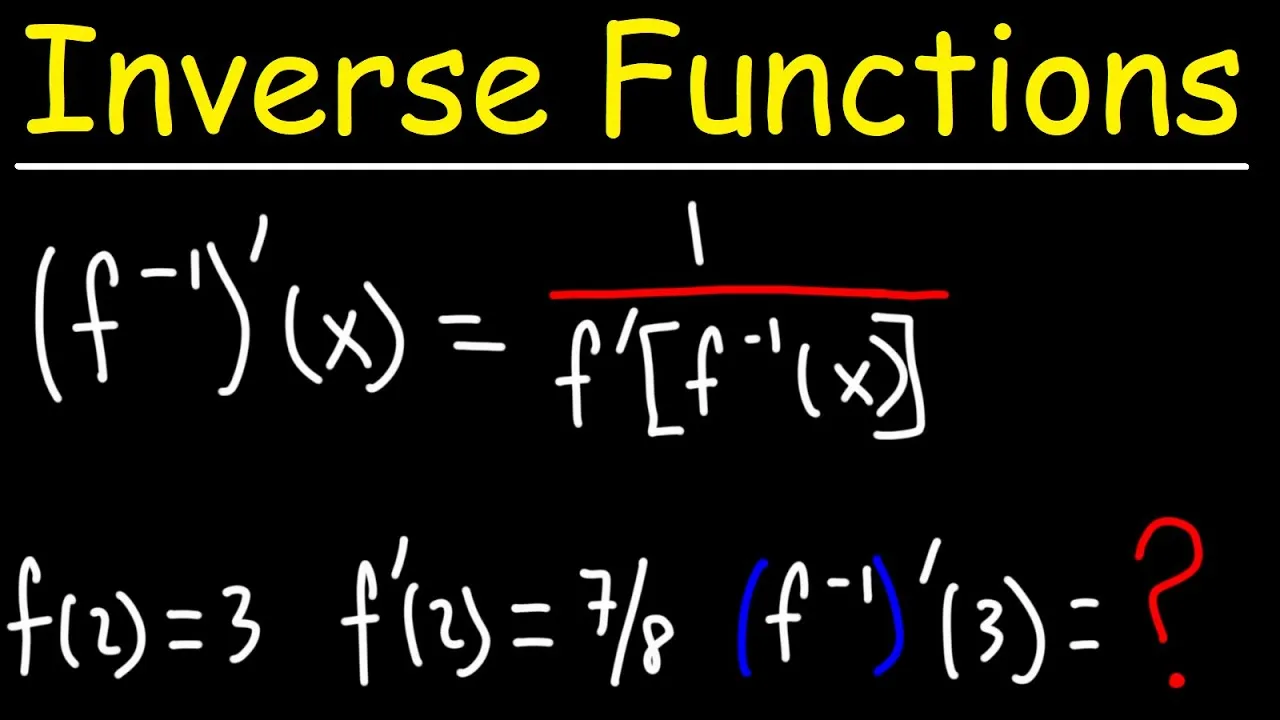
How to Find the Derivative of an Inverse Function Quickly
This guide will walk you through the process of evaluating the derivative of an inverse function. You’ll learn how to correctly interpret the given information, apply the necessary formula, and arrive at the correct answer, even when the notation can seem confusing at first.
Understanding the Core Concept
The key to solving problems involving the derivative of an inverse function lies in understanding the relationship between a function and its inverse, and how this relationship applies to derivatives. Specifically, you need to grasp the formula for the derivative of an inverse function and how to correctly identify the values to plug into it.
The Formula for the Derivative of an Inverse Function
The fundamental formula you need to know is:
(f⁻¹)'(a) = 1 / f'(f⁻¹(a))
Let’s break this down:
(f⁻¹)'(a): This represents the derivative of the inverse function, evaluated at the input value ‘a’.f'(f⁻¹(a)): This represents the derivative of the original function, evaluated at the valuef⁻¹(a).
Step-by-Step Guide
Identify the Given Information
Typically, you will be given two pieces of information about a function
f(x):- A point on the function:
f(x₀) = y₀ - The derivative of the function at that point:
f'(x₀) = value
Example: Let’s say you are given that
f(2) = 3andf'(2) = 7/8.- A point on the function:
Understand the Relationship Between f and f⁻¹
The most crucial concept to grasp is that for any function
fand its inversef⁻¹:- If
f(x₀) = y₀, thenf⁻¹(y₀) = x₀.
In our example, since
f(2) = 3, it means that the inverse function, when given an input of 3, will output 2. So,f⁻¹(3) = 2.Key Insight: For inverse functions, the roles of input (x) and output (y) are swapped. The input of
fbecomes the output off⁻¹, and the output offbecomes the input off⁻¹.- If
Determine the Input for the Derivative of the Inverse Function
The problem will ask you to find the derivative of the inverse function at a specific input. Let’s say you need to find
(f⁻¹)'(a).Important Note: When dealing with the derivative of an inverse function, the input value ‘a’ (which appears to be an x-value in the notation
(f⁻¹)'(a)) is actually the y-value from the original functionf.In our example, if we need to find the derivative of the inverse function at an input of 3, we are looking for
(f⁻¹)'(3). This ‘3’ is the y-value from our original pointf(2) = 3.Apply the Formula
Now, let’s plug our values into the formula:
(f⁻¹)'(a) = 1 / f'(f⁻¹(a)).We want to find
(f⁻¹)'(3). Following the formula:- The input ‘a’ is 3.
- We need to find
f⁻¹(3). From Step 2, we know thatf⁻¹(3) = 2. - Now, substitute this back into the formula:
(f⁻¹)'(3) = 1 / f'(2).
Evaluate f'(f⁻¹(a))
You need the value of the derivative of the original function,
f', evaluated at the pointf⁻¹(a).In our example, we need to find
f'(2). The problem statement directly gives us this value:f'(2) = 7/8.Calculate the Final Result
Substitute the value from Step 5 into the formula from Step 4.
We have
(f⁻¹)'(3) = 1 / f'(2), and we knowf'(2) = 7/8.So,
(f⁻¹)'(3) = 1 / (7/8).To simplify, take the reciprocal of the fraction:
(f⁻¹)'(3) = 8/7.
Tips for Success
- Focus on Input/Output Swapping: Always remember that for inverse functions, inputs and outputs switch places. If
f(x) = y, thenf⁻¹(y) = x. - Identify the ‘y’ for the Inverse Input: The input value given for the derivative of the inverse function (e.g., the ‘3’ in
(f⁻¹)'(3)) is the y-value from the original function. Use this y-value to find the corresponding x-value for the original function, which will be the input forf'. - Don’t Be Fooled by Notation: The notation
(f⁻¹)'(a)can be misleading. The ‘a’ looks like an x-value, but it’s actually the y-value from the original function.
Prerequisites
Before attempting these problems, ensure you have a solid understanding of:
- Basic function notation (
f(x)). - The concept of inverse functions and how to find them.
- The definition and calculation of derivatives.
Source: How to Evaluate the Derivative of an Inverse Function (YouTube)