How to Find the Second Derivative Using Implicit Differentiation
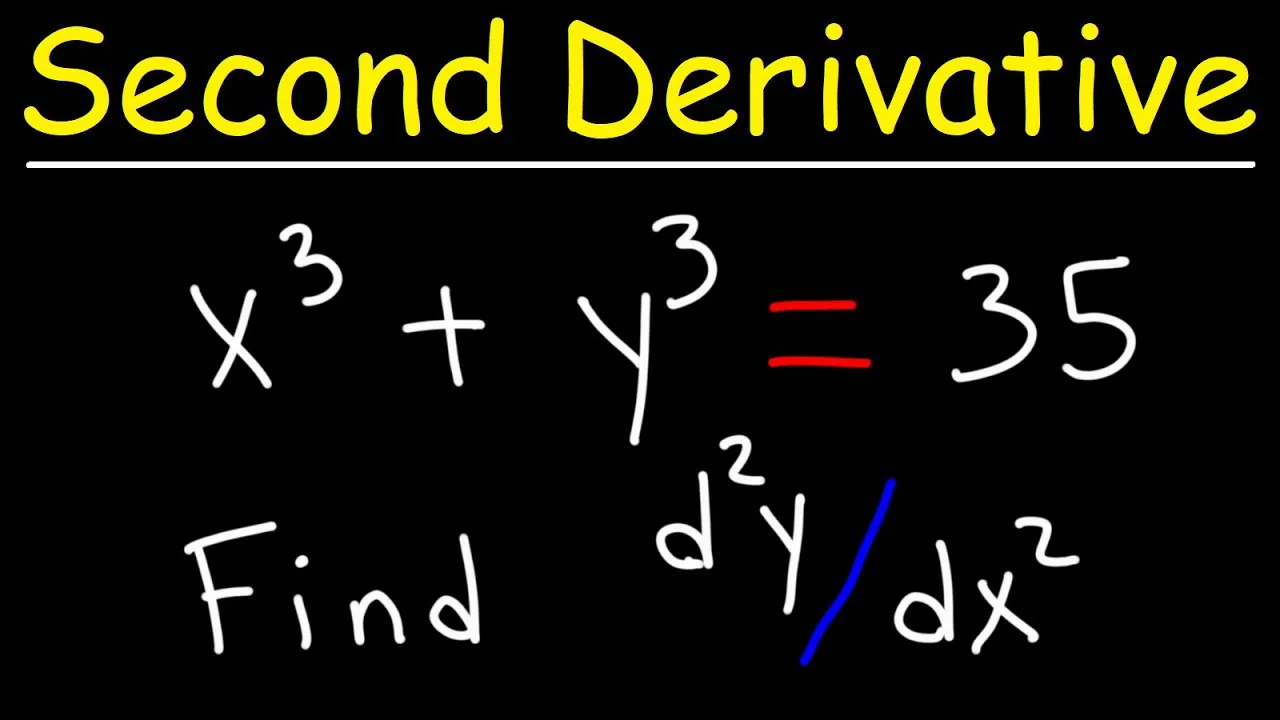
Implicit differentiation is a powerful technique used to find derivatives of equations where it’s difficult or impossible to isolate y explicitly in terms of x. This article will guide you through the process of finding the second derivative, ( frac{d^2y}{dx^2} ), of an implicitly defined function.
Overview
In this tutorial, you will learn how to:
- Apply implicit differentiation to find the first derivative, ( frac{dy}{dx} ).
- Differentiate the resulting expression for ( frac{dy}{dx} ) to find the second derivative, ( frac{d^2y}{dx^2} ).
- Use the quotient rule effectively during differentiation.
- Substitute the expression for ( frac{dy}{dx} ) back into the second derivative equation.
- Simplify the final expression, often by utilizing the original implicit equation.
Prerequisites
Before you begin, ensure you have a solid understanding of:
- Basic differentiation rules (power rule, constant multiple rule).
- The chain rule.
- The quotient rule.
- Implicit differentiation principles.
Steps to Find the Second Derivative
Step 1: Differentiate the Original Equation Implicitly to Find the First Derivative ( frac{dy}{dx} )
Start with the given implicit equation. In this example, we will use ( x^3 + y^3 = 35 ). Differentiate both sides of the equation with respect to ( x ), remembering to apply the chain rule whenever you differentiate a term involving ( y ).
- Differentiate ( x^3 ) with respect to ( x ): ( frac{d}{dx}(x^3) = 3x^2 ).
- Differentiate ( y^3 ) with respect to ( x ): ( frac{d}{dx}(y^3) = 3y^2 cdot frac{dy}{dx} ). (Using the chain rule: derivative of ( y^3 ) is ( 3y^2 ), multiplied by the derivative of ( y ) with respect to ( x ), which is ( frac{dy}{dx} )).
- Differentiate the constant ( 35 ) with respect to ( x ): ( frac{d}{dx}(35) = 0 ).
Combine these results:
( 3x^2 + 3y^2 frac{dy}{dx} = 0 )
Step 2: Solve for the First Derivative ( frac{dy}{dx} )
Isolate ( frac{dy}{dx} ) from the equation obtained in Step 1.
- Subtract ( 3x^2 ) from both sides: ( 3y^2 frac{dy}{dx} = -3x^2 ).
- Divide both sides by ( 3y^2 ): ( frac{dy}{dx} = frac{-3x^2}{3y^2} ).
- Simplify the expression by canceling the common factor of 3: ( frac{dy}{dx} = -frac{x^2}{y^2} ).
Tip: Always simplify your expression for ( frac{dy}{dx} ) as much as possible before proceeding to the next differentiation step. This will make the subsequent calculations much easier.
Step 3: Differentiate the First Derivative Implicitly to Find the Second Derivative ( frac{d^2y}{dx^2} )
Now, differentiate the expression for ( frac{dy}{dx} ) with respect to ( x ). The derivative of ( frac{dy}{dx} ) with respect to ( x ) is ( frac{d^2y}{dx^2} ). Since ( frac{dy}{dx} = -frac{x^2}{y^2} ) is a quotient, you will need to use the quotient rule.
Recall the quotient rule: If ( h(x) = frac{f(x)}{g(x)} ), then ( h'(x) = frac{g(x)f'(x) – f(x)g'(x)}{[g(x)]^2} ).
In our case, we are differentiating ( frac{dy}{dx} = -frac{x^2}{y^2} ). Let’s focus on differentiating ( frac{x^2}{y^2} ) first.
- Identify ( f(x) ) and ( g(x) ) for the quotient rule. Let ( f = x^2 ) and ( g = y^2 ).
- Find the derivatives of ( f ) and ( g ) with respect to ( x ).
- ( f’ = frac{d}{dx}(x^2) = 2x ).
- ( g’ = frac{d}{dx}(y^2) = 2y cdot frac{dy}{dx} ). (Again, using the chain rule).
- Apply the quotient rule formula: ( frac{d}{dx}left(frac{x^2}{y^2}right) = frac{g f’ – f g’}{g^2} ).
- Substitute the components:
- Simplify the numerator: ( frac{2xy^2 – 2x^2y frac{dy}{dx}}{y^4} ).
( frac{d}{dx}left(frac{x^2}{y^2}right) = frac{(y^2)(2x) – (x^2)(2y frac{dy}{dx})}{(y^2)^2} )
So, ( frac{d^2y}{dx^2} = -frac{d}{dx}left(frac{x^2}{y^2}right) = -left(frac{2xy^2 – 2x^2y frac{dy}{dx}}{y^4}right) ).
Step 4: Substitute the Expression for ( frac{dy}{dx} )
The expression for ( frac{d^2y}{dx^2} ) still contains ( frac{dy}{dx} ). Substitute the expression ( frac{dy}{dx} = -frac{x^2}{y^2} ) back into the equation from Step 3.
- Substitute ( frac{dy}{dx} = -frac{x^2}{y^2} ) into the numerator:
- Simplify the term involving ( frac{dy}{dx} ): ( 2x^2y left(-frac{x^2}{y^2}right) = -frac{2x^4y}{y^2} ).
- Notice that one ( y ) in the numerator can cancel with one ( y ) in the denominator: ( -frac{2x^4}{y} ).
- Substitute this back into the expression for ( frac{d^2y}{dx^2} ):
( frac{d^2y}{dx^2} = -frac{2xy^2 – 2x^2y left(-frac{x^2}{y^2}right)}{y^4} )
( frac{d^2y}{dx^2} = -frac{2xy^2 – left(-frac{2x^4}{y}right)}{y^4} ) which simplifies to ( frac{d^2y}{dx^2} = -frac{2xy^2 + frac{2x^4}{y}}{y^4} ).
Step 5: Simplify the Second Derivative Expression
The expression for ( frac{d^2y}{dx^2} ) can often be simplified further. A common strategy is to clear complex fractions by multiplying the numerator and denominator by a suitable term.
- Multiply the numerator and the denominator of the main fraction by ( y ) to eliminate the fraction within the numerator:
- Distribute ( y ) in the numerator:
- Factor out the greatest common factor (GCF) from the numerator. The GCF is ( 2x ):
( frac{d^2y}{dx^2} = -frac{y left(2xy^2 + frac{2x^4}{y}right)}{y cdot y^4} )
( frac{d^2y}{dx^2} = -frac{2xy^3 + 2x^4}{y^5} )
( frac{d^2y}{dx^2} = -frac{2x(y^3 + x^3)}{y^5} )
Step 6: Utilize the Original Equation for Final Simplification
Often, the original implicit equation can be used to substitute a part of the simplified second derivative expression, leading to a more compact final answer.
- Recall the original equation: ( x^3 + y^3 = 35 ).
- Notice that the term ( y^3 + x^3 ) appears in the numerator of our expression for ( frac{d^2y}{dx^2} ).
- Substitute ( 35 ) for ( y^3 + x^3 ) in the numerator:
- Perform the final multiplication:
( frac{d^2y}{dx^2} = -frac{2x(35)}{y^5} )
( frac{d^2y}{dx^2} = -frac{70x}{y^5} )
Expert Note: The ability to substitute back using the original equation is a hallmark of problems solvable with implicit differentiation, often leading to elegant final forms.
Conclusion
By following these steps, you have successfully found the second derivative ( frac{d^2y}{dx^2} ) of the implicitly defined function ( x^3 + y^3 = 35 ) using implicit differentiation. The final result is ( frac{d^2y}{dx^2} = -frac{70x}{y^5} ).
Source: Finding The Second Derivative by Implicit Differentiation (YouTube)