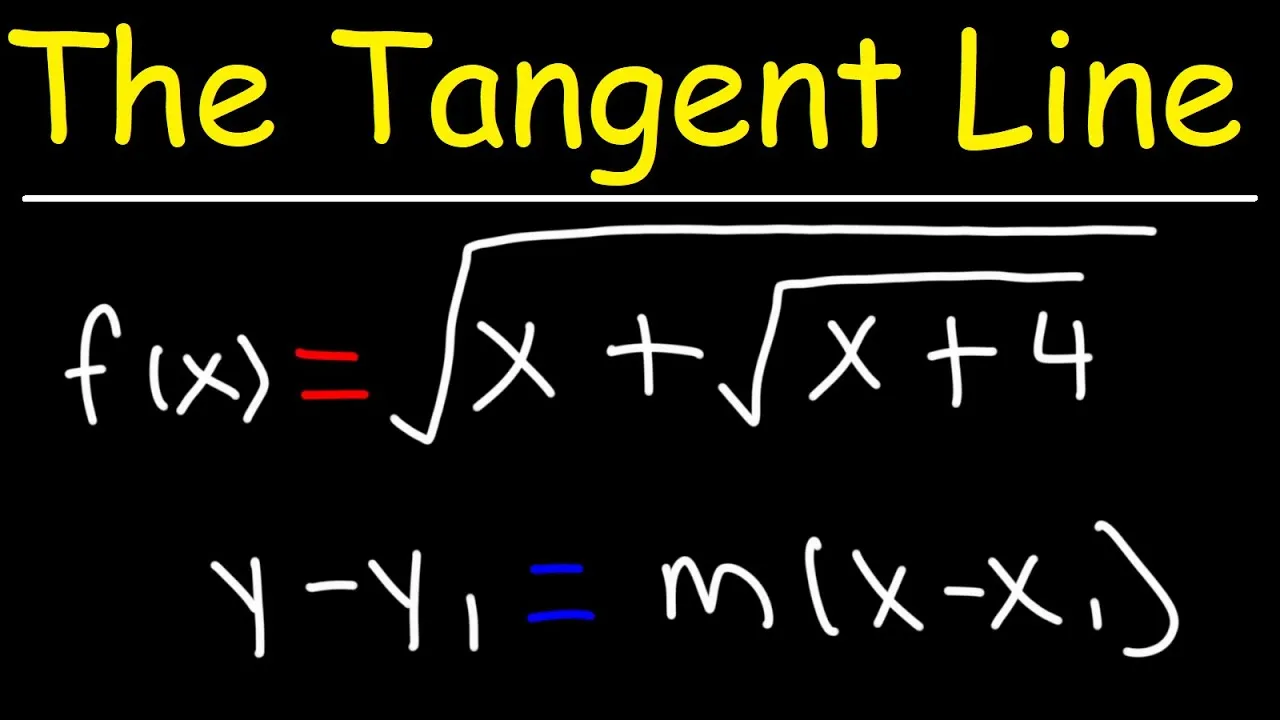
Mastering Tangent Lines: A Guide to Composite Radical Functions
This tutorial will guide you through the process of finding the equation of a tangent line to a composite radical function. We will cover how to determine the necessary point on the function and calculate the slope of the tangent line using the chain rule and power rule. Finally, we’ll use the point-slope formula to construct the equation of the tangent line.
Prerequisites
- Understanding of basic algebraic operations.
- Familiarity with radical notation and exponents.
- Knowledge of the power rule for differentiation.
- Understanding of the chain rule for differentiation.
- Familiarity with the point-slope form of a linear equation.
Step 1: Determine the Point of Tangency
To find the equation of a tangent line, we need two key pieces of information: the slope of the line and a point that the line passes through. The problem provides the x-coordinate of this point, which is x = 12. We need to find the corresponding y-coordinate by evaluating the function at this x-value. Let’s call the function f(x).
- Evaluate the function at the given x-value: Substitute x = 12 into the function f(x). In this example, the function is f(x) = sqrt{sqrt{x+4} + x + 4}.
- Calculate the y-coordinate:
- First, calculate the inner part: 12 + 4 = 16.
- Then, find the square root of that result: sqrt{16} = 4.
- Now, substitute this value back into the function: f(12) = sqrt{4 + 12 + 4}.
- Simplify the expression inside the outer square root: 4 + 12 + 4 = 20.
- The y-coordinate is sqrt{20}.
Correction from original transcript: The transcript incorrectly calculates f(12). Let’s re-evaluate f(12) for the function f(x) = sqrt{sqrt{x+4} + x + 4}.
- Evaluate the inner radical: sqrt{12+4} = sqrt{16} = 4.
- Substitute into the outer radical: f(12) = sqrt{4 + 12 + 4} = sqrt{20}.
So, the point of tangency is (12, sqrt{20}).
Expert Note: Always double-check your arithmetic, especially when dealing with nested functions and radicals. A small error early on can lead to an incorrect final answer.
Step 2: Find the Derivative of the Function
To find the slope of the tangent line, we need to calculate the first derivative of the function, f'(x). Since this is a composite function involving radicals, we will use the chain rule in conjunction with the power rule.
- Rewrite the function using exponents: It’s often easier to differentiate when the function is expressed using fractional exponents. The function f(x) = sqrt{sqrt{x+4} + x + 4} can be rewritten as:
f(x) = ( (x+4)^{1/2} + x + 4 )^{1/2} - Apply the chain rule (outer function first): The chain rule states that the derivative of g(u(x)) is g'(u(x)) * u'(x). In our case, the outer function is u^{1/2} and the inner function is (x+4)^{1/2} + x + 4.
- The derivative of the outer function (u^{1/2}) is frac{1}{2}u^{-1/2}.
- So, applying this to our function, we get: frac{1}{2} ( (x+4)^{1/2} + x + 4 )^{-1/2}.
- Find the derivative of the inner function (u’): Now we need to differentiate the expression inside the outer parentheses: (x+4)^{1/2} + x + 4.
- The derivative of (x+4)^{1/2} requires another application of the chain rule. The derivative of v^{1/2} is frac{1}{2}v^{-1/2}. Here, v = x+4, so v’ = 1. Thus, the derivative of (x+4)^{1/2} is frac{1}{2}(x+4)^{-1/2} * 1 = frac{1}{2sqrt{x+4}}.
- The derivative of x is 1.
- The derivative of 4 is 0.
- So, the derivative of the inner function is frac{1}{2sqrt{x+4}} + 1.
- Combine the parts using the chain rule: Multiply the derivative of the outer function by the derivative of the inner function:
f'(x) = frac{1}{2} ( (x+4)^{1/2} + x + 4 )^{-1/2} * left( frac{1}{2sqrt{x+4}} + 1 right)
Tip: Rewriting negative exponents as positive ones by moving terms to the denominator can help simplify the expression before plugging in values.
f'(x) = frac{1}{2sqrt{sqrt{x+4} + x + 4}} * left( frac{1}{2sqrt{x+4}} + 1 right)
Step 3: Calculate the Slope at x = 12
Now that we have the derivative, f'(x), we can find the slope of the tangent line at x = 12 by evaluating f'(12).
- Substitute x = 12 into the derivative:
f'(12) = frac{1}{2sqrt{sqrt{12+4} + 12 + 4}} * left( frac{1}{2sqrt{12+4}} + 1 right) - Simplify the terms:
- First, calculate sqrt{12+4} = sqrt{16} = 4.
- Substitute this value back: f'(12) = frac{1}{2sqrt{4 + 12 + 4}} * left( frac{1}{2*4} + 1 right)
- Simplify further: f'(12) = frac{1}{2sqrt{20}} * left( frac{1}{8} + 1 right)
- Combine the terms in the second parenthesis: frac{1}{8} + 1 = frac{1}{8} + frac{8}{8} = frac{9}{8}.
- So, f'(12) = frac{1}{2sqrt{20}} * frac{9}{8}.
- Multiply the fractions: f'(12) = frac{9}{16sqrt{20}}.
- Simplify the radical (optional but good practice): sqrt{20} = sqrt{4*5} = 2sqrt{5}.
f'(12) = frac{9}{16(2sqrt{5})} = frac{9}{32sqrt{5}}. - Rationalize the denominator (optional but often required): Multiply the numerator and denominator by sqrt{5}.
f'(12) = frac{9sqrt{5}}{32sqrt{5} * sqrt{5}} = frac{9sqrt{5}}{32*5} = frac{9sqrt{5}}{160}.
Warning: The transcript’s calculation for the slope resulted in 9/64. Based on the function f(x) = sqrt{sqrt{x+4} + x + 4}, the slope at x=12 is frac{9sqrt{5}}{160}. If the function was intended to be simpler, the original transcript’s calculation might be correct for that different function.
Step 4: Write the Equation of the Tangent Line
We now have the point of tangency (12, sqrt{20}) and the slope m = frac{9sqrt{5}}{160}. We can use the point-slope form of a linear equation, which is y – y1 = m(x – x1).
- Substitute the point and slope into the point-slope formula:
y – sqrt{20} = frac{9sqrt{5}}{160} (x – 12) - Simplify the equation (optional): You can rearrange this equation into slope-intercept form (y = mx + b) if needed.
y = frac{9sqrt{5}}{160} (x – 12) + sqrt{20}
y = frac{9sqrt{5}}{160}x – frac{9sqrt{5} * 12}{160} + sqrt{20}
y = frac{9sqrt{5}}{160}x – frac{108sqrt{5}}{160} + sqrt{20}
(Note: sqrt{20} = 2sqrt{5})
y = frac{9sqrt{5}}{160}x – frac{108sqrt{5}}{160} + frac{320sqrt{5}}{160}
y = frac{9sqrt{5}}{160}x + frac{212sqrt{5}}{160}
y = frac{9sqrt{5}}{160}x + frac{53sqrt{5}}{40}
Conclusion: By following these steps, you can systematically find the equation of the tangent line to a composite radical function using the chain rule. Remember to carefully apply the differentiation rules and perform your calculations accurately.
Source: Finding The Equation of the Tangent Line of a Composite Radical Function Using the Chain Rule (YouTube)