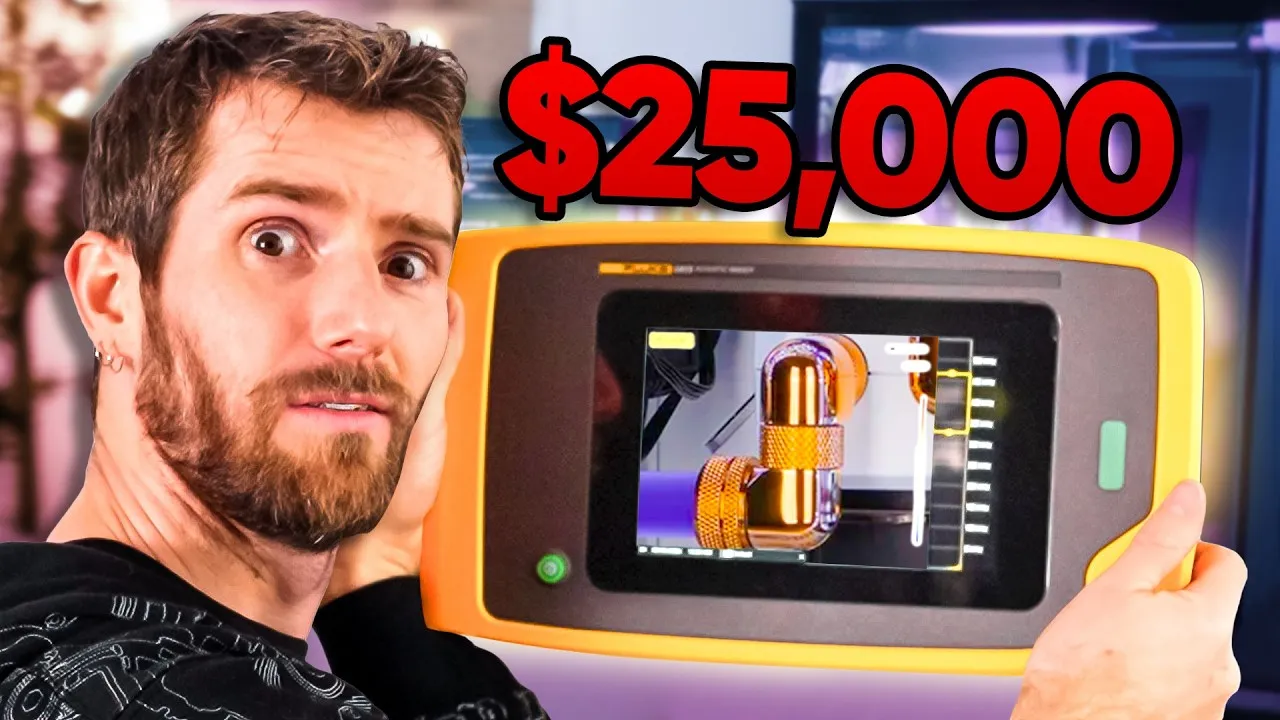
Fluke’s $25,000 Acoustic Imager Tackles Invisible Problems
Imagine trying to fix a problem you can’t even see. For minor issues like a leaky tire, a bit of soapy water reveals the offending bubbles. But when the system is as complex as a workshop’s compressed air hoses, finding a tiny, invisible leak can feel like searching for a needle in a haystack. Enter the Fluke II 915 acoustic imager, a $25,000 handheld device that promises to turn the invisible audible and visible.
This isn’t your typical camera. Instead of capturing light, the Fluke II 915 captures sound. It then translates this audio data into a visual representation, akin to a heat map, allowing users to pinpoint leaks and equipment malfunctions, even those operating at frequencies beyond human hearing. The question is: can this high-tech tool justify its hefty price tag by solving real-world problems?
The Compressed Air Conundrum
The inspiration for this deep dive into acoustic imaging came from a persistent issue in the workshop: a leaky compressed air system. This system is indispensable for a variety of tasks, from cleaning and polishing to cutting and even sandblasting. However, an unseen leak forces the compressor to run far more often than necessary, causing significant disruption. The Fluke II 915 was brought in with the hope of quickly identifying and resolving this costly problem.
Despite never having used the device before, the user was eager to put it to the test. The initial experience involved navigating the interface and understanding how to differentiate between ambient workshop noise and actual leaks. Within minutes, the imager began to show promise. A distinct sound anomaly was detected, pinpointing a leak that, while audible up close, was previously hard to locate accurately. The imager identified the leak, and within approximately two minutes, the source was found. A second, more obvious leak was also quickly identified, demonstrating the device’s efficiency in locating significant issues.
Quantifying the Cost of Leaks
Beyond simply locating leaks, the Fluke II 915 offers a ‘Leak Q’ mode. This feature allows users to input parameters such as gas type, compression levels, energy costs, and local currency to calculate the financial impact of a detected leak. In this case, even a small air leak was calculated to cost approximately $45 per year. For a system running year-round, this seemingly minor issue represents a tangible and preventable expense. Replacing the faulty fitting was deemed a no-brainer, highlighting the potential return on investment for such diagnostic tools, especially in industrial settings where even small leaks can escalate into significant financial losses.
The Technology Behind the Sound Map
The core of the Fluke II 915’s capability lies in its sophisticated algorithm and precise calibration. The hardware features an array of 64 microphones arranged in a logarithmic spiral, designed to capture sound effectively. Using beamforming technology, the device determines the origin of the sound and overlays this information onto the camera’s visual feed as a ‘sound map.’ This map, resembling a heat map, visually highlights areas of acoustic anomaly. The precise positioning of each microphone relative to the others and the central camera allows for accurate sound source triangulation by analyzing minute differences in sound reception delays.
However, the device has limitations. Its microphones capture sound within the 2 kHz to 100 kHz range, well above human hearing. This means that very low-frequency sounds, such as those from a slow liquid drip, might not be detected. To address this, a workaround was devised for a water cooling system leak: pressurizing the loop with air to generate a detectable sound.
Tackling Smaller Leaks and Beyond
The experiment extended to testing the imager’s ability to detect smaller leaks, such as a missing O-ring in a hardline PC water cooling fitting. Even without an O-ring, the system appeared sealed, but the Fluke II 915 successfully identified the subtle leak. This capability is particularly valuable for preventing potential damage to sensitive components like GPUs, where even small liquid leaks can be catastrophic.
For environments like clean rooms, where maintaining controlled air pressure is crucial, the Fluke II 915 can be complemented by the Fluke Beacon. This accessory emits a 40,000 Hz sound, undetectable by humans, allowing for leak detection within pressurized systems. The imager can then be tuned to this specific frequency to pinpoint the source.
Broadening the Applications
The utility of acoustic imagers extends far beyond simple air leaks. They can be employed to inspect critical infrastructure like transmission towers from a distance (up to 120 meters), detecting partial discharge or arcing that could pose fire hazards. Closer to home, the device was used to investigate coil whine in a GPU. While not dangerous, coil whine can be an irritating auditory distraction. The imager successfully pinpointed the source of the noise to the VRM area on the back of the card when the GPU was under load.
The user also explored its use in diagnosing a high-pitched whine emanating from USB fiber optic extenders. By adjusting the frequency band and sensitivity settings, the imager could isolate the specific frequency of the whine, even though it was within the audible range for some but not all individuals. This highlights the device’s power in diagnosing subtle auditory issues.
Considering the Cost and Alternatives
The Fluke II 915, at $25,000, is a significant investment. While its capabilities are impressive, its practicality for widespread individual use is questionable. For businesses, the cost can be justified by the potential savings in energy, reduced downtime, and prevention of costly equipment failures. The Fluke III 500, for instance, offers leak Q functionality for around $8,500 but with a more limited frequency range. More advanced models like the II 15 include additional features like ‘mech’ mode for detecting faulty bearings in industrial machinery.
For those seeking more budget-friendly options, the market offers alternatives, including open-source acoustic imagers like the Centenna. However, these often require more user calibration and technical expertise. The choice ultimately depends on the specific needs and budget of the user or organization.
Workshop Fixes and Final Verdict
Back in the workshop, the initial compressed air leaks were addressed. The suspected culprit was a faulty regulator and potentially the hoses. Both were replaced, and the regulator was rebuilt. The system was tested again, and remarkably, no leaks were detected. In another instance, a missing O-ring in a fastener was discovered, which, despite not causing a major leak, was rectified. The workshop confirmed that the issues were resolved, thanks to the diagnostic power of the acoustic imager.
The Fluke II 915 acoustic imager is a powerful tool that excels at making the invisible audible and visible. While its price point places it firmly in the professional and industrial realm, its ability to diagnose complex issues, quantify financial losses from leaks, and potentially prevent costly failures makes it an invaluable asset for specific applications. For the average consumer or hobbyist, it remains an aspirational piece of technology, but its impact on industrial efficiency and maintenance is undeniable.
Source: I Paid $25,000 to Find This Leak (YouTube)