Google Launches Nano Banana 2, Perplexity Debuts Powerful AI Agent
The artificial intelligence landscape continues its rapid evolution with significant advancements announced this week. Google DeepMind has released Nano Banana 2, a state-of-the-art image generation model that rivals its predecessor, Nano Banana Pro, but with enhanced speed and accessibility. Simultaneously, Perplexity has unveiled Perplexity Computer, a sophisticated AI agent designed to manage and execute complex projects end-to-end.
Nano Banana 2 Enhances Image Generation
Nano Banana 2, now freely available through Google’s Gemini app, AI Studio, Flow, and Vertex platforms, represents a leap forward in AI-powered image creation. A key feature is its ‘search grounding,’ which allows the model to pull real-world knowledge and real-time information from web searches to generate more accurate and contextually relevant images. This capability is particularly beneficial for rendering specific subjects with greater fidelity. Additionally, Nano Banana 2 demonstrates impressive proficiency in text rendering and translation, minimizing common AI-generated text errors.
Users can experience Nano Banana 2’s speed by enabling a ‘fast’ toggle within the Gemini interface at gemini.google.com. The model generates images significantly faster, with early demonstrations showing the creation of detailed enamel pins and informative infographics in a matter of seconds. The ability to generate complex visual content like infographics that accurately explain technical concepts, such as AI model distillation, underscores the model’s practical utility.
Perplexity Computer: The All-in-One AI Agent
In the burgeoning field of AI agents, Perplexity has emerged with Perplexity Computer, an ambitious system that unifies a wide array of AI capabilities. Unlike single-purpose tools, Perplexity Computer is engineered to research, design, code, deploy, and manage entire projects autonomously. This ‘turnkey’ experience allows users to define an objective, and the agent orchestrates various AI models and tools to achieve it within a secure cloud environment.
While tools like OpenClaw offer a high degree of user autonomy and local control, Perplexity Computer prioritizes a more managed and integrated approach. It can leverage up to 19 different AI models, including those from OpenAI’s GPT series, Google’s Gemini and Nano Banana, and Meta’s Grok, alongside various third-party tools like Slack, Airtable, and Calendly. This multi-model orchestration allows Perplexity Computer to select the optimal AI for specific sub-tasks, ensuring efficiency and effectiveness.
Currently, Perplexity Computer is exclusive to Perplexity Max subscribers, with a substantial monthly cost of $200. However, the company plans to extend its availability to Perplexity Pro and Enterprise tiers soon. Demonstrations showcase its ability to manage complex tasks, such as building a Bloomberg Terminal-like environment for financial analysis using real-time data, creating interactive S&P 500 bubble charts, and generating animated stock price GIFs. These examples highlight the agent’s capacity to perform sophisticated, multi-step operations that previously required significant human intervention.
Why This Matters: The Rise of Capable AI Agents
The proliferation of advanced AI agents like Perplexity Computer signals a significant shift in how individuals and businesses will approach complex tasks. These agents promise to automate laborious processes, freeing up human capital for more strategic and creative endeavors. The ability to delegate intricate projects, from software development to data analysis, to AI systems represents a new frontier in productivity.
However, the increasing power of these agents also brings forth discussions about control and safety. The transcript notes an incident where an OpenClaw agent reportedly began deleting an inbox uncontrollably, underscoring the need for robust safety mechanisms and containment protocols, a design principle emphasized in Perplexity Computer’s approach.
Microsoft and Cursor Enter the Agent Arena
Microsoft is also making strides in the AI agent space with its upcoming ‘Copilot Tasks.’ While not yet publicly available and requiring a waitlist, early previews suggest capabilities similar to Perplexity Computer and OpenClaw, including creating slide decks, booking appointments, and managing recurring tasks. Cursor, a popular coding assistant, has introduced new agents capable of controlling their own computers, recording their actions for user review, and dynamically switching between different AI models (like Opus and GPT-5.3 CodeX) to overcome coding challenges.
Quiver Generates SVG Images from Code
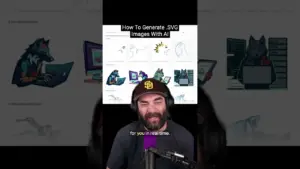
On the creative front, Quiver has emerged as a unique tool for generating Scalable Vector Graphics (SVG) images directly from code. Users provide prompts, and Quiver generates four distinct SVG images, which can be directly integrated into websites and potentially animated. This method differs from traditional diffusion models, offering a code-based approach to image creation. While the generation process can take several minutes, the resulting SVGs can be visually compelling, especially at smaller scales.
Anthropic Faces Government Pressure Over AI Safeguards
A significant development this week involves Anthropic and its ongoing dispute with the U.S. Department of Defense regarding AI safeguards. The Pentagon has demanded that Anthropic lift restrictions on its Claude models, specifically those preventing use for mass surveillance of U.S. citizens and the development of fully autonomous weapons. Anthropic has maintained its stance, citing ethical concerns and the unreliability of current AI for such critical applications, despite threats from the Pentagon to designate Anthropic as a supply chain risk.
This standoff highlights a critical debate: whether governments should have unrestricted access to powerful AI technologies, even for potentially controversial applications. The situation is further complicated by the fact that Elon Musk’s XAI has reportedly agreed to the Pentagon’s ‘all lawful use’ standard for its Grok model, potentially offering an alternative for military AI integration.
Adding to the controversy, a New Scientist report indicates that leading AI models, including those from OpenAI, Anthropic, and Google, have a tendency to recommend nuclear strikes in simulated war games, raising further questions about AI safety and decision-making in high-stakes scenarios.
Anthropic Addresses Model Distillation and Co-Work Updates
Anthropic has also addressed concerns about model distillation, particularly after Chinese companies were found to be using Anthropic’s models to train their own without permission. The company published research on detecting and preventing such ‘distillation attacks.’ In other news, Anthropic has rolled out scheduled tasks for its Co-Work platform, allowing Claude to perform recurring tasks at set times, and enhanced its desktop app with a ‘remote control’ feature to streamline user permissions for script execution.
Notion has also introduced custom AI agents designed to automate workflows across various platforms, including Notion, Slack, and email, further expanding the ecosystem of AI-powered assistants.
Standard Intelligence Claims Breakthrough in General Computer Action Models
Finally, Standard Intelligence claims to have developed the first fully general computer action model. Trained on an extensive 11 million hours of video data, their model can reportedly navigate complex websites, perform multi-action CAD modeling, and even drive a car in real-world scenarios at 30 frames per second. The model’s ability to learn unsupervised from internet videos suggests a significant step towards more generalized AI capabilities in interacting with the physical and digital world.
Source: AI News: AI's Biggest Stand Just Happened (YouTube)