Google Launches Gemini 3.1 Pro, Boosting AI for Scientific Tasks and Coding
Google has unveiled Gemini 3.1 Pro, a significant update to its flagship artificial intelligence model, demonstrating notable improvements in specialized areas such as scientific research, complex coding, and agentic tasks. While not a general overhaul, this iteration focuses on enhancing capabilities that require deep understanding and intricate problem-solving.
Advancements in Scientific and Research Applications
One of the most visually striking demonstrations of Gemini 3.1 Pro’s enhanced capabilities lies in its ability to generate complex animated Scalable Vector Graphics (SVGs). In a test scenario, the model was tasked with creating an animated SVG of a grey wolf playing basketball, designed to be viewable directly in a web browser. After approximately three and a half minutes, the generated output was previewed. While not flawless, with some elements like the basketball player’s number misplaced and the headband slightly obscuring the face, the result was deemed a significant improvement. This showcases the model’s growing prowess in creative generation tied to specific, albeit imaginative, parameters.
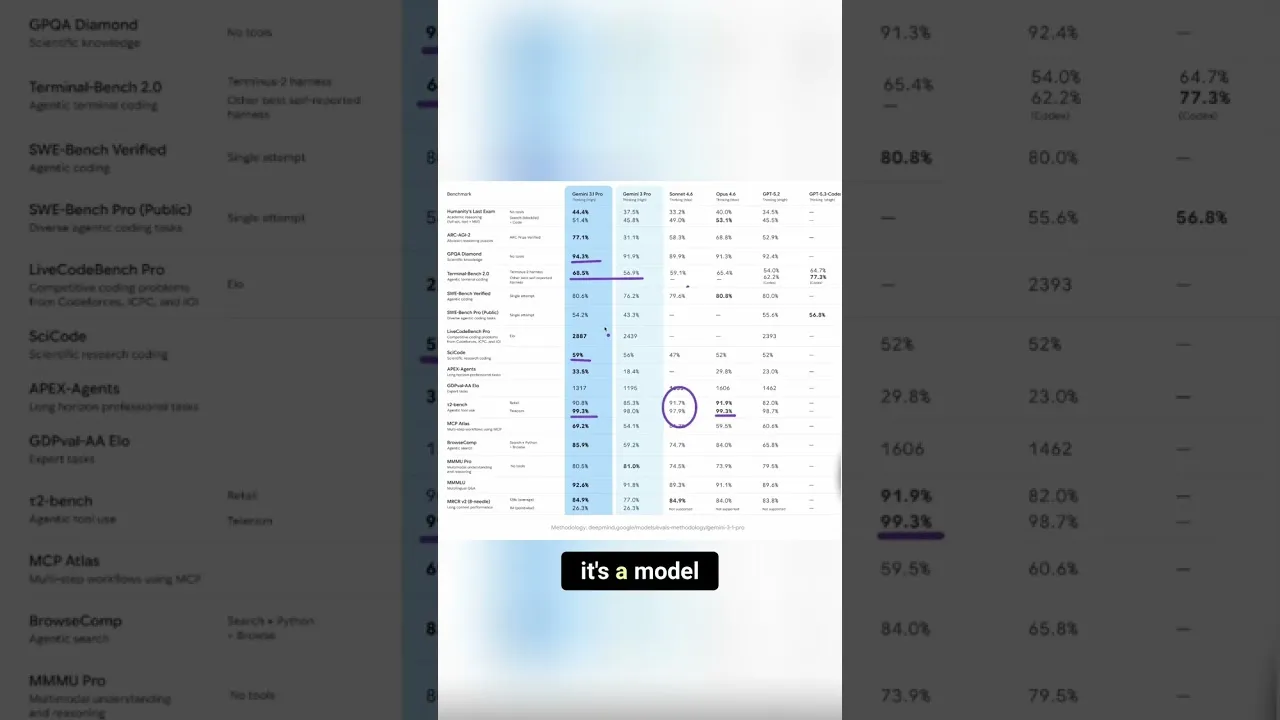
The core of Gemini 3.1 Pro’s advancement, according to initial reports, lies in its enhanced performance across several key domains:
- Scientific Knowledge: The model exhibits a deeper understanding and recall of scientific concepts and data.
- Agentic Terminal Coding: It shows improved ability to interact with and control terminal environments through code, simulating more autonomous agent behavior.
- Scientific Research Coding: Gemini 3.1 Pro is better equipped to handle the specific coding challenges and requirements of scientific research, potentially assisting in data analysis, simulation, and experimental setup.
Availability for Developers and Enterprises
Google is making Gemini 3.1 Pro accessible to a wide range of users through various platforms. Developers can leverage the new model via:
- Google AI Studio: A web-based tool for prototyping and building AI-powered applications.
- Gemini CLI: A command-line interface for developers to integrate Gemini into their workflows.
- Google Anti-gravity: (Note: This appears to be a potential misinterpretation or internal codename from the transcript, as no public Google product is widely known by this name in the context of AI model access. It may refer to a specific research project or internal tool.)
- Android Studio: Google’s integrated development environment (IDE) for Android app development, suggesting potential on-device or integrated AI features.
For enterprise-level applications and solutions, Gemini 3.1 Pro will be available through:
- Vertex AI: Google Cloud’s unified machine learning platform, offering robust tools for building, deploying, and scaling AI models.
- Gemini Enterprise: Likely a dedicated offering for businesses seeking advanced AI capabilities and support.
Understanding AI Models and Parameters
Large Language Models (LLMs) like Gemini are built upon complex neural networks, often with billions or even trillions of parameters. These parameters are essentially the internal variables the model learns during its training process, dictating how it processes information and generates responses. A higher number of parameters often correlates with a model’s capacity to understand nuance, context, and complex relationships within data.
When discussing model improvements, ‘benchmarks’ are crucial. These are standardized tests designed to measure an AI model’s performance across various tasks, such as language understanding, reasoning, and coding. Improvements in benchmarks indicate that the model is becoming more capable and reliable in specific areas. Gemini 3.1 Pro’s focus on scientific and coding tasks suggests its benchmark improvements are likely concentrated in these specialized testing suites.
Why This Matters
The targeted improvements in Gemini 3.1 Pro signal a maturing trend in AI development. Instead of aiming for a single model that excels at everything, companies are increasingly focusing on specialization. This means AI can become more powerful and efficient for specific industries and use cases.
For scientists and researchers, enhanced AI tools could accelerate discovery by automating complex data analysis, assisting in hypothesis generation, or even helping to write research code. In software development, particularly for intricate systems or scientific applications, Gemini 3.1 Pro’s improved coding capabilities could lead to faster development cycles and more robust codebases.
The ability to generate complex assets like animated SVGs, even with minor imperfections, points towards future AI systems that can serve as powerful creative assistants, bridging the gap between conceptual ideas and tangible digital outputs. As AI models become more specialized and accessible, their integration into professional workflows is set to deepen, transforming how we approach complex problems and creative endeavors.
Source: Testing The New Gemini 3.1 Pro Model (YouTube)