Master the Hairy Ball Theorem: A Visual Proof
The Hairy Ball Theorem, despite its whimsical name, is a fundamental concept in topology with surprising real-world implications. Informally, it states that you cannot comb the hair on a hairy ball flat without creating at least one cowlick. This article will guide you through understanding this theorem, exploring its practical applications, and delving into an elegant mathematical proof that demonstrates why it’s impossible to comb every strand of hair flat on a sphere.
Understanding the Hairy Ball Theorem
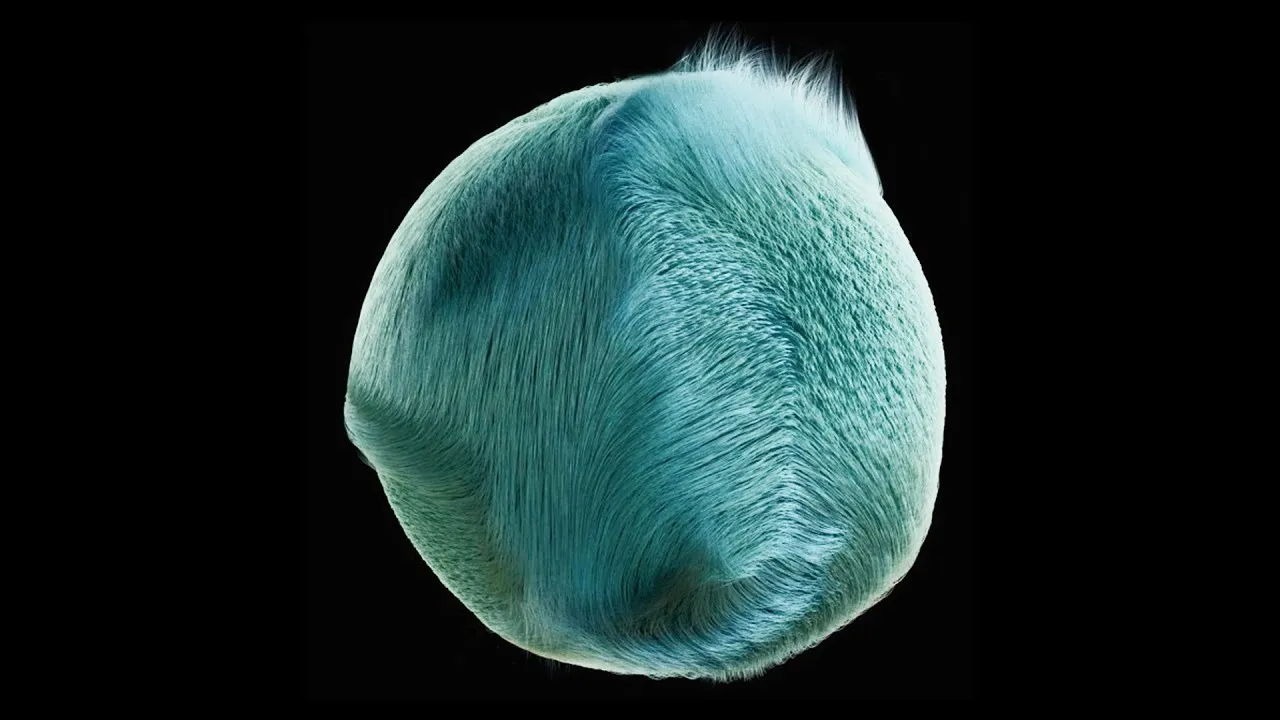
Imagine a sphere covered in tiny hairs. If you try to comb all these hairs flat and in a consistent direction (e.g., all pointing counterclockwise around an axis), you’ll inevitably run into a problem. At the ‘poles’ or certain points, the hair will have nowhere to go and will be forced to stick up. This is the essence of the Hairy Ball Theorem: for any continuous attempt to comb the ‘hair’ (represented by tangent vectors) flat across a sphere, there will always be at least one point where the hair stands on end (a zero vector).
Formal Statement
More formally, the Hairy Ball Theorem states that every continuous tangent vector field on a sphere must have at least one zero. A tangent vector field assigns a vector to every point on the sphere, lying within the tangent plane at that point. The ‘continuity’ means that the vectors don’t change abruptly as you move across the sphere.
Why It Matters: Real-World Applications
While the name is playful, the theorem has practical implications in fields like computer graphics, meteorology, and physics.
1. Game Development and 3D Modeling
Consider programming a 3D airplane model to follow an arbitrary trajectory. The plane’s nose should point along the trajectory’s tangent vector. However, this leaves rotational ambiguity around the nose-to-tail axis. If you try to define this rotation by, for instance, always pointing the left wing in a specific direction relative to the tangent, you’re essentially trying to create a continuous tangent vector field on a sphere (where the direction of the nose maps to points on the sphere). The Hairy Ball Theorem guarantees that such a continuous assignment is impossible without glitches, especially at the ‘poles’ where the plane might point straight up or down. This means you cannot solely rely on the velocity vector to orient a 3D object; more information is needed for robust animation.
2. Meteorology and Wind Patterns
Imagine mapping wind velocities across the Earth’s surface at a constant altitude. Wind velocity can be thought of as a tangent vector field on the sphere representing Earth. Assuming wind velocity changes continuously, the Hairy Ball Theorem implies that there must always be at least one point on Earth where the wind velocity is exactly zero. While the atmosphere is 3D, the component of wind parallel to the ground must be zero at some point.
3. Physics and Electromagnetic Waves
For a radio signal to be identical in all directions in 3D space, its electric and magnetic fields would need to have a specific property. Far from the source, these fields oscillate perpendicular to the direction of propagation. If you consider a sphere at a fixed distance from the source, the electric or magnetic field can be viewed as a tangent vector field on that sphere. The Hairy Ball Theorem states that such a field must have a zero at some point. This means a perfectly uniform signal in all directions is impossible; the signal itself must be zero at some point, defeating the purpose.
The Puzzle: Can You Have Just One “Cowlick”?
Before diving into the formal proof, let’s consider a puzzle: can we create a vector field on a sphere that has only a single point where the vector is zero? Most intuitive attempts lead to at least two points with opposite characteristics (like sources and sinks, or swirling poles). However, it is possible to construct a vector field with just one zero point using a technique called stereographic projection.
Stereographic Projection
This method maps every point on a sphere (except for the ‘north pole’) to a unique point on a 2D plane (like the xy-plane). Imagine a light source at the north pole shining rays through points on the sphere onto the plane. Conversely, every point on the plane maps back to a unique point on the sphere (again, excluding the north pole).
By defining a simple, non-zero vector field on the 2D plane (e.g., a constant vector pointing to the right everywhere) and projecting it back onto the sphere, we get a vector field on the sphere that is non-zero everywhere except at the north pole. This demonstrates that it’s possible to have a vector field with just one point of zero magnitude, rather than the two points often suggested by intuition.
The Elegant Proof: Turning a Sphere Inside Out
The formal proof of the Hairy Ball Theorem often uses a proof by contradiction. We assume that a continuous, non-zero tangent vector field on the sphere exists, and then show that this assumption leads to an impossible consequence.
1. The Deformation
Assume we have a sphere centered at the origin with a continuous, non-zero tangent vector field defined on it. For any point $p$ on the sphere, let $v$ be the tangent vector at $p$. We can define a plane passing through the origin, $p$, and the vector $v$. This plane intersects the sphere in a great circle.
Now, imagine moving each point $p$ along this great circle in the direction of its associated vector $v$ for exactly half the circle’s circumference. Since the vector field is continuous, nearby points will follow nearby paths.
2. Key Properties of the Deformation
This deformation has two crucial properties:
- Mapping to the Negative: Each point $p$ ends up at $-p$. That is, it’s mapped to the point diametrically opposite on the sphere.
- No Crossing the Origin: Because each point $p$ moves along a great circle centered at the origin, it never passes through the origin itself.
3. Reversing Orientation
To understand why this is problematic, we need to define what it means to turn a sphere ‘inside out’. This is done by considering the orientation of the surface. We can assign a coordinate system (like latitude and longitude) to the sphere. At any point, we can define two tangent vectors corresponding to increasing longitude and increasing latitude. Using the right-hand rule (index finger along one vector, middle finger along the other), our thumb points in a specific direction. Conventionally, this direction points ‘outward’ from the sphere.
When a point $p$ is mapped to $-p$, the orientation is reversed. If you consider the coordinate system at $-p$, the right-hand rule will now point ‘inward’. This means the deformation effectively reverses the orientation of the sphere. This is analogous to how reflecting the entire sphere through the origin or rotating it 180 degrees around an axis and then reflecting through a plane maps every point $p$ to $-p$ and reverses the outward normal vectors.
4. The Contradiction: Flux and Incompressibility
The second crucial property—that no point crosses the origin—leads to a contradiction when combined with the first. Consider a physical analogy:
- Imagine a fountain at the origin spewing out an incompressible fluid (like water) uniformly in all directions at a constant rate (e.g., 1 liter per second).
- The ‘flux’ through a surface is the net amount of fluid flowing across it. For an outward-pointing surface, flux is positive if fluid flows out and negative if it flows in.
- For an incompressible fluid originating from a point source inside a closed surface, the total flux through the surface must equal the rate at which the source produces the fluid (1 liter/sec). This holds even if the surface deforms, as long as it remains closed and doesn’t cross the origin.
Now, consider our deformed sphere:
- The deformation maps every point $p$ to $-p$, effectively reversing the orientation of the sphere. This means the unit normal vectors, which initially pointed outward, now point inward.
- If the sphere never crosses the origin, it still encloses the source. The total flux should remain constant at +1 liter/sec.
- However, because the sphere is now ‘inside out’ (normals pointing inward), the fluid that was flowing out is now flowing in. The total flux, when measured with respect to the new inward-pointing normals, would become -1 liter/sec.
This is a contradiction: the total flux cannot be both +1 and -1 liter/sec simultaneously. Therefore, our initial assumption—that a continuous, non-zero tangent vector field exists on the sphere—must be false.
Conclusion
The Hairy Ball Theorem, elegantly proven through the concept of deforming a sphere and analyzing fluid flux, demonstrates a fundamental topological constraint. You simply cannot comb all the hair flat on a sphere without at least one stubborn cowlick. This theorem, despite its playful name, reveals deep truths about the nature of continuous fields on curved surfaces and has far-reaching implications in science and technology.
Source: The Hairy Ball Theorem (YouTube)