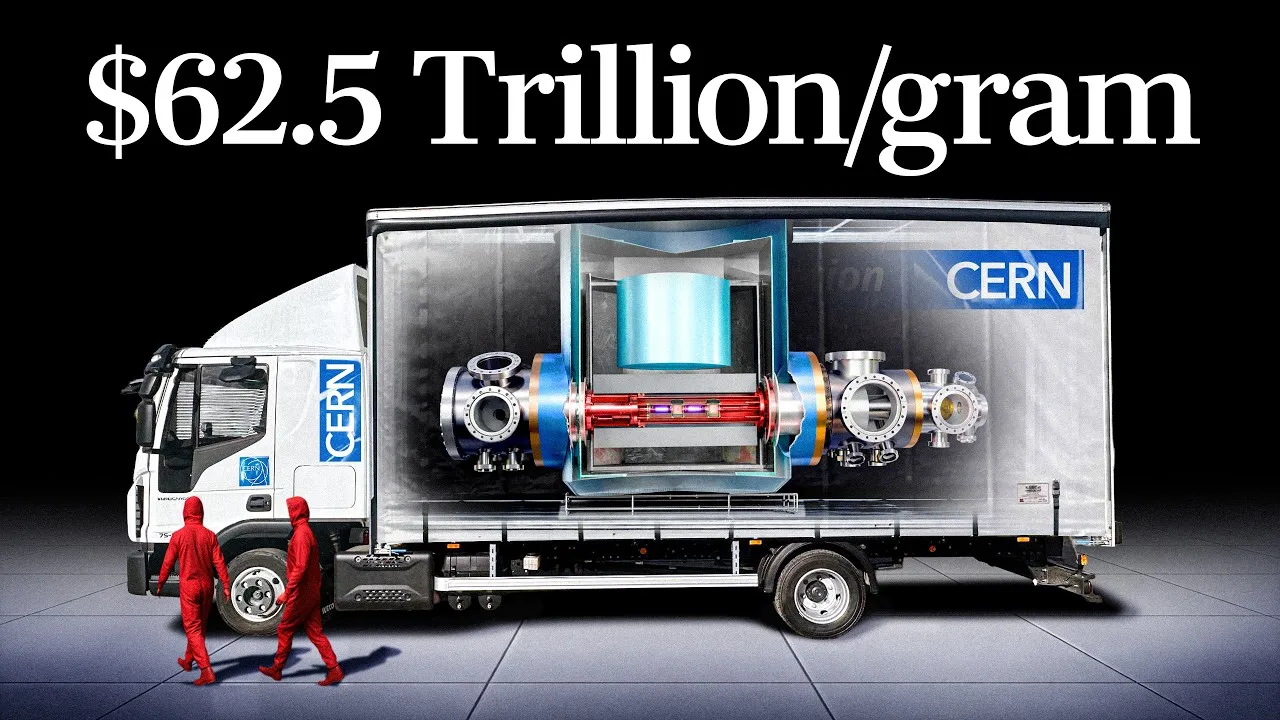
How to Understand Antimatter and Its Mystery
Antimatter is a fascinating concept, often appearing in science fiction. But it’s also very real, created and studied at places like CERN. Understanding antimatter helps us explore one of the biggest puzzles in physics: why our universe is made of matter and not antimatter. This article explains what antimatter is, how it’s made, and why scientists are so interested in its differences from regular matter.
What is Antimatter?
Imagine regular matter is made of tiny building blocks like electrons and protons. Antimatter is made of similar blocks, but with opposite properties. For example, an antiproton has the same mass as a proton but a negative electric charge, while an anti-electron (called a positron) has the same mass as an electron but a positive charge.
When matter and antimatter meet, they destroy each other in a process called annihilation. This process releases a huge amount of energy, following Einstein’s famous equation E=mc². This is the most powerful reaction known in physics.
The Mystery of the Missing Antimatter
Scientists believe that right after the Big Bang, equal amounts of matter and antimatter were created. If this were true, all the matter and antimatter should have annihilated each other, leaving only energy. But clearly, our universe is full of matter. This means there’s a big imbalance, and scientists want to know why.
This imbalance, where there’s much more matter than antimatter, is a major unsolved mystery in physics. It suggests there must be some subtle difference between matter and antimatter that we don’t fully understand yet.
How Scientists Make Antimatter at CERN
Creating antimatter is incredibly difficult and expensive. At CERN, the European Organization for Nuclear Research, scientists have built an ‘antimatter factory’ to produce it.
Accelerate Protons: The process starts with protons, the positively charged particles found in the nucleus of atoms. These protons are accelerated to extremely high speeds, about 99.93% the speed of light, using a machine called the Proton Synchrotron.
Smash into a Target: These high-speed protons are then smashed into a small target made of iridium. Iridium is used because it’s very dense, meaning it has many atoms packed closely together.
Create Particle-Antiparticle Pairs: When a fast-moving proton hits an iridium nucleus, it has so much energy that it can create new particles and their antimatter twins. Think of it like breaking a strong rubber band; it snaps and creates new pieces. In this case, the collision can create pairs of quarks and antiquarks. Sometimes, these antiquarks combine to form an antiproton.
Filter and Collect Antiprotons: The collision creates a chaotic mix of particles, including antiprotons. Powerful magnets are used to filter out the antiprotons from the other particles. This happens very quickly, in about a hundred-billionth of a trillionth of a second.
Slow Down and Cool Antiprotons: The antiprotons are still moving very fast, around 96% the speed of light. They are sent to a special ring called the Antiproton Decelerator (AD) and then to another system called ELENA. These machines use electric and magnetic fields to slow the antiprotons down to much lower speeds, about 1.5% the speed of light (around 16.2 million kilometers per hour). This cooling process is crucial for experiments.
Store Antimatter: Storing antimatter is a huge challenge because it annihilates on contact with regular matter. Scientists use special magnetic traps, called Penning traps, to hold antiprotons and anti-atoms. These traps use strong magnetic and electric fields to keep the antimatter away from the walls of the container. The environment must also have an extremely good vacuum to prevent stray air molecules from causing annihilation.
Why Storing and Studying Antimatter is Difficult
Antimatter is incredibly expensive to produce, estimated to be worth billions of dollars per gram. Even tiny amounts are hard to make and even harder to store.
The biggest hurdle is its tendency to annihilate with matter. Even a slight imperfection in the magnetic trap or a leak in the vacuum can destroy the antimatter being held. This makes studying it for long periods very difficult. For example, early experiments could only store anti-hydrogen atoms for about 40 billionths of a second.
The Search for Differences
Scientists at CERN are working to store antimatter for longer periods. Their goal is to study it very closely and look for any subtle differences between matter and antimatter. If they find even a tiny difference in how they behave or interact, it could help explain why there’s so much more matter than antimatter in the universe.
Finding such a difference could reveal new physics beyond our current understanding, potentially answering one of the biggest questions about the origin and structure of our universe.
Prerequisites
- Basic understanding of atoms and particles (like protons and electrons).
- Familiarity with the concept of energy and mass.
Expert Notes
The concept of antimatter arises from Paul Dirac’s equation, which combined quantum mechanics and special relativity. The equation predicted particles with negative energy, which were later interpreted as antiparticles. The observed asymmetry in the universe is a key area of research, with experiments like those at CERN aiming to find violations of fundamental symmetries (like CP violation) that could explain this imbalance.
Source: Why It's Almost Impossible To Ship Antimatter (YouTube)