How to Understand Population Growth and Resources
Have you ever wondered why some animal populations boom and then suddenly disappear? It often comes down to the things they need to survive. This article will explain how the availability of resources, like food and water, directly impacts how big a population can get and why it might shrink again.
What You Will Learn
You’ll learn what resources living things need to survive and reproduce. We’ll cover the difference between living (biotic) and non-living (abiotic) resources. You will also discover how limited resources lead to competition and how this competition affects population size. Finally, we’ll look at a real-world example, like locust swarms, to see these ideas in action.
Prerequisites
- Basic understanding of living things and their needs.
Step 1: Understand What Resources Are
Everything alive needs certain things to survive and make more of its kind. We call these essential things resources. Think of them as the ingredients for life. Some resources come from other living things, like the food we eat. Scientists call these biotic factors. Other resources come from the non-living parts of our world. Things like clean water, the air we breathe, a safe place to live (shelter), and the physical space an organism needs are called abiotic factors.
Step 2: How Resources Help Populations Grow
When organisms have plenty of the resources they need, they tend to be healthy. They grow well and have more babies. When many individuals in a group have enough resources, the whole group, or population, can grow larger. It’s like a garden: if you give plants enough sunlight, water, and good soil, they will flourish and spread.
Step 3: The Big Catch – Limited Resources
Here’s the important part: most resources are not unlimited. They don’t last forever or exist in endless amounts. A field can only grow so much food. A small pond can only hold so much water. A forest can only provide so many homes. This means that even if a population starts to grow, it can’t keep growing forever if the resources stay the same.
Step 4: Imagine Rabbits in a Meadow
Let’s picture a small group of rabbits in a grassy meadow. At first, there’s plenty of grass to eat, fresh water, and lots of space for them to hop around. Because food and space are plentiful, many rabbits survive and have lots of baby rabbits. The rabbit population begins to increase.
Step 5: Competition Begins
As more and more rabbits live in the same meadow, they all need to share the same grass and water. Soon, there isn’t enough for every single rabbit. When the number of individuals becomes larger than the available resources, competition starts. The rabbits begin to compete for food, water, and living space. Some rabbits might not get enough to eat or a safe place to rest. This means fewer baby rabbits are born, and some rabbits might even die. As a result, the rabbit population’s growth slows down. It might even start to get smaller.
Step 6: Competition Happens Between Species Too
This competition isn’t just limited to rabbits or individuals of the same species. Different types of organisms can also compete for the same resources. For instance, a bird and a squirrel might both want the same seeds. Different kinds of plants might compete for the same patch of sunlight and water in the ground. This competition isn’t about animals being mean; it’s simply what happens when many living things need the same limited supplies. Competition directly affects which organisms survive and get to reproduce.
Step 7: The Case of the Locusts
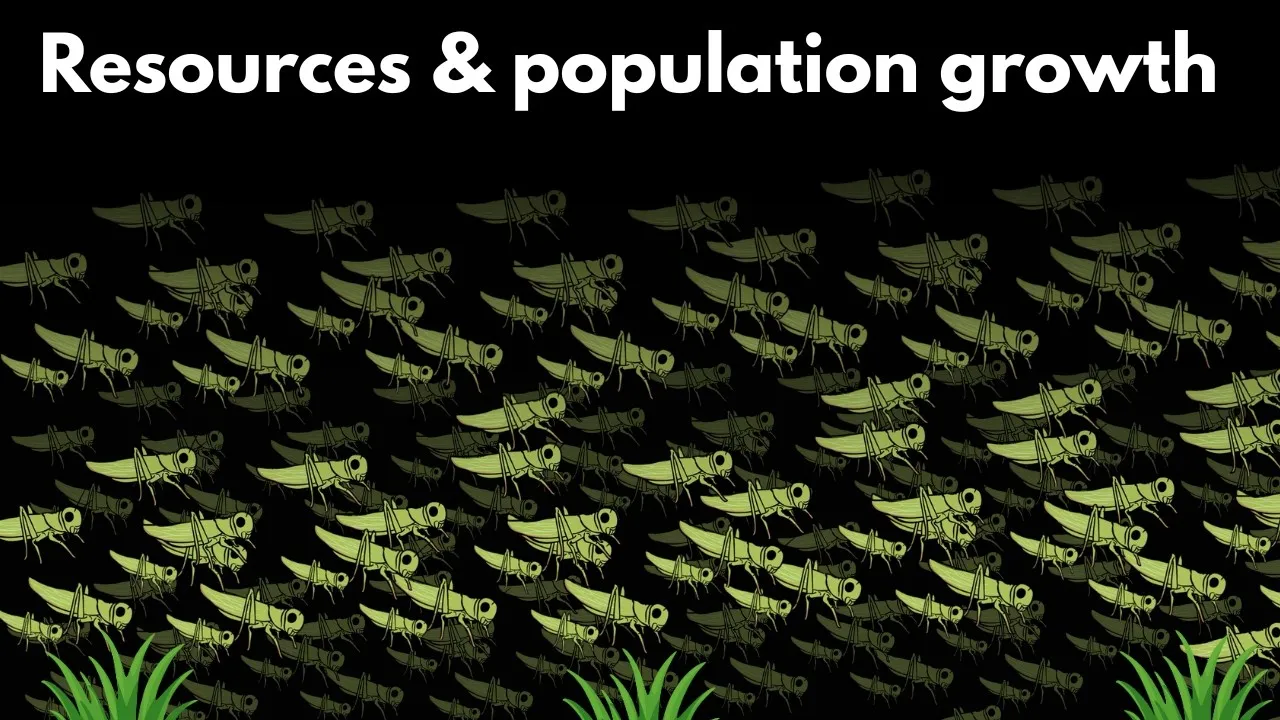
Let’s look at locusts, which are famous for appearing in huge numbers. Locust plagues often start after periods of heavy rain. Why? Because the rain helps plants grow very quickly, providing lots of food for the locusts. With an abundance of food, locust populations can grow very fast. Locusts also have a unique ability: when their numbers get very high and they are crowded together, their bodies and behavior change. They stop living alone and start actively seeking each other out. They gather into massive groups, moving together as swarms. These swarms can eat entire fields of crops very quickly. This is what turns normal population growth into the huge locust plagues people have feared for centuries.
Step 8: Why Locust Swarms Disappear
However, this rapid growth doesn’t last. As the locust population gets bigger and bigger, they start eating up all the available plants. Eventually, there isn’t enough food left to support such a massive number of locusts. Competition for the remaining food increases, and the population crashes. This causes the swarms to disappear just as quickly as they appeared. This cycle shows how population growth and resources are always linked.
Step 9: The Connection Summarized
In summary, all living things need resources like food, water, oxygen, shelter, space, and sunlight to live. These resources are often limited. When resources seem plentiful, populations can grow quickly. But as populations increase, individuals must share those limited resources, making them scarce. When resources become scarce, population growth slows down or even stops completely. The amount of available resources ultimately determines how large or small a population can become.
Source: Resources and population growth | Middle school Biology | Khan Academy (YouTube)