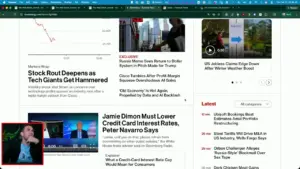
Market Sees Major Sell-Off, Presenting Rare Investment Chances
The stock market is experiencing a significant downturn, with major indices and individual stocks plummeting from their all-time highs. This period of intense volatility, reminiscent of the conditions seen during the late 2008 financial crisis, is creating what some analysts are calling a “once-in-a-lifetime” investment opportunity. However, this opportunity comes with significant risk, testing the financial bravery of investors.
Widespread Declines Across Sectors
The recent market action paints a grim picture. The Dow Jones Industrial Average saw a sharp decline of nearly 1,000 points in a single day, while the Nasdaq Composite also experienced substantial losses. This broad market weakness is affecting even traditionally stable companies.
Tech Giants Face Steep Corrections
Despite the narrative surrounding Artificial Intelligence (AI) driving innovation, many technology stocks have been hit hard:
- Microsoft, often considered a safe haven, is down 30% from its peak.
- Palo Alto Networks has fallen 36%.
- Crowdstrike and Palantir are both down 38%.
- Applovin has seen a 50% drop.
- Salesforce, a company typically viewed as highly secure, has been cut in half, down 52% from its all-time high.
- ServiceNow is down nearly 60%.
- Oracle has fallen over 60%.
- Adobe, once perceived as having an exceptionally stable business model, has plummeted 65% from its peak.
Impact on Other Key Assets
The downturn extends beyond large-cap tech. IBM experienced a significant drop of 13% in one trading session. Cryptocurrencies have also shown weakness, with Bitcoin struggling to hold the $64,000 level and Ethereum potentially heading below $1,000. Analysts suggest Bitcoin may not bottom until the fourth quarter of this year, with a potential low between $20,000 and $30,000.
The AI Narrative and Market Overreactions
The rapid rise of AI has led to sweeping conclusions in the market, with many believing it will render existing software and services obsolete. This sentiment has impacted companies like AMD, whose stock price remains below $200 despite the potential demand for its chips in an AI-driven future. Analysts argue that if AI were truly set to dominate, companies like AMD and Nvidia should be trading at significantly higher valuations.
The speaker highlights the current market sentiment with a touch of sarcasm: “AI is going to take over everything… Everything’s irrelevant just AI everything…” This perspective suggests that the market may be overreacting to the AI trend, creating mispriced opportunities in other sectors.
Strategic Moves: Tesla Hedges and SAS Stocks
One notable strategy involves using Tesla as a hedge against a market downturn. Due to Tesla’s high valuation, it tends to sell off more aggressively than the broader market during risk-off periods. The plan is to begin liquidating these hedges as the Nasdaq (QQQ ETF) declines by 7% or more from its all-time highs, with the intention of fully exiting when the QQQ drops 10% or more.
The proceeds from these hedges are earmarked for investment in Software-as-a-Service (SaaS) stocks, specifically mentioning Salesforce, Adobe, and ServiceNow. These companies, despite their significant stock price declines (some over 50%), are believed by some to be nearing a bottom. The argument is that the market is mispricing these businesses due to fears about AI, overlooking their strong fundamentals and continued growth.
The Case for SaaS Resilience
The prevailing narrative that AI will make SaaS companies irrelevant is challenged. The analogy is drawn that AI needs the data and established workflows that SaaS platforms provide. Companies like Salesforce possess decades of customer data, and ServiceNow holds extensive IT ticket history, which are crucial for AI models to function effectively. Furthermore, users prefer to work within familiar applications rather than switching to separate AI interfaces.
The financial metrics presented for these SaaS companies are compelling:
- Salesforce trades at a forward Price-to-Earnings (P/E) ratio under 14, with double-digit revenue and EPS growth.
- Adobe has a forward P/E of 10, with strong double-digit EPS growth and high single-digit to low double-digit revenue growth.
- ServiceNow boasts a forward P/E of 24, with both revenue and EPS growing at approximately 20%.
These valuations, combined with robust growth, are seen as indicating a potential bottom, especially when compared to historical market corrections where similar companies experienced extreme price drops before recovering.
The LLM ‘Tax’ and SaaS Adaptation
The relationship between Large Language Models (LLMs) and SaaS companies is described as a “toll booth” or “tax.” LLM providers like OpenAI are generating significant revenue by charging SaaS companies for API access. While this creates a margin squeeze for some SaaS providers, they are adapting:
- Shifting from per-user to per-task pricing to pass on LLM costs.
- Developing their own smaller LLMs to reduce reliance on external providers.
- Potentially charging LLM providers for access to their proprietary data for training.
Despite the revenue extraction by LLM companies, the long-term outlook for SaaS profitability is considered strong, as these platforms remain essential for delivering AI capabilities and possess critical data advantages.
PayPal: A Potential Short-Term Opportunity
Separately, PayPal is identified as a potential short-term, high-conviction trade. Recent reports suggest significant takeover interest from rivals, with some parties looking to acquire the entire company and others interested in specific assets like Braintree. While PayPal’s growth has slowed, its core business and Venmo service are used by hundreds of millions, and its payment infrastructure remains a valuable asset. This takeover speculation could present a quick profit opportunity over the next 6 to 9 months, though risks remain.
Navigating Market Volatility: The Long-Term Perspective
The current market environment is characterized by intense short-term anxiety and what is termed “silly stages” where valuations become detached from fundamentals. The comparison of SaaS companies to the declining newspaper industry is highlighted as a particularly egregious example of market delusion.
Investors are urged to maintain a long-term focus, conduct thorough analysis, and identify attractive valuations. The analogy of playing poker is used to emphasize the importance of betting strongly when holding a good hand, while acknowledging the inherent risks and the possibility of being wrong despite a solid strategy. The current market downturn, while painful, is seen as a period where diligent analysis can uncover significant long-term value.
Source: Once in a life investment opportunity is coming. (YouTube)