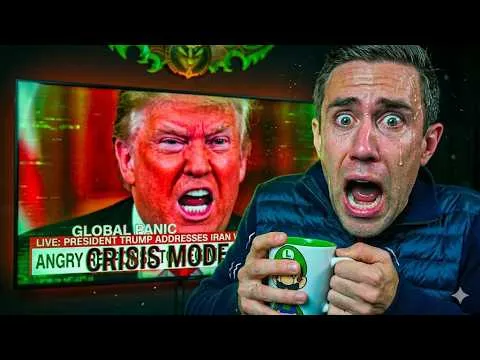
Market Sinks Amid Unpredictable Iran Policy
The stock market experienced a sharp downturn today, largely driven by a series of seemingly contradictory statements from Donald Trump regarding U.S. operations in Iran. This constant shift in messaging created significant uncertainty, leaving investors struggling to understand the evolving situation and its potential impact on global markets.
Yields Surge as Uncertainty Grikes
A key factor contributing to the market’s decline was the rise in Treasury yields. The 10-year Treasury yield climbed by 10.3 basis points, nearing 4.4%. Earlier in the day, a report warned that if the yield didn’t fall from its current level of 4.34%, the market could see a sell-off. This prediction proved accurate, as the market moved steadily downward throughout the trading session.
Oil Prices Spike Despite De-escalation Talk
Oil prices also saw a significant increase. Brent crude rose from around $107 per barrel in the morning to about $112. This surge occurred even as reports emerged that Donald Trump was considering winding down operations. However, these statements were contradicted by news of additional troops being sent to the region. Further adding to the tension, Iran launched two ballistic missiles towards the Diego Garcia base, though neither hit their target. These events painted a picture of ongoing conflict rather than de-escalation.
A Timeline of Shifting Statements
The market’s volatility seems directly linked to a pattern of fluctuating statements regarding the U.S. approach to Iran:
- June 13, 2015: Trump suggested Iran should make a deal quickly, stating, “Just do it before it is too late,” implying a swift conclusion to operations.
- February 28: He called for regime change in Iran, suggesting the Iranian people should take over their country’s governance.
- February 28 (Later): Major combat operations began, with Trump stating, “We’re going to destroy their missiles and raise their missile industry to the ground. We are going to annihilate their enemy.”
- March 2: Trump indicated the initial project would last four to five weeks, but later added the war could take longer, stating, “Whatever time it takes is it’s okay. Whatever it takes. Wars can be fought forever and very successfully.”
- March 6: He declared there would be “no deal with Iran except total and unconditional surrender,” suggesting a prolonged conflict.
- March 8-11: Conflicting messages emerged. On March 8th, statements suggested strikes were “just the beginning.” Yet, on March 9th, Trump told CBS the war was “very complete.”
- March 9: He also mentioned the U.S. “could do a lot about the Strait” of Hormuz, hinting at taking control, which briefly boosted oil prices.
- March 8 (Rumors): Reports surfaced about special forces potentially seizing uranium. Trump confirmed this possibility as a “short-term excursion” for the future. He also stated, “We’ve already won in many ways, but we haven’t won enough. We need more winning.”
- March 10-11: Further conflicting reports stated the operation was “almost done” and that “practically nothing left at the country.” Yet, other statements indicated an increase in bombardment.
- March 11: Trump claimed what remained of the operation “could be done in an hour.”
- March 13: When asked about ending the war, he responded, “When I feel it in my bones,” disconnecting it from operational objectives.
- March 13: News emerged that the 31st Marine Expeditionary Unit was ordered to the Middle East, involving over 4,700 personnel, suggesting escalation.
- March 13 (Later): Trump stated, “One way or another, we will soon get the Strait of Hormuz open, safe, and free.”
- March 15-16: He requested help from allies to police the Strait, but Europeans largely declined.
- March 17: Trump then stated the U.S. didn’t need their help, asserting, “We’re the strongest nation in the world.”
- March 18: Discussions about securing uranium and potential ground invasions, including taking islands, resurfaced.
- March 19: The administration stated there was “no time frame” for ending the war.
- March 19 (Yesterday): Trump declared, “I’m not putting troops anywhere.”
- Today: News verified the deployment of additional amphibious ships and personnel to the Middle East, potentially for ground operations.
- Today (After Market Close): Trump stated, “we’re winding down,” and “getting very close to meeting our objectives.” Simultaneously, he indicated that “the Strait of Hormuz will have to be guarded and policed as necessary by other nations. The United States does not.”
Market Impact: Inflation Fears Rise
The constant back-and-forth has not only created market turmoil but also fueled concerns about inflation. One-year inflation expectations have surged to their highest levels in approximately four years, nearing levels not seen since the early stages of the COVID-19 pandemic. This spike suggests that the market anticipates persistent inflationary pressures, potentially complicating the Federal Reserve’s monetary policy decisions. Investors are now questioning the central bank’s ability to provide a safety net through lower interest rates or quantitative easing, as rate hikes are increasingly being priced into the market.
What Investors Should Know
The current market environment is characterized by high volatility, making it difficult for investors to make informed decisions. The unpredictable nature of geopolitical events, particularly those involving major global powers, can have swift and significant impacts on asset prices. The surge in oil prices and rising Treasury yields reflect these heightened risks. Furthermore, the market’s reaction to inflation expectations indicates a growing concern that central banks may be forced to maintain tighter monetary policies for longer than previously anticipated. This could lead to slower economic growth and continued pressure on stock valuations. Investors should monitor inflation data closely and be aware of how geopolitical developments continue to shape market sentiment and economic outlooks.
Long-Term Implications
The ongoing uncertainty surrounding U.S. foreign policy and its implications for global stability can have lasting effects on investment strategies. A prolonged period of heightened geopolitical tension can deter foreign investment, disrupt supply chains, and increase the cost of doing business. For investors, this means a greater emphasis on risk management and diversification. Understanding the interplay between geopolitical events, economic indicators, and central bank policy will be crucial for navigating future market cycles. The current situation underscores the importance of staying informed and adapting investment approaches to a dynamic global landscape.
Source: Trump FLIP FLOPS on Iran (YouTube)