Understand How Objects Spin Without External Force
Did you know that a satellite can change its spin without using any thrusters? It can do this by using a powerful physics principle called the conservation of angular momentum. This article will explain what that means and how you can use it to understand and predict how things spin.
What You Will Learn
You will learn about angular momentum and its conservation. We will explore how this principle applies to spinning objects, from simple discs to ice skaters and even stars. You’ll see how it helps explain why things speed up or slow down their rotation without any outside push.
Prerequisites
- Basic understanding of mass, velocity, and momentum.
- Familiarity with the concept of rotation and spinning.
Step 1: Understand Linear Momentum First
Before diving into spinning, let’s quickly remember regular momentum, called linear momentum. If an object has mass (m) and velocity (v), its momentum is simply mass times velocity (m * v). Momentum is important because of a rule called the conservation of linear momentum. This rule states that if no outside forces act on a group of objects (a system), the total momentum of that system will never change. Think about two blocks colliding. If you ignore friction, the total momentum of the blocks before they hit is the same as their total momentum after they hit. This helps us predict how fast they will move after the crash.
Step 2: Introduce Angular Momentum
Now, let’s talk about spinning, or rotation. When a rigid object spins, it has something called angular momentum. It’s like linear momentum, but for rotation. It depends on two things: the object’s rotational inertia and its angular velocity (how fast it’s spinning).
Rotational Inertia
Rotational inertia is a measure of how hard it is to change an object’s spin. It depends not only on the object’s mass but also on how that mass is spread out. If the mass is farther from the center of rotation, the rotational inertia is higher. Imagine trying to spin a long, thin rod versus a short, thick one. The rod is harder to spin, meaning it has a higher rotational inertia.
Angular Velocity
Angular velocity is simply how fast an object is spinning. It’s usually shown with the Greek letter omega (ω).
Step 3: Learn the Conservation of Angular Momentum
Just like linear momentum, angular momentum is also conserved. The principle of conservation of angular momentum says that if there are no outside torques (twisting forces) acting on a system, its total angular momentum will remain constant. Torque is the rotational version of force. For example, a spinning disc on a table with no friction has no external torques acting on it.
Example: Two Spinning Discs
Imagine a spinning disc (Disc 1) on a table. You drop another disc (Disc 2) on top of it. Disc 2 isn’t spinning at first. Because there’s friction between the discs, Disc 1 tries to speed up Disc 2, and Disc 2 tries to slow down Disc 1. They will eventually spin at the same speed. If we consider both discs together as our system, there are no outside torques. Therefore, the total angular momentum before they spin together must equal the total angular momentum after. This allows us to calculate their final spinning speed.
Example: Car Tires
Consider a car with its wheels off the ground. If the two wheels can spin separately, they might have different spinning speeds (angular velocities ω1 and ω2) and different rotational inertias (I1 and I2). If you connect them so they must spin at the same speed (ω), the total angular momentum before connecting them (I1ω1 + I2ω2) must equal the total angular momentum after (I1 + I2)ω. This lets you find the final common speed.
Step 4: Apply to Non-Rigid Bodies and Real-World Examples
This principle isn’t just for solid objects like discs. It also applies to things like ice skaters and stars.
Ice Skater
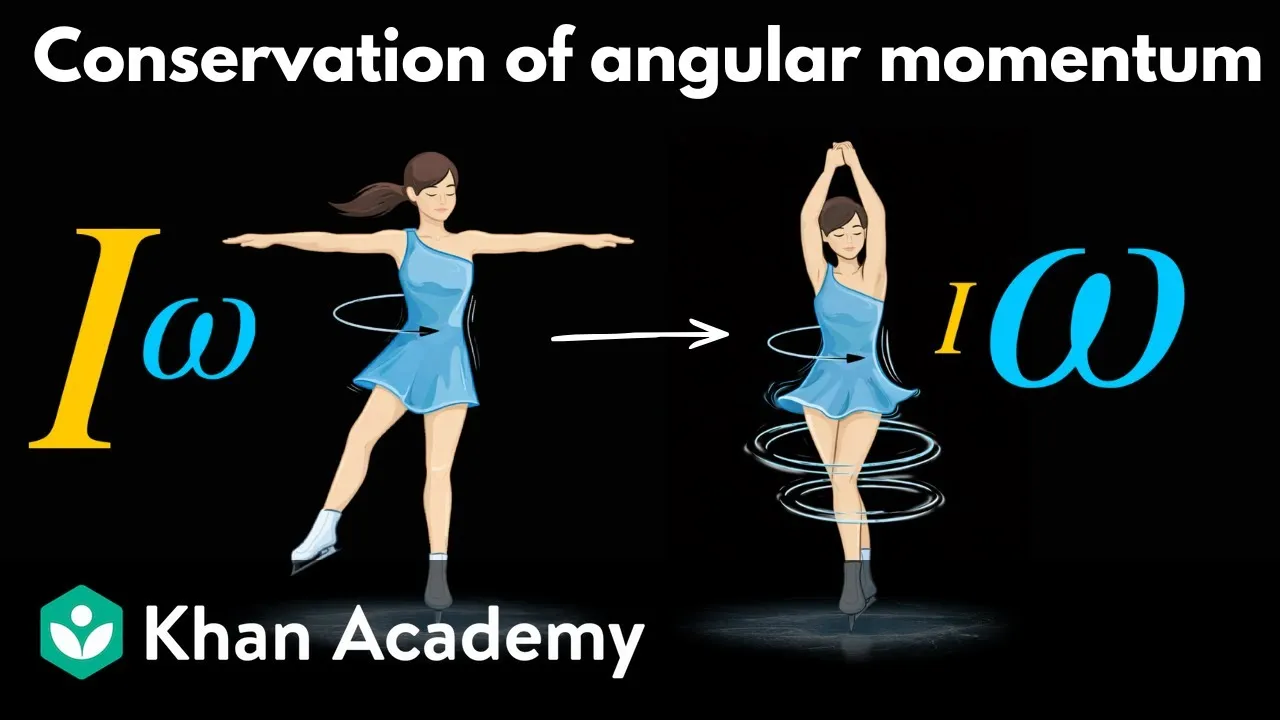
An ice skater starts spinning with arms and legs outstretched. This gives her a large rotational inertia. As she pulls her arms and legs in, her mass gets closer to the axis of rotation. This decreases her rotational inertia. Since there are no significant external torques, her angular momentum must stay the same. To keep the product (rotational inertia * angular velocity) constant, her angular velocity must increase. That’s why she spins faster!
Stars and Neutron Stars
Stars form from huge clouds of gas. Initially, the gas is spread out, giving it a high rotational inertia. As gravity pulls the gas together to form a star, the mass gets closer to the center. This lowers the rotational inertia. To conserve angular momentum, the star must spin much faster. When massive stars collapse into incredibly dense neutron stars, their rotational inertia becomes extremely low. This causes them to spin incredibly fast, sometimes hundreds of times per second. This rapid spinning is a direct result of the conservation of angular momentum.
Step 5: Understand Reaction Wheels in Space
Satellites and space telescopes need to turn and point accurately. They do this using devices called reaction wheels. Imagine a box in space with a spinning disc inside, connected to a motor. The whole system (box + disc) has a certain angular momentum. If there are no outside torques, this total angular momentum stays constant.
How Reaction Wheels Work
If the motor slows down the spinning disc, its angular momentum decreases. To keep the total angular momentum the same, the box itself must start to rotate in the same direction. If the motor speeds up the disc, the box will rotate in the opposite direction. By controlling the speed of these internal spinning discs (reaction wheels), operators can make the satellite rotate precisely in any direction without using any fuel or external forces. Satellites often use three reaction wheels to control rotation along three different axes.
Conclusion
The conservation of angular momentum is a fundamental principle that explains a wide range of phenomena, from a figure skater speeding up to the rapid spin of neutron stars and the precise movements of satellites. By understanding how rotational inertia and angular velocity interact, you can predict how spinning objects will behave.
Source: Conservation of angular momentum | AP Physics | Khan Academy (YouTube)